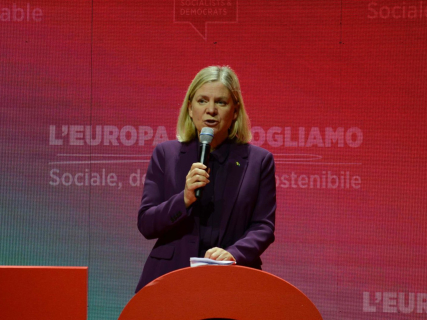

The opposition parties, led by the Social Democratic Party of Sweden (S), are ahead in the Riksdag, the Swedish unicameral Parliament, by reaching 175 seats compared to the 174 that the formations supporting the outgoing Prime Minister, the conservative Ulf Kristersson, would obtain, according to the first official projection.
The estimate, prepared by the public television SVT based on 20,000 votes already counted, emphasizes that only 20,000 ballots separate the two opposing political blocks in Sweden.
This projection largely coincides with the exit polls, which also point to a slight advantage for the social democrats and their partners (51.3%), while Kristersson's Moderate Party and its allies, including the far-right Sweden Democrats (SD), would receive 46.8% of the votes.
According to the Valu study for SVT, the Social Democratic Party would obtain 28.4% support, remaining the most voted force, followed by the Moderate Party, which would stand at 18.1%.
The third place in number of votes, according to SVT's analysis, corresponds to the far-right party SD, led by Jimmie Akesson, which reaches 18.1%, one point less than in the 2022 elections, which represents a setback for the formation, which hoped to continue increasing its support. One of its deputies, Josef Fransson, has lashed out at voters of the minority forces: "Congratulations to all the mentally disabled who vote for small parties! Fun!", he wrote on social media.
Behind them are the Left Party (V, 8%), which surpasses the Center Party (C, 7.5%). The Green Party (MP, 7.4%) rises to sixth place, ahead of the Christian Democratic Party (KD, 6.1%) and the Liberal People's Party (L, 5.4%). The presence of the liberals in the Chamber may be key for subsequent parliamentary balances.
A second survey released by the TV4 network offers a very similar picture, with the historic Social Democratic Party of Sweden at 28.4%, followed by Sweden Democrats (18.5%) and the Moderate Party (17.5%). This poll, based on 4,045 interviews, also grants representation in Parliament to the liberals. In this case, the right block would total 47% of the votes, while the four left parties would reach 51.3% support.
For the moment, the main political leaders have not publicly commented on the results of the exit polls, although the atmosphere at the polling stations offers clues: at the Social Democratic Party's and the liberals' headquarters, celebrations have taken place, while at the SD headquarters, discouragement prevails.
Kristersson has led the Swedish Government since the signing in 2022 of the Tido Agreement, by which the far-right was left out of the Executive, despite surpassing the Moderate Party in votes, and it supported him in exchange for a significant part of its program on immigration, asylum, and border control being adopted.
This time, the Sweden Democrats have made it clear during the campaign that they are not willing to be left out of the Council of Ministers again and aspire to hold ministerial portfolios in exchange for their parliamentary support.