
Seven flights that were operating this Tuesday in European airspace have been affected by false bomb threats throughout the morning, which has forced the authorities in Poland, Italy, Bulgaria and Spain to deploy different security devices and activate their emergency protocols.
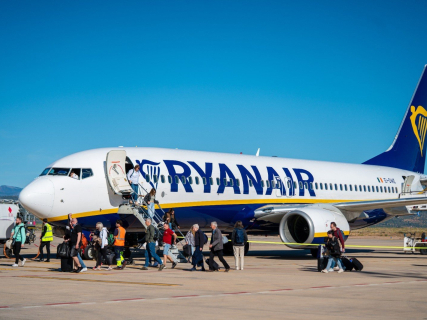
On Spanish territory, the Murcia airport has activated its security procedures after receiving an alert on board an aircraft of the Ryanair airline that had taken off from the British city of Mánchester bound for this airport facility.
Two other flights involved in these incidents were heading to the Polish capital, Warsaw, after taking off respectively from London, the capital of the United Kingdom, and from Copenhagen, the capital of Denmark, which has forced a review of operations at the destination airport.
"We inform you that the bomb threat was canceled at 12:21 p.m. (local time in Poland). After the intervention of the corresponding services, Warsaw/Modlin airport has resumed operations normally," the airport authorities of the Polish airport have indicated, who pointed out that the situation has caused delays in the departures of some flights.
In Bulgaria, the Ministry of the Interior has said that two aircraft bound for Sofia, the Bulgarian capital, and coming from Bérgamo, in Italy, and from Dublin, in Ireland, also received bomb alerts. Once they landed in the country, both aircraft were subjected to an exhaustive search by agents of the Specialized Unit for Combating Terrorism, in search of possible explosive devices.
The Bulgarian Minister of Transport and Communications, Georgi Peev, has confirmed that no explosives were found on either of the two planes on which the threats were weighing, according to information released by the news agency BTA.
Two more flights have been added to these five: one coming from Dublin and another that had departed from Lisbon. Both landed at Rome’s Fiumicino airport, in the Italian capital, where they were subjected to inspections after similar threats were reported. The checks concluded without relevant findings, although the Italian Air Forces were forced to deploy two aircraft to escort one of the suspected aircraft, according to what the newspaper "La Stampa" reported.
Overall, four of the seven affected flights belonged to the Irish airline Ryanair, while a sixth was operated by the Polish company LOT —the one that covered the route between London and Warsaw— and the seventh by the Scandinavian SAS, responsible for the trip between Copenhagen and Warsaw. All the threats ultimately turned out to be false.