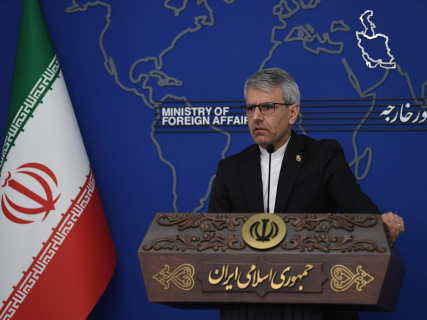

The Iranian authorities reiterated this Monday that compliance with the points included in the memorandum of understanding signed in June with the United States to reopen the Strait of Hormuz and stop the war conflict remains the central pillar for reaching an agreement, after the latest contacts held with Qatar in recent days to relaunch dialogue with Washington.
"Negotiations should not be seen apart from the understanding reached in Islamabad; the negotiating party, the demands and the problem are the same," said the spokesman for Iran's Ministry of Foreign Affairs, Esmail Baqaei, in a press conference reported by the television channel IRIB, after stressing that Washington accepted the terms agreed with Iran in the so-called Islamabad memorandum "and then violated them."
"Accepting Iran's conditions is necessary to restore security in the Strait of Hormuz and the Persian Gulf," he assured, while noting that the exchanges continue although Tehran "has long since conveyed everything necessary and taking into account the legitimate demands."
Baqaei reiterated that Washington must "first lift all sanctions imposed after the violation" of the agreement, in reference to the economic pressure campaign driven by the White House, and advance in "the release of Iranian goods and assets," as stated in the Islamabad pact.
The Iranian Foreign Ministry spokesman acknowledged the "complexity" of the crisis, underscoring that the passage of time "has increased its complexity," and accused the United States of worsening the scenario since then. "In our opinion, this exchange of messages is still continuing. The United States must make a decision," he urged.
The Iranian official also pointed to the existence of discrepancies within Donald Trump's Government, which he links to pressure from an American public opinion that demands "an independent approach" in the Middle East. "American society is tired and angry with the parasitic behavior of the Zionist regime," he said, to stress that Washington is risking "its credibility and status" by, in his view, aligning with Israel.
"The United States needs to decide faster for its own credibility," he added, after more than eight months of war following the surprise attack by Washington and Tel Aviv in February.
At the same time, it has warned that Tehran must be prepared "for any eventuality," in a context in which both the resumption of talks and the possibility that the United States reactivates the war after the midterm elections, scheduled for this Tuesday, are being considered.
In recent days, an Iranian delegation has held contacts in Doha with Qatar's mediators to try to finalize the conditions for reopening the Strait of Hormuz, on the basis of a two-day plan. This proposal contemplates two phases: first, that the United States adopt a series of measures, and on a second day that Iran proceed to reopen the Strait of Hormuz and restore maritime traffic to the previous situation, as the Iranian Foreign Minister, Abbas Araqchi, has explained.
These moves come after an exchange of proposals between the U.S. vice president, JD Vance, and the secretary of Iran's Supreme National Security Council, Mohsen Rezaei, within the framework of a possible restart of the peace talks.