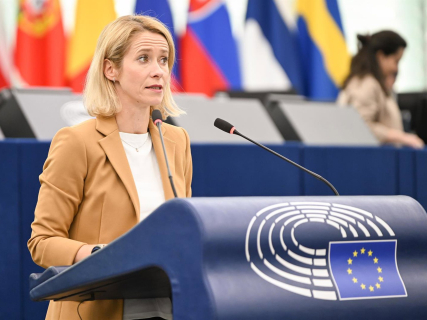

The High Representative of the European Union for Foreign Policy, Kaja Kallas, emphasized this Tuesday that the EU must prepare very carefully for a possible activation of the Blocking Statute, the community instrument designed to neutralize the impact of sanctions from third countries, in light of the measures announced by the United States against the International Criminal Court (ICC), warning that there will only be "one opportunity" to apply it correctly.
"If we use the Blocking Statute, we will only have one opportunity, a single opportunity, to do it right," indicated the head of European diplomacy during a debate in the plenary session of the European Parliament in Strasbourg (France). There she confirmed that the use of this mechanism is already being analyzed, although she stressed that any decision on its activation must be "well prepared."
Kallas specified that Brussels keeps "all options on the table" to protect the court against Washington's sanctions, including the Blocking Statute itself. However, she insisted that the European reaction cannot be limited to this tool and that the Union must be ready to adopt "all necessary measures" in order to safeguard the interests of European operators within the single market.
In this regard, she pointed out that the sanctions announced by the U.S. Administration against the ICC as an institution have not yet come into force, so she urged European companies not to preempt their application or suspend the services they currently provide to the court.
She also advocated for taking advantage of the six-month transitional period communicated by the Trump Administration to try to steer a diplomatic solution to the "wrong" U.S. sanctions. At the same time, she celebrated that the Twenty-Seven remain "united" in their response to these measures.
The Estonian representative also warned that the sanctions directed against the ICC as an organization put "the entire court at risk," especially due to their possible impact on computer systems, banking services, and the payment of salaries to its staff. She added that the Court is already exploring alternatives in these areas with the aim of ensuring the continuity of its activities.
WARN OF CONSEQUENCES TO COUNTRIES THAT LEAVE THE ICC
In parallel, Kallas has warned that countries that choose to abandon the Rome Statute, the founding treaty of the International Criminal Court, will have to face the consequences of that decision in their relationship with the European Union, in a context of increasing international pressure on the institution.
"We must make it very, very clear to our partners that if they are being pressured to abandon the Rome Statute, their decision to withdraw will also have clear consequences for their relations with the European Union," she stated.
In this regard, she pointed out that the EU's diplomatic delegations in third countries can play a key role in detecting potential risks of withdrawal from the treaty and trying to persuade governments not to take that step, while Brussels will continue to work with the member states to strengthen international support for the court.
The head of European diplomacy also recalled that the EU has contributed 30 million euros to the ICC in the last two years to finance reparations for victims, strengthen its investigative capacity, and support its tasks, and she indicated that the community institutions are studying new ways to increase that support.
"The ICC is being attacked precisely at the moment when we need it the most. An aggression that goes unpunished only breeds new aggressions," Kallas defended, who plans to travel this week to The Hague to meet with the court's presidency and discuss possible additional support measures from the European Union.