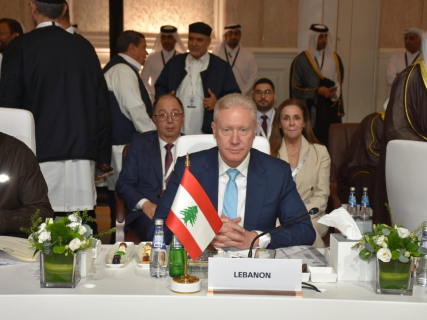

The Lebanese Foreign Minister, Yusef Ragi, has stated that the Lebanese Executive has managed to curb Israeli attacks against Beirut "through negotiation," emphasizing that, although the diplomatic path is "long and complex," the country will continue to bet on it "until it regains its full sovereignty." At the same time, he has lashed out at the Shiite militia party Hezbollah for its refusal to disarm, considering that it "threatens the security and sovereignty" of Lebanon.
Lebanon "has managed to stop the attacks against Beirut and its suburbs through negotiation," Ragi reiterated in statements to the Al Arabiya network, where he stressed that, despite the difficulties of the process, the Government will remain firm "until it regains its full sovereignty." According to the minister, the bet on diplomacy has allowed Beirut to contain Israeli bombings and advance in the recovery of Lebanese territory, although he admitted that the military presence and actions of Israel in the country have not concluded.
Ragi has wanted to distance the conversations with Israel from the internal initiative of the Government to take control of all weapons on Lebanese soil. "Restricting weapons is a Lebanese demand, as no normal state can coexist with militias," he pointed out, insisting that this policy "has nothing to do with the negotiation with Israel."
In this context, the head of Lebanese diplomacy has directed his criticisms directly at Hezbollah, reproaching it for its warnings about a possible "civil war," which in his view constitute "the most compelling proof of the correctness of the decision to restrict weapons."
"The possibility of a civil war is not on the table and is no longer part of the Lebanese vocabulary," Ragi emphasized, before adding that "those who promote civil war do not want the Lebanese state to extend its sovereignty (...) and Hezbollah, along with its weapons, threatens the security and sovereignty of Lebanon."
The minister's statements come after Hezbollah's Secretary General, Naim Qassem, called on Saturday for the resistance of the Lebanese people as "the only way to liberate the land," at a time when Israeli bombings in the south of the country continue.
Israel has continued its military operations in Lebanese territory despite the preliminary agreement reached on June 26 with the mediation of the United States. That understanding provided the basis for a permanent ceasefire and the restoration of Lebanese sovereignty in the south, including the disarmament of Hezbollah, a condition that the Shiite group has outright rejected.
Since then, Israeli authorities have invoked security reasons and Hezbollah's refusal to accept the pact to justify the continuation of their attacks in the area. These actions are framed within the new invasion initiated after the launch of projectiles by the Shiite group against Israel, in response to the joint offensive that the United States and Israel carried out on February 28 against Iran.