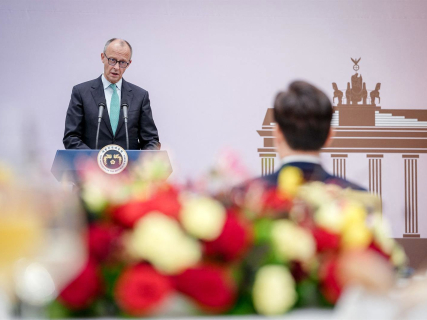

The German chancellor, Friedrich Merz, warned this Thursday that North Korea’s participation in the war in Ukraine, with the deployment of military personnel in support of Russia, poses a direct threat to Europe’s security. At the same time, he stressed that Moscow is providing assistance to Pyongyang, thus emphasizing that the security balances in Europe and Asia are closely connected.
"North Korean soldiers are fighting in the Donbas and Moscow is supplying weapons to Pyonyang. The security of (the Korean peninsula) affects the security of Europe, and vice versa. That is why Germany and South Korea are strengthening their ties," the chancellor stated in a message on social media during his official visit to Seoul. In the South Korean capital, Merz agreed with President Lee Jae Myung to deepen bilateral cooperation in the areas of security and defense.
During the meeting, both leaders highlighted the strategic partnership between Berlin and Seoul, with the aim of intensifying cooperation in security matters through regular military exchanges, joint exercises, and a greater flow of information. They also addressed the need for defense industry companies to increase their joint projects and strengthen their coordination.
"We have laid the foundations to respond to supply chain uncertainties by strengthening cooperation in the fields of critical minerals and energy security," the South Korean president said in statements collected by the Yonhap agency, alluding to the economic and technological dimension of this partnership.
Unification of the Korean peninsula
Upon his arrival in the Asian country, Merz delivered a message in favor of the future unification of the Korean peninsula, evoking the German experience of division for more than forty years and its subsequent reunification. The German leader sought to establish a historical parallel between both territories.
"Korea and Germany are united by the painful experience of division. I also wish for the citizens of Korea what we have been able to experience in Germany: unity in freedom," he wrote in the visitor book that he signed upon his arrival, reiterating Berlin's support for the aspirations of peace and unity in the region.
Merz and Lee have likewise agreed to maintain a close dialogue on the evolution of the war in Ukraine, the situation in the Middle East, the future of the free trade order and measures to address the climate crisis, with the intention of coordinating positions and strengthening their cooperation on the main global challenges.