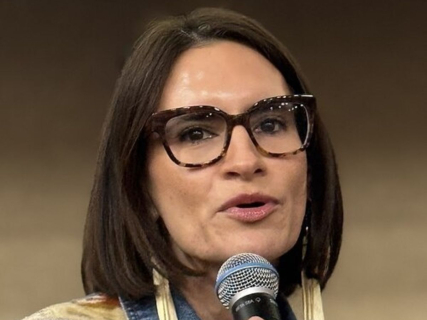

Democratic Peggy Flanagan has won the United States Senate election for Minnesota against Republican Michele Tafoya, according to CNN’s projection and the confirmation by Associated Press. The victory allows the Democratic Party to keep the seat vacated by Senator Tina Smith in the midterm elections held this Tuesday.
The result also has a historical dimension: Flanagan becomes the first Indigenous woman elected to the federal Senate of the United States. The new senator belongs to the White Earth nation of the Ojibwe and until now held the post of lieutenant governor of Minnesota, a position she had held since January 2019.
From lieutenant governor of Minnesota to the Senate
Born in St. Louis Park, Minnesota, in 1979, Peggy Flanagan graduated from the University of Minnesota in 2002, where she studied Child Psychology and American Indian Studies. Before entering the institutions, she worked as a community organizer and trainer at Wellstone Action, an organization dedicated to political training and to boosting progressive campaign efforts.
She also led the Children’s Defense Fund of Minnesota, an entity focused on defending children’s rights. In 2015, she was elected to the state House of Representatives, where she held a seat until 2019. That year she took office as lieutenant governor alongside Tim Walz, with whom she ran again and won the 2022 elections.
During her time in the state executive branch, Flanagan has taken part in initiatives related to education, housing, children, and Indigenous communities. Among them is the creation of a state office dedicated to missing and murdered Indigenous people.
The first Indigenous woman in the U.S. Senate
Flanagan’s arrival in the Upper Chamber breaks a representation barrier for Indigenous communities. Although the United States has had Native American men in the Senate, no Indigenous woman had previously held a seat in that institution.
The new senator will bring to Congress a political track record linked to the representation of Indigenous communities and to public policies aimed at children and families. Her election also marks a new stage after nearly eight years as lieutenant governor of Minnesota.