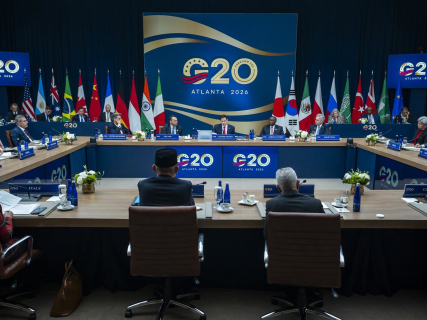

The two-day G20 summit ended this Saturday without a consensual document among the participating countries, after no agreement was reached on the main security and economic issues linked to the war in Ukraine and the situation in Iran.
In the final press appearance, the U.S. Secretary of State and host, Marco Rubio, underscored the relevance of guaranteeing freedom of navigation in strategic maritime passages —such as the Strait of Hormuz and the Black Sea, both currently blocked—, as well as the protection of supply chains and energy security. Although Rubio insisted that all attendees were aware of the weight of these issues, he admitted that strong discrepancies persist over how to address them.
"I do not intend to tell you today that we are close to finding universally accepted solutions to these problems," he stressed.
Rubio says he "does not know" a date to negotiate with Iran
When questioned about the diplomatic contacts that Qatar is promoting to facilitate a possible meeting between Iran and the United States, Rubio stated that he "does not know if there is an established deadline" for them and recalled that "it is up to President Trump to make decisions on the matter".
"Several meetings have been held; in fact, they have never been interrupted. Active conversations have been maintained, in some cases directly, but often through intermediaries. The President prefers, in the face of any international challenge, to try to resolve it diplomatically and peacefully, if possible," he emphasized.
Regarding the hypothesis of resuming military attacks against Tehran, the Secretary of State specified that Washington prioritizes the diplomatic route, although he stressed that the United States "can achieve any military objective if it sets its mind to it".
"The president prefers not to do it that way. If he had done it, he would have done it weeks ago, months ago. He prefers to resolve it diplomatically, but I think what he is expressing to you is the incredible confidence that if we needed to do something militarily, we would have the ability to do it and we really have everything necessary to succeed, but we prefer to do it peacefully," he declared.
Defense of the Russian presence and split in the G20
Rubio has also justified Russia's presence, represented by its Foreign Minister, Serguéi Lavrov, during the meeting, by maintaining that any peace agreement between Moscow and Kiev requires both parties to be part of the dialogue.
"To end the war in Ukraine peacefully, a negotiated solution is needed. Among whom is that solution found? Between Russia and Ukraine. How can a negotiated solution between Russia and Ukraine be achieved if you cannot talk to both countries? How can you talk to Russia and Ukraine if you do not interact with them? Therefore, I think today is one more opportunity to continue interacting with the Russian system," he said.
The economic meeting has highlighted deep fractures among those attending over the invasion of Ukraine, the escalation between the United States and Iran, and the tariff policies promoted by Washington.
Several delegations have warned that these tensions are behind the rise in energy prices on a global scale and an increasing climate of uncertainty in international trade. Likewise, they have expressed concern about a possible military attack by the United States against Iran after the midterm elections on November 3 and about Tehran's possible reaction.
These discrepancies became evident from the first day, when the United States suspended at the last minute the traditional family photo of the foreign ministers due to the refusal of representatives from Europe, Canada and Australia to pose alongside the head of Russian diplomacy, Serguéi Lavrov. The tension increased even further with Washington's decision to leave out of the meeting South Africa, a G20 member and the group's outgoing presidency.
In this scenario of maximum tension, the US president, Donald Trump, will be the host of the G20 Leaders' Summit scheduled in Miami in December, to which he has extended a formal invitation to Russian president, Vladímir Putin. However, the Secretary of State, Marco Rubio, clarified this Saturday that Moscow has still not confirmed the Russian leader's presence at the meeting.