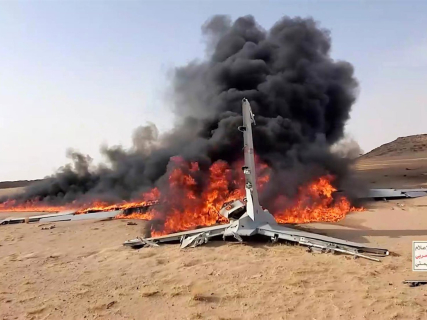

The Government of Yemen has reported this afternoon the start of a new offensive by the Houthi insurgency against the city of Marib, in the west of the country. This is the capital of the province of the same name and the main enclave still controlled by government forces closest to Sana'a, the capital, under rebel control for more than ten years. The Houthi movement, a firm ally of Iran, plays a key role in the current regional war landscape.
"The terrorist Houthi militia has resumed bombing civilian neighborhoods in the city of Marib with missiles and drones," the Yemeni Army has stated on social media. For its part, Ansar Allah, the political arm of the Houthis, has justified the actions of the last 72 hours as "preventive measures aimed at thwarting the plans" of Saudi Arabia, the main military partner of the internationally recognized Executive, with a special focus on a military camp in the area.
"We renew our advice to the deceived and the swindled sons of our country to abandon the camps of the Saudi enemy and return to their regions before it is too late," warned the Houthi military spokesman, Yayha Sarea, on Friday, "and we ask that they do not become the fuel for treacherous entities," referring to the Government based in Aden, "that have mortgaged their destiny to foreign powers while trafficking with them and their blood."
In addition to the attacks on Marib, at least eleven people were injured in the Saudi region of Najran, in the south of the kingdom, following an attack attributed to Houthi militias last Thursday. This incident culminates nearly a month of rising violence in a war that in recent years had reduced its intensity, but which is far from having concluded, as evidenced by the recent clashes between southern separatists and the Yemeni Government in Aden, uncomfortable partners in a fragile coalition against the Houthis.
In reaction to this escalation, the Yemeni Army has announced the launch of a military operation against positions, personnel, and resources of the rebels at various points along the front lines, with special emphasis on the port city of Hodeida, controlled by the insurgency. Additionally, Iran's state radio and television has reported the alleged death of the chief of staff of the Yemeni Army, General Saghir bin Aziz, in one of the Houthi attacks in Marib, a claim that has not yet been officially confirmed.
In light of this deterioration, the United Nations Security Council expressed this Friday its concern over the increase in tensions in Yemen and urged all parties to avoid steps that could jeopardize diplomatic efforts aimed at a lasting ceasefire or that threaten regional and international stability.
The UN special envoy for Yemen, Hans Grundberg, has warned of the real risk that the country could return to large-scale conflict, which would be the most critical episode since the ceasefire brokered by the United Nations in April 2022. This situation is exacerbated by the wars in Gaza and Iran, which have pushed the Houthis to launch attacks against Israel and against commercial navigation as a gesture of support for the Palestinian cause and for the Iranian authorities.
Extreme humanitarian crisis and forecasts for 2026
All of this takes place amid one of the most severe humanitarian emergencies on the planet. The Food and Agriculture Organization of the United Nations (FAO) and the World Food Programme (WFP) point to Yemen as a "critical point" comparable to the extreme situations being experienced in Gaza or Sudan.
The International Organization for Migration (IOM) warned this Thursday that "thousands of families" in Yemen have lost "their homes and access to basic services" due to flooding, forced displacements, and the worsening economic conditions that continue to plague the country. According to their projections, "more than 22 million people --almost half, women and girls-- will need humanitarian assistance and protection" throughout 2026.
The agency specifies that the magnitude of the crisis is such that "in 2026, more than 22 million people --including 10.95 million women and girls-- will need humanitarian assistance and protection services." "This population includes 5.2 million internally displaced persons, 329,000 migrants, and 63,000 refugees and asylum seekers," the IOM has detailed, emphasizing the enormous challenge faced by international aid agencies.