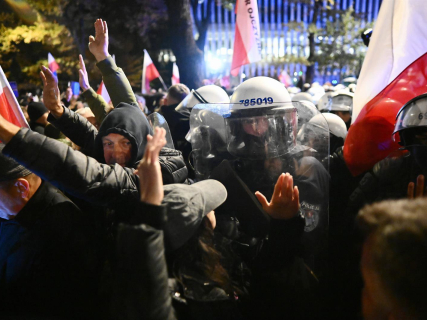

The Organization for Security and Co-operation in Europe (OSCE) has expressed this Saturday its concern over the institutional crisis surrounding the Constitutional Tribunal of Poland and has called for respect for both the country’s institutions and the Polish citizenry. At the same time, it has urged that any political conflict be channeled through a dialogue grounded in the principles of the Polish Constitution.
"The current tensions concern fundamental questions of constitutional governance, judicial independence and the rule of law. These are not merely internal political matters. They affect the democratic principles and commitments that all OSCE participating States have committed themselves to defend," declared the President of the OSCE Parliamentary Assembly, Mikita Poturaiev, who highlighted Poland as "a valuable member of the community" and "a country with a proud democratic tradition".
Poturaiev has underlined that political conflicts, "no matter how deep", must be channeled "through peaceful, legal and democratic processes". In this line, he has asked "all parties involved" to act with restraint and avoid "actions or speeches that may further intensify the tensions", defending "constructive dialogue guided by the Constitution, the rule of law and Poland's international commitments".
"Democracy does not require the absence of political disagreements. It requires a shared commitment to resolving them within the framework of democratic institutions and the law," he has insisted, while expressing his "full confidence" that this "challenge" will be overcome through mutual respect, responsibility and dialogue.
With this objective, the OSCE representative has offered the organization’s cooperation to the Polish authorities to "support constructive parliamentary dialogue, within its mandate and with full respect for Poland's sovereignty and its democratic institutions".
Origin and escalation of the conflict in the Constitutional Tribunal
The dispute within the Polish Constitutional Tribunal was triggered at the beginning of this year, when the country’s president, Karol Nawrocki, refused to swear in three of the six magistrates appointed by Parliament. In turn, the president of the Court, Bogdan Swieczkowski, opposed the judges backed by the current parliamentary majority taking up their posts.
The situation worsened with the appointment before Parliament of Maciej Berek, chief legal adviser to the Executive of Prime Minister Donald Tusk, as new judge of the Constitutional Tribunal. President Nawrocki also refused to swear him in, which increased institutional tension.
This Friday afternoon, the Polish official agency PAP reported that Swieczkowski and his vice president, Bartlomiej Sochanski, had been suspended for a month and that their data had been removed from the official website of the court by order of Judge Anna Korwin-Piotrowska, who appeared on public television to proclaim that she had become the new president of the court.
Shortly after the modifications on the institutional page, the court itself communicated on its social networks that the site had suffered an "illegal takeover", that Korwin-Piotrowska does not act on behalf of the court and that anyone who collaborates in these actions "is committing the crime of coup d'état".
On the other hand, the prime minister, Donald Tusk, stated that the recovery of the rule of law "is a duty" and that "after years of arbitrariness" "a difficult, sometimes painful, process has begun, which requires decisive action" because "there is no other way".