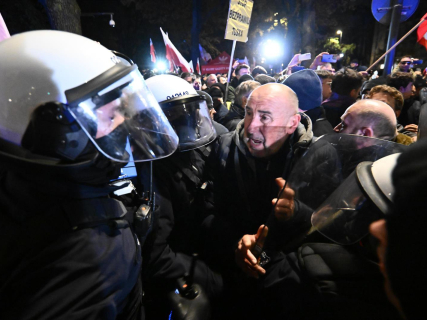

The constitutional crisis in Poland has escalated during the early hours of this Saturday, October 31. The President of the Republic, Karol Nawrocki, has gone to the headquarters of the Constitutional Tribunal in Warsaw after interrupting his trip to Senegal. His arrival has been accompanied by shoving and by a clash over who has the authority to act as judge and lead the institution.
The confrontation was triggered on Friday with the publication of orders to temporarily remove from their duties the president of the tribunal, Bogdan Święczkowski, and his vice president, Bartłomiej Sochański. The affected leadership rejects those measures and denounces an illegal takeover of the institution.
Nawrocki returns and enters the Constitutional Tribunal at dawn
The announcement of his return has turned into an in-person intervention. According to Polsat News, Nawrocki went to the tribunal accompanied by the first president of the Supreme Court, Zbigniew Kapiński, after holding a meeting with him.
Access was marked by shoving and conflicting accounts. Maciej Berek, one of those chosen by Parliament for the Constitutional Tribunal, released images and accused the president of assaulting the magistrates. From the presidential circle, on the contrary, they maintain that an attempt was made to prevent Nawrocki from entering and that his physical integrity was violated. These are accusations from the parties, not judicially established responsibilities.
The discussion continued inside the building. Radio ZET reports a recording in which Nawrocki denies the status of magistrates of the Constitutional Tribunal to Anna Korwin-Piotrowska, Krystian Markiewicz and Maciej Berek. Korwin-Piotrowska, for her part, claims that she is in charge of the institution.
In that exchange, the head of the presidential Chancellery, Zbigniew Bogucki, accuses Korwin-Piotrowska of committing a coup d'état. The expression therefore has an identifiable author within the presidential circle and is part of the political and legal confrontation.
Who has ordered the removal of the tribunal's officials
According to the documentation delivered to PAP and reported by Puls Biznesu, the orders were issued by Anna Korwin-Piotrowska, presented as the person responsible for the tribunal on the basis of her judicial seniority.
The measures establish an interruption of functions for one month and invoke article 130 of the law on the organization of the ordinary courts. Among their reasons are alleged obstacles to the meeting of all the magistrates elected by Parliament and the supposedly irregular composition of the chambers.
The questioned leadership maintains that Święczkowski and Sochański remain in their posts, denies the status of Constitutional magistrate to Korwin-Piotrowska, and denounces that the institutional website was illegally taken over. The dispute thus affects the authority of the one who signs the orders himself.
Three detained and a police version that denies the assault on the building
The police have reported three arrests after protesters crossed the fence of the premises. It also reported the throwing of objects at officers during the protests.
Regarding the initial deployment on Friday, the official version contradicts reports that described it as a police entry by force into the building. According to Polish public radio, the officers stated that they were on the grounds of the Constitutional Court, but not inside it, and denied having expelled members of its security service.
The police explained that it was acting following requests from the Minister of Justice and Attorney General, Waldemar Żurek, and from Korwin-Piotrowska, related to possible risks for workers, magistrates, and public order. That is the police justification for the operation; it does not resolve the controversy over the decisions adopted inside the court.
Tusk and Nawrocki dispute how to restore legality
The conflict has its background in the dispute over judicial appointments begun in 2015. Tusk's Government defends the reform of the Constitutional Court, while Nawrocki questions incorporations promoted by the current parliamentary majority.
Reuters points out that the blockade includes the presidential refusal to swear in candidates and Święczkowski's resistance to admitting magistrates elected by that majority. The agency also reports criticism of the appointment of Maciej Berek, an ally of Tusk, for its implications for the separation of powers.
Tusk has defended that restoring the rule of law requires firm decisions. From Law and Justice, the main opposition party, what happened is presented as an attack on the constitutional order.
Is it a coup d'état or a constitutional crisis?
The developments evidence an escalation: there are rival decisions on the court’s leadership, protests, arrests, and a face-to-face confrontation by the president with those who claim their status as judges.
They also make it possible to attribute the accusation of a coup d’état with precision. However, the information consulted does not establish that characterization as a proven fact. Reporting that a political official denounces a coup does not amount to confirming that it has taken place.
The crux of the problem is that the parties reject the legitimacy of those who should make decisions within the Constitutional Court. The immediate unknown is who will be able to effectively exercise its leadership and how the validity of the orders will be resolved, while the confrontation between the Presidency and the Government remains open.