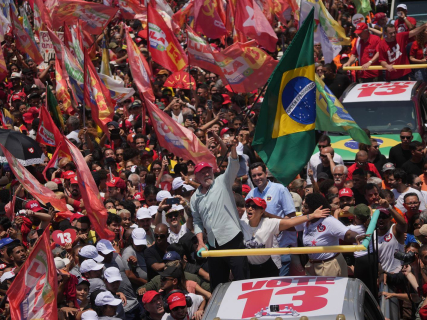

Brazil opened its polling stations this Sunday, October 25, to hold the second round of the presidential elections, in which the current president, Luiz Inácio Lula da Silva, and senator Flávio Bolsonaro, son of former president Jair Bolsonaro, are competing for the presidency of the country for the next four years. A total of 158.7 million citizens are called to vote in elections marked by political polarization and by the equality reflected in the latest polls, after neither of the two candidates managed to exceed 50% of the valid votes in the first electoral round on October 4.
The polling centers opened at 8:00 AM, according to the official time of Brasilia (12:00 PM in mainland Spain), and will remain operational until 5:00 PM Brazilian time, 9:00 PM in Spain. From that moment, the dissemination of the official results of the electronic counting will begin, which will determine whether Lula achieves his fourth presidential term or if Flávio Bolsonaro manages to bring his family back to the Palácio da Planalto. In addition to the presidency, voters in five states and the Federal District will have to elect their respective governors.
Lula and Flávio Bolsonaro reach the second round after a very tight result
The second electoral round takes place after Flávio Bolsonaro, candidate of the Liberal Party (PL), won the first round with 47.03% of the valid votes, compared to the 45.16% obtained by Lula da Silva, representative of the Workers' Party (PT).
According to the results of the Brazilian Electoral Justice, the son of former president Jair Bolsonaro gathered 56.1 million votes, while the current president obtained 53.8 million. The difference between the two was approximately 2.2 million votes, equivalent to 1.87 percentage points, a margin that left the election of the head of state pending for this Sunday.
The result of the first round represented significant support for Flávio Bolsonaro's candidacy, which has managed to gather a good part of the conservative vote around his figure. The 45-year-old senator is running for the presidency for the first time and seeks to prolong the political project of his father, Jair Bolsonaro, who governed Brazil from 2019 to 2022.
For his part, Lula, 80 years old, aims to achieve a non-consecutive fourth term. The progressive leader held the Presidency from 2003 to 2010 and returned to power in January 2023, after defeating Jair Bolsonaro in the 2022 elections.
The campaign has faced two political projects with differences in economic, social, and foreign policy matters, in addition to being marked by cross-criticism between both candidates and by the weight of the legacy of the previous Government of Bolsonaro.
The latest polls reflect a technical tie between Lula and Bolsonaro
The uncertainty about the result remains until the election day. The latest Datafolha poll, published this Saturday, October 24, gives Flávio Bolsonaro 51% of valid votes and Lula 49%, a difference of two points that is within the margin of error of the study.
The survey, conducted through 4,050 interviews on October 23 and 24, has a margin of error of two percentage points and a confidence level of 95%. Therefore, the figures reflect a situation of technical tie, without the study allowing to conclusively establish which of the two candidates will receive more votes.
Other polling firms, such as Quaest and AtlasIntel, have also recorded reduced differences between both candidates during the last days of the campaign. In the case of AtlasIntel, the study published on the eve of the voting placed Bolsonaro at 50.8% of valid votes and Lula at 49.2%, within the margin of error.
One of the relevant factors will be participation. In the first round, the abstention reached 21.08%, according to data from the Electoral Justice, so the mobilization of voters will again be a central issue on this Sunday’s election day.
More than 158 million Brazilians are called to the polls
The Superior Electoral Court (TSE) has organized a voting day that will take place simultaneously across the country, with a unified schedule regarding Brasília. Due to the different Brazilian time zones, the opening and closing of polling centers will occur at different local times in some regions.
Voting in Brazil is mandatory for literate citizens aged between 18 and 70, while it is voluntary for young people aged 16 and 17, those over 70, and illiterate individuals.
Voters must identify themselves with an official document with a photograph or through the electoral application e-Título, when it includes an image of the holder. Additionally, authorities have prohibited the use of mobile phones and recording devices inside the voting booths, with the aim of protecting the secret nature of the ballot.
The legislation also guarantees the right to vote for those who are waiting in line at the time of the official closing of the polling stations.
Five states and the Federal District also elect a governor
In addition to the Presidency of the Republic, the second round will allow the election of governors of Acre, Amazonas, Espírito Santo, Rio Grande do Norte, and Tocantins, as well as the Federal District, where no candidacy managed to surpass the required threshold to win in the first round.
In these constituencies, citizens must first cast their vote for the Governorship and then choose the presidential candidate. In the rest of the country, the ballots will be exclusively for resolving the second round of the presidential elections.
The day also extends to Brazilians residing abroad. About 919,000 voters are registered to vote outside the country, distributed across various consulates and authorized centers. Due to time differences, some of these citizens began to exercise their right to vote on Saturday, October 24, as occurred in New Zealand and Australia.
What time will the results of the Brazilian elections be known?
The voting will officially conclude at 5:00 PM Brasília time, equivalent to 9:00 PM in mainland Spain, at which point the Superior Electoral Court will begin to disseminate the results of the count.
The Brazilian system uses electronic ballots, which allows for the quick counting of votes once the day is over. However, the definitive result will depend on the reception and validation of data from the various polling centers.
To win the second round, Lula or Flávio Bolsonaro must obtain more than half of the valid votes, a category that excludes blank and null votes.
With the polling stations already open, Brazil faces a decisive day for its political future, in which citizens must decide between the continuity of the current government of the Workers' Party and the return to power of the political project represented by the Bolsonaro family. The result will also have repercussions on the Latin American landscape and on the international relations of the largest economy in South America.