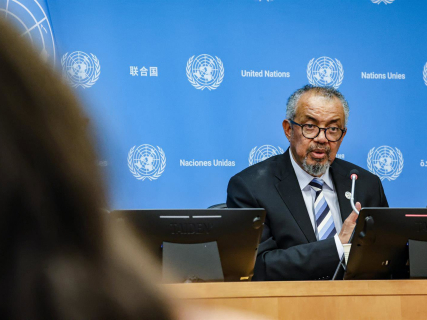

The Director-General of the World Health Organization (WHO), Tedros Adhanom Ghebreyesus, has warned of the critical health situation facing the Democratic Republic of the Congo (DRC), hit at the same time by an Ebola epidemic that has already surpassed 10,000 cases and 5,000 deaths, and by the “worst outbreak of cholera recorded in the country in decades,” which has accumulated more than 60,000 infections and 1,800 deaths so far this year.
In remarks to the press in Geneva, Tedros explained that, although in certain areas Ebola transmission has slowed down, new hotspots continue to appear. Efforts to stop the spread are seriously conditioned by massive population movements, adverse climatic conditions, attacks on health facilities, and logistical complications in reaching the most isolated areas.
As a response to this scenario, the WHO has proposed adding two candidate vaccines—developed by the University of Oxford together with India’s Serum Institute and by the pharmaceutical company Moderna—to the clinical trials coordinated by the National Institute for Biomedical Research of the DRC, with the aim of specifically combating the Bundibugyo strain.
The United Nations health agency has also emphasized the concern caused by the overlap of both emergencies in the eastern provinces of North Kivu and South Kivu, where armed conflict has destroyed essential infrastructure and has led to a severe shortage of safe drinking water and sanitation services.
Tedros also stressed the danger that cholera could spread along the Congo River basin to the capital, Kinshasa, and called on the international community to lift travel restrictions imposed on the affected countries, insisting that these measures penalize transparency and make a coordinated public health response at the global level more difficult.