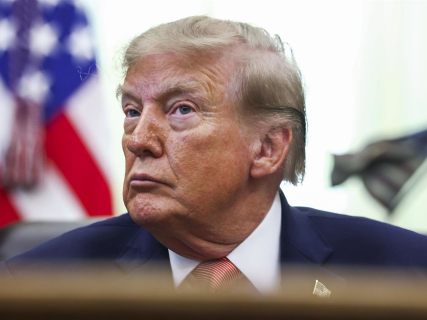

The President of the United States, Donald Trump, revealed this Wednesday that he maintains direct contacts with his Russian counterpart, Vladimir Putin, with the aim of ending the war in Ukraine, stating that the solution to the military conflict is "perhaps now closer than we have ever been."
In a roundtable at the White House, Trump indicated that the dialogues with Moscow to try to stop the war are progressing and also involve China, referring to the recent visit to the country by Chinese President Xi Jinping just a week ago.
"The fact is that both (Russia and China) would like to see the war resolved. So we are in the process of doing that with Russia, and we have China that is also involved," the American leader pointed out. In this context of greater diplomatic rapprochement, Trump framed the release of American citizen Stephen Hubbard, a gesture that, he recounted, he was able to directly raise with the Kremlin chief during a phone conversation focused on peace in Eastern Europe. "I was talking to Vladimir Putin about resolving his war with Ukraine (...) and I mentioned to him: 'Could you let Stephen Hubbard out, please?'. And he agreed to do it," he explained.
When questioned by the press about comments from special envoy Witkoff, who described Putin as "humanitarian" after the release from St. Petersburg, Trump avoided openly endorsing that label, although he clarified the context of those statements. "I suppose it could be said for that particular purpose, for allowing the release of a man who I thought was going to be in prison for life. But I wouldn't say anything in either direction," he responded.
To justify his dialogue strategy with the Kremlin, the president lashed out at those who demanded a harsher response against Moscow. "The last thing I want to do is ruin the plans when we are close to resolving a war. The last thing you are going to do is something horrendous," Trump defended, warning that if he had listened to "really stupid people" who called for extreme measures, Hubbard would have spent "another 20 years" behind bars and the fragile peace process would have collapsed.
Geopolitics and the role of Iran
Trump has also linked the efforts regarding Ukraine with the balance of power in the Middle East, showing that he feels "quite happy" that Moscow and Beijing have preferred to stay on the sidelines and not come to Iran's defense amid the latest military escalations in the area.
"Russia could have participated much more strongly with Iran, and likewise China (...), but the reality is that there is relatively little involvement. The fact is that both would like to see the war (in Ukraine) resolved," the president has insisted, taking the opportunity to emphasize the extreme weakness in which, in his view, the Islamic Republic currently finds itself.
According to the diagnosis offered by Trump, Iran is living a critical situation, with an inflation of 301% and without an effective command structure: "Its army is completely destroyed. Its air defenses and almost everything has disappeared, including its economy (...) The first group of leaders has disappeared, the second group has disappeared, and even parts of the third group of leaders have disappeared."