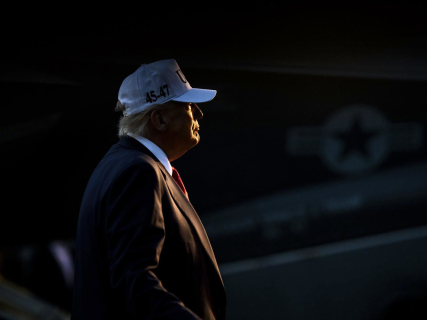

Europe will have more interlocutors with the capacity to put limits on Donald Trump in Washington. The Democratic victory in the Senate and the projections that also attribute it to the House of Representatives open a different stage in the transatlantic relationship. The president will remain at the head of U.S. foreign policy, but he will have to deal with a Congress willing to scrutinize his decisions.
For a European company that exports to the United States, the first question will be whether tariffs will go down. For Ukraine, whether new aid will arrive. For European governments, whether they will be able to count on a more predictable relationship with their main military ally.
The answer will not be the same on every front. The new parliamentary balance offers tools to negotiate and exert pressure, but it does not imply an immediate withdrawal of the measures adopted by Trump. It also does not change the person responsible for meeting with foreign leaders or for directing U.S. diplomacy.
Tariffs do not disappear with Republican defeat
The most immediate commercial effect will be political: Trump will face greater scrutiny over the costs of his tariffs and over the companies and consumers that pay them. Democrats will be able to promote investigations, demand explanations, and propose legislative changes.
That does not equate to an automatic reduction for European products. Congress has delegated certain tariff powers to the president through different laws. Modifying those assignments or reversing measures may require legislation that Trump has the capacity to veto.
Reuters had already pointed out before the elections that a Democratic victory would increase parliamentary pressure on trade policy, but it would hardly, by itself, produce a general withdrawal of tariffs. Overcoming a presidential veto requires two-thirds in both chambers, an requirement far higher than obtaining an ordinary majority.
For Spanish and European exporters, the outcome opens an opportunity to influence U.S. trade policy. It still does not allow recalculating costs by assuming that selling in that market will be cheaper.
Brussels wins another route for negotiation in Washington
The change reinforces the importance of the relationship between European institutions and Congress. The committees that deal with trade, budgets, and foreign affairs can become spaces to discuss White House decisions and their effects on allies.
The European Union will still have to negotiate with the Trump Administration. But it can look for parliamentary support to defend commitments, explain the impact of a measure, or promote solutions that also interest American businesses and workers.
That work will have to be based on specific interests. A Democratic majority does not mean that Washington will adopt European preferences on industry, agriculture, or regulation. U.S. lawmakers will also answer to their own voters.
The economic relationship at stake is considerable: the Council of the EU describes the transatlantic link as the largest bilateral relationship for trade and investment in the world. Existing trade commitments will continue to be the starting point for any negotiation.
Ukraine can find more backing, though the aid is not guaranteed
For Kyiv, a Congress more favorable to supporting Ukraine can facilitate aid initiatives, pressure on Russia, and monitoring of presidential decisions. It can also raise the political cost of a change of course that harms European allies.
The most important tool will be the negotiation of the funding and defense laws. Lawmakers can try to incorporate measures to support Ukraine into broader packages that the White House needs to approve.
However, turning that possibility into supplies and resources requires concrete agreements. The president retains veto power and a central role in the implementation of foreign policy. Experts consulted by Kyiv Independent before the elections warned precisely about that difference between having a receptive Congress and getting new measures to come into effect.
Europe cannot budget starting today for an increase in U.S. aid. It can, however, work with a more favorable correlation of forces in order to try.
The pressure to spend more on defense will continue
Trump’s defeat does not undo the commitments made by NATO members nor does it eliminate Europe’s military needs. The agreed goal in The Hague includes reaching in 2035 5% of GDP on defense and security-related spending, with at least 3.5% earmarked for the core defense requirements.
The midterms may change the tone of the discussion and bolster those who advocate transatlantic cooperation. They do not replace national decisions on budgets, capabilities, and procurement of military equipment.
For Spain as well, they do not themselves constitute a change in its position or in the demands it receives within the Alliance. Any change will have to be spelled out in decisions by governments and in negotiations among allies.
Iran and energy: more control does not mean an immediate end to the war
U.S. policy in the Middle East affects Europe due to its consequences for security, maritime transport, and energy markets. A Democratic majority will be able to investigate the management of the war with Iran and challenge its funding or its objectives.
But it would be premature to translate the election outcome into a guaranteed drop in oil prices or an end to military operations. The president retains broad powers in foreign policy, and parliamentary initiatives aimed at restricting them may encounter legal obstacles and vetoes.
For Europe, that leaves two scenarios open: more negotiation with Washington or a presidency that seeks to offset its internal difficulties with international decisions. The election outcome does not allow either of them to be taken for granted.
A weakened Trump may still be unpredictable
Europe’s temptation will be to interpret the shift as a return to the relationship prior to Trump. However, the change occurs in Congress, while the president retains the Oval Office and will continue to be the main interlocutor of foreign governments.
Before the elections, European and NATO officials interviewed by AFP were already expressing doubts about how much his foreign policy could be moderated by a parliamentary defeat. The concern was that internal limits would not necessarily translate into a more predictable international course.
The new majority in the Senate will be able to intervene in the confirmation of ambassadors and other senior positions subject to that procedure. This adds oversight over future appointments, although it does not automatically relieve those who are already holding their posts.
What Europe must look at from now on
The first indicators will be the priorities of the new majorities, the proposals on tariffs, and the financing negotiations of the Administration. It will also be necessary to observe which measures on Ukraine manage to gain support from both parties.
The institutional change does not happen immediately. The terms of the new members of Congress begin in January 2027; until then, the outgoing Congress will continue to operate. This interval will make it possible to check which decisions the Administration is trying to close before facing the new distribution of power. subsequent to European leaders.