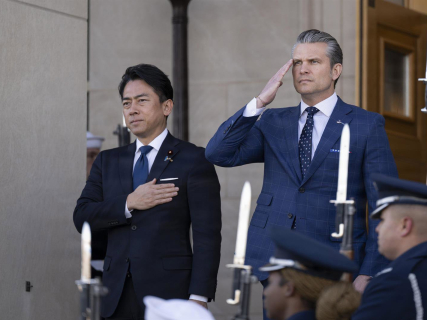

The Japanese Minister of Defense, Shinjiro Koizumi, and the head of the United States Pentagon, Pete Hegseth, agreed this Wednesday to intensify cooperation in the cyber domain in the face of the rise in attacks carried out by 'hackers', in a context in which the Asian country is seeing more and more incidents of this kind.
The understanding was sealed on the sidelines of the defense ministers' summit of the Association of Southeast Asian Nations (ASEAN), held in the Philippines, where both leaders explained that the objective is to respond to "malicious cyber activities" that originate both inside and outside Japan.
In this regard, they underlined the need to maintain a constant flow of information exchange and strengthen bilateral coordination mechanisms to prevent "serious impacts of this type of attacks on the lives of citizens, the country's economic activity and the security of the two countries", according to the Japanese Ministry of Defense in an official statement.
In recent weeks, Japan has been the target of numerous cyberattacks and data leaks that have put the personal information of millions of people at risk, revealing the vulnerability of key infrastructures and critical systems.
Koizumi and Hegseth also announced a second agreement to set up on Japanese territory a facility intended for the final assembly and verification testing of advanced medium-range air-to-air missiles (AMRAAM, by its acronym in English), in order to reinforce joint defensive capabilities.
At the same time, the United States is facing a notable reduction of its missile arsenals in the framework of its current conflict with Iran, a scenario that, according to various analysts, also translates into a decrease in its SM-3 interceptor reserves.