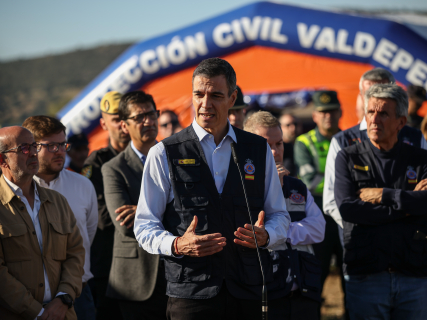
Sánchez promises to get "to the end" in the investigation of the Urda accident and act with "forcefulness" if there were negligence

The President of the Government assures that the possible responsibilities will be investigated and that the matter will be taken to the end to recover trust in the railway system

EuropaPress 7874837 presidente gobierno pedro sanchez atiende medios comunicacion puesto mando

EuropaPress 7874837 presidente gobierno pedro sanchez atiende medios comunicacion puesto mando

Add DEMÓCRATA to Google

Ask FREN

Published

Last updated

2 minutes

Most read

Elecciones 29N · Encuestas

La media de las encuestas

Media a 27 de octubre de 2026 · 15 institutos

  • PP31,0 %
  • PSOE27,3 %
  • Vox18,9 %
  • Sumar6,3 %
  • Podemos2,9 %
  • ERC2,3 %
010203040ene 2024jul 2024ene 2025jul 2025ene 2026jul 2026

Media del último estudio de cada instituto en 30 días y su evolución semanal desde el 23J. Partidos con al menos un 2 %.

Todas las encuestas

Elecciones generales del 29 de noviembre · Demócrata

The President of the Government, Pedro Sánchez, has promised to go "all the way" in the investigation of the railway accident in Urda (Toledo) and has assured that the Executive will act with "total firmness" if it is proven that there were negligence or failures in the safety systems. During his appearance from the advanced command post installed next to the scene of the collision, the head of the Executive has pointed out that clarifying the causes of the tragedy constitutes one of the Government's main priorities, along with attention to the victims and their relatives.

"We are going to go all the way," Sánchez has stated, who has explained that the Railway Accident Investigation Commission (CIAF), the Ministry of Transport, and the judicial authorities are working to reconstruct the circumstances in which the collision between a Renfe AVE and an Iryo train occurred, which has caused dozens of fatalities.

The president has insisted that, if the investigations substantiate the existence of negligence or deficiencies in the safety mechanisms, the corresponding decisions will be adopted. "All appropriate measures will be taken and with total firmness," he has assured.

Sánchez points to different causes in the Urda and Adamuz accidents

The new railway tragedy, recorded barely nine months after the Adamuz accident (Córdoba), has led the President of the Government to speak about the possible relationship between both incidents. According to what he has explained, the first indications point to the causes of the two accidents being different, although it will still be necessary to wait for the conclusions of the investigations.

Sánchez has defended the need to strengthen the safety mechanisms of the Spanish railway system and has linked the Executive's future actions to the results of the investigations that remain open.

His statements come after the Minister of Transport, Óscar Puente, explained that a failure in the LZB safety system forced the Adif control center to take over the management of traffic on a 63-kilometer stretch where there were six trains.

According to the reconstruction offered by Puente, the control center authorized the accident-stricken AVE to resume its journey at 8:36 a.m. The train covered approximately 25 kilometers during the following 17 minutes, until it hit the back of the Iryo train, which remained stopped at the entrance to a station.

For the moment, it has not been officially determined what circumstances caused the collision or whether the decisions adopted during the LZB system incident bear a direct relation to the accident.

"Today Spain is in mourning"

During his intervention, Sánchez has also conveyed his condolences to the families of the victims and has thanked the work of the emergency services, Civil Protection and the neighbors of Urda, who have mobilized to collaborate in assisting those affected.

"Today Spain is in mourning," the president has stated, who has recalled the personal consequences of the tragedy. "Behind each of the people who have died today there are broken lives, broken families," he has lamented.

The head of the Executive has pointed out that the first priority continues to be finding as many people as possible alive, attending to the injured and guaranteeing psychological and family support for those affected.

Sánchez has gone to the site of the accident accompanied by the Minister of the Interior, Fernando Grande-Marlaska, where he has met with the president of Castilla-La Mancha, Emiliano García-Page, who has warned that the death toll could continue to rise as the rescue work progresses.

More key points, information and questions with FREN

AI-GENERATED CONTENT

What is the status of the processing of possible legislative reforms on railway safety following the recent accidents in Spain?

As of October 28, 2026, the identified reforms are mainly progressing through regulatory means, not through a new comprehensive railway safety law. After the Adamuz and Gelida accidents, it is necessary to distinguish between drafts not yet approved, institutional changes already published, and parliamentary proposals that do not themselves modify the regulations.

1. Pending regulatory reforms
  • Operational safety and interoperability. The Ministry of Transport submitted a modification of Royal Decree 929/2020 for public consultation, with comments accepted until May 18, 2026. The draft includes two changes: counting intermediate periods shorter than 45 minutes as driving time and expanding the powers of the State Railway Safety Agency to access facilities, trains, and equipment, even when the inspection affects another entity. The consultation ended; no subsequent approval is recorded in the sources consulted. Therefore, these novelties should not be presented as current obligations. (Demócrata Analysis).
  • New Railway Sector Regulation. Its draft is in public consultation from September 25 to November 12, 2026. It replaces and updates a regulatory framework affected by successive modifications, especially Law 26/2022. It is a broader reform than the response to the accidents: its prior consultation began in October 2025. Contributions can still be submitted; it is not yet an approved regulation. (Transport Public Consultation).
2. Independent investigation: development already approved

The creation of the Independent Administrative Authority for the Technical Investigation of Railway, Maritime, and Civil Aviation Accidents and Incidents is not pending parliamentary approval: the law was definitively approved on July 23, 2024. Its development advanced with Royal Decree 141/2026, of February 25, which approved the organic statute and was published on February 27. Subsequently, Order PJC/582/2026 published the agreement on its physical headquarters on June 10. These milestones demonstrate regulatory and organizational progress but are not sufficient to affirm its full operational status. (Approved legislative text; Organic statute; Agreement on headquarters).

3. Parliament: investigation and proposals, not new obligations

The Senate approved in February an investigative commission on the railway network, which held hearings during 2026. Its activity serves to oversee maintenance, investments, and risk management, but does not equate to processing a law. (Creation of the commission).

Automatic alerts for repeated incidents, audits, and new maintenance priorities have also been proposed. The located documentation records them as motions, amendments, or non-legislative proposals —requests to the Government without binding legal force—, not as an approved reform of Law 38/2015. (Parliamentary proposal).

4. Aid to victims: a separate proceeding

Royal Decree-Law 1/2026, of January 27, regulates aid to victims, not new operational safety requirements. Its subsequent processing as a bill expired on October 6, 2026; this expiration should not be confused with the repeal of the decree-law. (Aid decree-law; Parliamentary publication).

In conclusion, the immediate milestone is the closing of the new regulation consultation on November 12. The final approval of the reform on driving and inspection remains pending; no new comprehensive state law specifically approved as a response to these accidents is recorded.

What are the powers and functions of the Prime Minister regarding the coordination of railway emergencies according to current legislation?

The Prime Minister exercises a function of political leadership and strategic coordination when a railway emergency reaches the dimension of a national security crisis. He is not, by that position alone, the operational director of any railway accident: sectoral railway management, civil protection, and reinforced national security coordination must be distinguished.

1. Direction of the National Security System

Article 15 of the Law 36/2015, on National Security, assigns the Prime Minister to "direct the National Security policy and the National Security System" and to declare the situation of interest for national security. These are general powers, applicable to a railway emergency when the legal conditions concur, not exclusive competencies over the railway sector.

According to articles 17 and 20, he exercises this direction assisted by the National Security Council. The National Security Department acts as technical secretariat and permanent working body. Ministers develop and execute national security policy within their respective departments, according to article 16.

2. Declaration of a crisis requiring reinforced coordination

Article 23 requires that, due to the severity of its effects and the dimension, urgency, and cross-cutting nature of the necessary measures, the situation requires reinforced coordination of the competent authorities. Therefore, a railway accident does not automatically activate this regime.

If these circumstances concur, article 24 establishes that the declaration corresponds to the Prime Minister by royal decree, which must specify:

  • The definition of the crisis and its geographical scope.
  • Its duration and, if applicable, possible extension.
  • The appointment, if appropriate, of a functional authority and their powers of direction and coordination.
  • The human and material resources necessary to address the situation.

The declaration obliges the competent authorities to provide the necessary means under their dependency. The Government must immediately inform the Congress of the measures adopted and the evolution of the situation.

3. Coordination of the response and limits

Once this situation is declared, article 25 provides that the Prime Minister will convene the National Security Council to direct and coordinate its management. He may designate a functional authority to promote coordinated action; the Council advises on that appointment.

Article 26 foresees a specialized support committee, whose presidency the Prime Minister designates among the Council members or, if applicable, the functional authority. It also allows activating preventive instruments for analysis and monitoring in advance.

These mechanisms operate with the ordinary powers and means of the administrations. They do not allow suspending fundamental rights nor do they turn strategic coordination into a general substitution of sectoral or territorial competencies.

4. What corresponds to the Interior Ministry and the railway field

It is essential to distinguish this declaration from the national interest emergency of civil protection. According to articles 28 and 29 of Law 17/2015, on Civil Protection, the latter is declared by the Minister of the Interior, not the Prime Minister, when the legal assumptions of supra-regional coordination or national direction concur.

Additionally, article 37 establishes that the Interior Ministry requests the intervention of the Military Emergency Unit and Defense orders it. In national interest emergencies, the UME assumes operational direction under the leadership of Interior.

On the other hand, Law 38/2015, on the railway sector, places railway safety within its sectoral organization, with the State Railway Safety Agency as the responsible national authority. In summary: the Prime Minister is responsible for directing the strategic response when appropriate; not automatically assuming technical railway command nor the operational command of civil protection.

What is the political career and party affiliation of Óscar Puente, the current Minister of Transport?

Óscar Puente Santiago belongs to the Spanish Socialist Workers' Party (PSOE), in which he has been active since 1990. He has been Minister of Transport and Sustainable Mobility since November 21, 2023. His political career developed mainly in Valladolid, where he was a councilor, socialist leader, and mayor between 2015 and 2023, before moving to the Congress and the Government of Spain.

Education and early political steps

He was born in Valladolid on November 15, 1968. He holds a Law degree from the University of Valladolid and a master's degree in Political Management from the Jaime Vera Foundation. He worked as a lawyer between 1995 and 2015, until his arrival at the Mayor's Office, according to his official biography.

Within the PSOE, he began to assume organizational responsibilities in 2004, as deputy secretary general of the Provincial Executive of Valladolid. In 2007 he was elected councilor of the City Council and, since 2008, he presided over and served as spokesperson of the socialist municipal group. In 2009 he became secretary general of the municipal group, a responsibility he held until 2021. Since December of that year, he has held the provincial secretary general of the PSOE of Valladolid.

Eight years as mayor of Valladolid

After eight years in municipal opposition, Puente accessed the Mayor's Office in June 2015. Although the PP had been the most voted force, he gathered an alternative majority that ended two decades of popular governments in the city. In the 2019 municipal elections, the PSOE was the most voted candidacy and Puente continued as mayor, according to the profile published by Demócrata.

During that period, he also assumed responsibilities representing the municipality outside Valladolid. He presided over the Spanish Network of Healthy Cities of the Spanish Federation of Municipalities and Provinces between 2015 and 2019; was a member of the Governing Board of the federation between 2019 and 2023, and a representative in the Urban Initiatives Network between 2020 and 2023.

In May 2023, the PSOE was again the most voted force in Valladolid, but Puente did not retain the Mayor's Office: the sum of PP and Vox allowed Jesús Julio Carnero to take office. Thus ended his eight-year period leading the City Council.

National projection within the PSOE

His first prominent responsibility in the national socialist leadership came in June 2017, after Pedro Sánchez regained the party's general secretaryship. Puente was appointed spokesperson of the PSOE Federal Executive Commission and held that role until October 2021, alongside the Mayor's Office.

In the general elections of July 23, 2023, he headed the socialist candidacy for Valladolid and obtained a seat in Congress. In September, he led the PSOE intervention in the investiture debate of Alberto Núñez Feijóo. That speech expanded his national public exposure, as noted in the cited Demócrata profile.

From Congress to the Ministry of Transport

On November 21, 2023, he took office as Minister of Transport and Sustainable Mobility in Pedro Sánchez's Government, succeeding Raquel Sánchez. His department covers state policies on transport and infrastructure, including railways, roads, ports, and airports, as well as sustainable mobility. The La Moncloa biography records his institutional career.

In summary, his career combines three areas: the internal organization of the PSOE, municipal management, and state responsibility. His political affiliation is with the PSOE and his main executive experience prior to the Ministry was the eight years as mayor of Valladolid.

Play

Test your knowledge with FREN!

How much do you know about this topic? Answer the following 3 questions.

What priority has the Government highlighted after the Urda railway accident?

Question 1 of 3

Which organization is responsible for investigating the causes of the Urda accident alongside the Ministry of Transport?

Question 2 of 3

What system failure forced the Adif control center to manually manage traffic before the accident?

Question 3 of 3