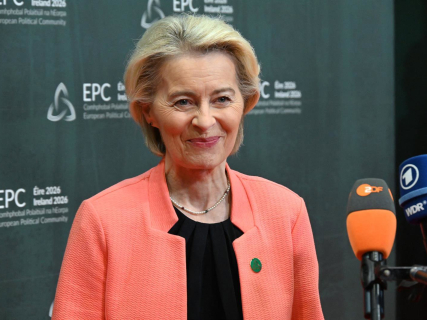

The President of the European Commission, Ursula von der Leyen, said this Friday that it is "clear" that Europe should have a role in the peace talks on Ukraine, after the White House special envoys, Steve Witkoff and Jared Kushner, pointed out the day before that Moscow would be willing to accept that Europeans be integrated into the negotiating delegation.
"I welcome the prisoner exchange and I consider it clear that Europe must take part in the peace talks, both to safeguard our interests and to support Ukraine," the German conservative leader stressed in a brief statement without questions to the media, upon her arrival at the informal summit of EU Heads of State and Government taking place in Dublin.
The head of the EU executive recalled that she already announced on Thursday that her services are preparing, by two weeks from now and coinciding with the formal European Council of November 26 and 27 in Brussels, two initiatives to strengthen Ukraine in the face of pressure from Vladimir Putin: on the one hand, a new round of sanctions against Russia — the 22nd — and, on the other, a proposal to cover Kiev's financing needs in 2027, of which Brussels calculates that the EU could take on around two thirds, that is, 45,000 million out of a total of 70,000.
The EU Heads of State and Government will debate this Friday in Dublin whether the Union should appoint a special representative to act on behalf of the bloc in the talks sponsored by the United States and what specific powers it should have, after the Italian prime minister, Giorgia Meloni, expressed in a letter to the President of the European Council, António Costa, her displeasure at the lack of internal coordination.
On the eve, several leaders had already defended, during the European Political Community summit held also in Dublin with the participation of more than 50 delegations, the importance of the bloc speaking with one single voice and in a coordinated manner, although they were more ambiguous when it came to proposing a candidate or a specific profile for that role.
Costa himself was cited by some officials as a possible option, in his capacity as a representative of the institutions, while the EU High Representative for Foreign Policy, Kaja Kallas, asserted herself alongside the president of the European Council as interlocutors legitimized by the Treaties to address questions of "European security" in frameworks such as peace negotiations.
However, France and Germany argue that there is already a consolidated format that has worked in previous crises, and both the French president, Emmanuel Macron, and the chancellor Friedrich Merz defended keeping the scheme known as 'E3' (France, Germany and the United Kingdom), although with the possibility of incorporating representatives of the EU and NATO institutions.