Where has the earthquake in Colombia been today? Epicenter, magnitude, and map of the strong tremor

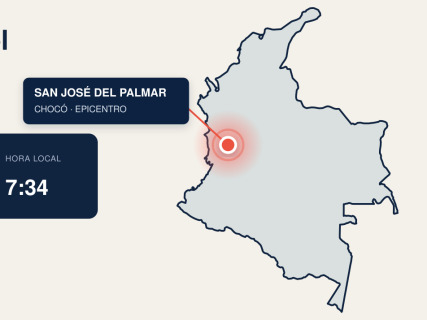
A strong earthquake of magnitude 7.4 has shaken Colombia this Monday, August 10, 2026. The epicenter was located in San José del Palmar, a municipality in the department of Chocó, in the west of the country.

1 minute

epicentro terremoto colombia (1)

epicentro terremoto colombia (1)

Add DEMÓCRATA to Google

Ask FREN

Published

Last updated

1 minute

Most read

The earthquake of magnitude 7.4 that shook Colombia this Monday, August 10, 2026, had its epicenter in San José del Palmar, municipality of the department of Chocó, in the west of the country. According to the bulletin from the Colombian Geological Service (SGC), the movement occurred at 7:34 hours in Colombia —14:34 hours in mainland Spain— and had a depth of 96 kilometers. Initial reports placed the magnitude between 6.6 and 6.7, but the Colombian agency later revised the calculation to 7.4.

The tremor was felt with particular intensity in the center and west of Colombia, including cities such as Cali, Pereira, Armenia, Manizales, Medellín, and Bogotá. It was also perceived in areas of Ecuador, Panama, and Venezuela.

Map of the epicenter of the earthquake in Colombia

The epicenter was located in San José del Palmar, in the Western mountain range and near the border between Chocó and Valle del Cauca
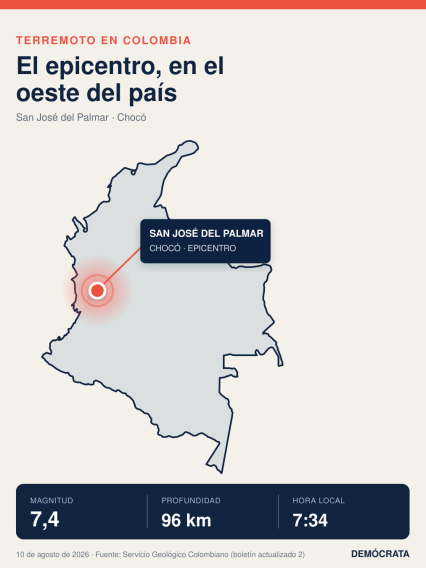
Epicenter of the earthquake in Colombia
Epicenter of the earthquake in Colombia 

Colombian authorities have activated emergency protocols and are assessing damage in Chocó and other affected regions.

The departmental governor has communicated that there are injured people and significant damage to buildings in Quibdó, although the assessment of the same is still ongoing. 

Data from today's earthquake in Colombia

Magnitude: 7.4
Epicenter: San José del Palmar, Chocó
Depth: 96 kilometers
Local time: 7:34 hours
Time in Spain: 14:34 hoursDate: Monday, August 10, 2026


More key points, information and questions with FREN

AI-GENERATED CONTENT

What is the legislative process for declaring a disaster zone in Colombia after an earthquake?

In the field I work in, focused on the policy and regulatory framework of Spain, I do not have detailed and verifiable normative information about the specific procedure followed by the Colombian State to declare a disaster zone after an earthquake. Without access to official Colombian sources in this context, it is not possible to accurately describe which law, which specific authority, and which formal steps are applied in Colombia. I can explain, in a general and comparative way, how these types of declarations are usually articulated in the legal-political systems of the region, but you should take it only as a guiding outline and not as an exact description of the Colombian case.

1. Main limitation: area of expertise

My specialization is politics, parliamentary activity, and the regulations of Spain (Congress, Senate, Government, autonomous communities, etc.), as well as its European context. When the question refers to another country—in this case, Colombia—it is a field of comparative politics where:

  • I do not have the text of the applicable Colombian laws in front of me (for example, risk management regulations, states of exception, emergency decrees, or similar).
  • I do not have concrete references about the body that formally "declares" the disaster zone (Presidency, competent ministry, territorial entities, etc.).
  • I cannot verify dates, recent legal reforms, or the exact institutional practice.

For all these reasons, it would not be rigorous to state: "Article X of Law Y requires such and such steps" or "the competence corresponds to such authority," because I would be basing it on assumptions and not on verified information.

2. General structure of this type of process in Latin America

Even without going into Colombian detail, in many countries in the region the procedure to manage a major earthquake and declare a disaster zone usually combines three levels: the political-constitutional, the legal-administrative, and the operational.

2.1. Political-constitutional level

There is usually a constitutional or quasi-constitutional regulation on exceptional situations (states of emergency, internal commotion, catastrophe, calamity, etc.). Normally:

  • The head of State or Government has extraordinary but limited powers to react to serious natural disasters.
  • Exceptional decrees are issued that must later be controlled or ratified by the legislative power or courts.
  • The extraordinary measures are temporally delimited and, sometimes, minimum guarantees of fundamental rights are established.

This does not describe the specific case of Colombia, but it is the logic usually behind these figures.

2.2. Legal-administrative level

Besides the constitutional framework, there is usually a disaster risk management or emergency care law that:

  • Defines what is understood by "disaster," "calamity," or "disaster zone."
  • Establishes who can initiate the procedure (central government, governors, mayors, technical bodies).
  • Details the legal effects of the declaration (mobilization of resources, emergency contracting, procedural flexibilization, economic aid, etc.).

In some countries, that declaration is made by administrative resolution or executive decree; in others, it requires collaboration with territorial authorities or even legislative intervention to approve extraordinary financing frameworks.

2.3. Operational and technical level

Alongside the legal component, technical and civil protection services usually intervene that:

  • Evaluate the magnitude of the earthquake, damage to infrastructure, and the number of people affected.
  • Issue reports that serve as the basis for the formal declaration of a disaster zone.
  • Propose the geographical delimitation of the most affected areas.

It is common that the formal act of declaration (for example, a decree) refers to these technical reports to justify the need and scope of the measure.

3. How to obtain the exact procedure in Colombia

To know precisely the legislative and administrative process in Colombia, it would be appropriate to consult directly:

  • The Political Constitution of Colombia and the articles on states of exception and emergencies.
  • The framework laws on disaster risk management and civil protection in force.
  • The decrees or official acts issued in previous earthquakes, which show the real practice.
  • The institutional websites of the Government of Colombia and the Congress of the Republic, where these norms and their developments are usually published.

Only with that basis could the specific procedure be traced step by step: who proposes the declaration, which body decides, what form the act takes (law, decree, resolution), what parliamentary or judicial controls exist, and what the concrete effects are for the population and affected territories.

What constitutional and legal norms exactly regulate the declaration of disaster zones after an earthquake in Colombia? Which Colombian authorities (national and territorial) participate in the decision and execution of that declaration? What concrete legal and economic consequences does it have for citizens and companies when an area is declared a disaster zone in Colombia?

What are the competencies of the president of Colombia in emergency management according to the Constitution?

According to the Political Constitution of Colombia, the president concentrates broad competencies to manage emergencies, mainly through the states of exception (external war, internal commotion, and economic, social, and ecological emergency), and through his ordinary functions as head of State, head of Government, and supreme administrative authority. These powers allow him to issue decrees with the force of law, mobilize the Public Force, and coordinate the entire administration to face serious crises. However, they are subject to strict controls by Congress and the Constitutional Court, as well as material and temporal limits. Below are detailed the main relevant competencies in emergency management.

1. General framework of presidential power in crises

The 1991 Constitution configures the president as the central authority for managing critical situations. Under ordinary conditions, he exercises functions such as:

  • Maintaining public order throughout the territory and restoring it where disturbed.
  • Directing the Public Force (Military Forces and National Police).
  • Exercising regulatory power for the proper execution of laws.
  • Directing international relations, crucial in emergencies with an external dimension (international aid, cooperation, borders).

In serious emergencies that exceed ordinary mechanisms, the regime of states of exception comes into play, mainly regulated in articles 212 to 215 of the Constitution.

2. States of exception and extraordinary powers

a) State of external war (art. 212)

When an external war occurs or there is imminent danger of one, the president, with the signature of all ministers, can:

  • Declare the state of external war, with Senate approval if the situation allows.
  • Assume legislative powers through decrees with the force of law, strictly related to defense and conflict management.
  • Order the mobilization and use of the Military Forces and other State resources necessary for national defense.

These measures are subject to automatic constitutional control by the Constitutional Court.

b) State of internal commotion (art. 213)

In cases of serious disturbance of public order that imminently threaten institutional stability, State security, or citizen coexistence, the president can:

  • Declare the state of internal commotion, with the signature of all ministers, for periods up to 90 days, extendable within constitutional limits.
  • Issue legislative decrees with the force of law, necessary and proportional to face the disturbance.
  • Adopt special police and security measures, including restrictions on some rights, always respecting intangible rights (life, prohibition of torture, etc.).

Congress must convene by right to politically control the measures, and the Constitutional Court performs legal control over the decrees.

c) State of economic, social, and ecological emergency (art. 215)

For crises that seriously affect the economic, social, or ecological order (for example, natural disasters, pandemics, economic collapses), the president can:

  • Declare the state of emergency for periods up to 30 days, accumulable up to 90 days in the year.
  • Issue decrees with the force of law aimed exclusively at overcoming the crisis and preventing the spread of its effects.
  • Redirect public spending and adopt exceptional tax or economic measures within constitutional limits.

Congress can repeal, modify, or add to these decrees, and the Constitutional Court exercises automatic control over their constitutionality.

3. Limits and controls on emergency powers

Although the president concentrates very broad powers in emergencies, the Constitution establishes several checks and balances:

  • Temporality: states of exception have a maximum duration and cannot be permanent.
  • Purpose and connection: measures must be directly related to the cause of the crisis and be necessary and proportional.
  • Respect for intangible rights: certain fundamental rights cannot be suspended under any circumstances.
  • Political control: Congress oversees the use of powers and can modify or repeal legislative decrees.
  • Judicial control: the Constitutional Court automatically reviews states of exception decrees.

4. Administrative coordination and practical operation

Beyond the constitutional text, in practice the president directs interinstitutional coordination in emergencies (ministries, governorships, mayoralties, risk management entities), approves national response plans, and can create or activate unified command structures. Although many operational details are in ordinary laws, the constitutional basis is clear: the president is the political and legal center of the State's response to serious crises.

Which fundamental rights cannot be suspended during states of exception in Colombia? How does the Colombian Congress control the decrees issued by the president in a state of emergency? What practical differences exist between the state of internal commotion and the state of economic, social, and ecological emergency?

What legal requirements must be met to activate the Unified Command Post in Colombia?

The Unified Command Post (PMU) in Colombia is a relevant operational figure in the management of public order, protests, emergencies, and disasters, but I do not have specific and verified legal information in the sources I have access to about the concrete legal requirements for its activation (applicable Colombian regulations, decrees, or internal orders). Additionally, I specialize in politics and regulations of Spain, so I am not an adequate tool to detail precisely the Colombian legal framework governing the activation of a PMU. For a rigorous answer, it is essential to consult directly Colombian regulations and official sources from that country.

That said, to give you a conceptual orientation (not legal) and to know what to look for in Colombian sources, the PMU is generally understood as an interinstitutional coordination space where government authorities, security forces, emergency services, and, in certain cases, oversight or control entities meet to make operational decisions regarding a specific situation. In many countries, its activation is supported by regulations on risk management, citizen security, or states of exception. However, automatically transferring this scheme to the Colombian case without citing a specific law, decree, or protocol would be speculative, and that is not acceptable for a serious legal response.

Limitations of this response

My design is mainly oriented to:

  • Spanish regulations and politics: laws, royal decrees, royal decree-laws, regulations, and their processing in Congress and the Senate.
  • Parliamentary and governmental activity in Spain: legislative initiatives, government oversight, Council of Ministers agreements, hearings, votes, etc.
  • Political and social current affairs in Spain: context analysis, regulatory impacts, and media monitoring, with special attention to information collected by the newspaper Demócrata.

When the question refers to the internal regulations of another country (in this case, Colombia) and also requires a concrete legal detail level (legal requirements for activating an operational device), I cannot guarantee accuracy or updating if I try to "fill in" with general knowledge. In these cases, the responsible answer is to expressly clarify that I do not have that specific regulation.

What type of information you should look for in Colombia

If you need to know precisely the legal requirements to activate a PMU in Colombia, I recommend focusing the search on the following types of documents and organizations:

  • Framework laws on security, public order, and risk management: regulations that govern the National Disaster Risk Management System or the handling of protests and mobilizations, where command and coordination structures are usually defined.
  • Presidential or Ministry of Interior and Defense decrees: in many countries, the formal creation of figures like the PMU is done by decree, detailing competencies, institutional integration, and activation conditions.
  • Internal operational protocols: resolutions or circulars addressed to Police, governorships, and mayoralties, which usually specify when and how a PMU is convened (for example, in the face of a certain risk level, a calamity declaration, or the forecast of large demonstrations).
  • Jurisprudence and opinions of control bodies: in the Colombian case, the Constitutional Court, the Council of State, the Attorney General's Office, or the Ombudsman may have issued rulings that delimit the use of the PMU, especially regarding fundamental rights during protests.

What I can do within my scope

Although I cannot detail the Colombian legal framework on the PMU, I can help you with analogous topics but referring to Spain. For example:

  • Explain how civil protection and emergency management are organized in Spain (National Civil Protection System, Steering Committees, coordination between administrations).
  • Analyze how security and public order devices for demonstrations or mass events are regulated in Spain, from a legal and competency perspective.
  • Describe the figures of coordination centers or committees activated by the central Government or autonomous communities in crisis situations (for example, coordination committees of the Ministry of Interior or territorial emergency plans).

If you need a comparison between Spanish and Colombian models, I could also help structure key questions to authorities or specialized sources in Colombia, but always making clear that my detailed part would only be solid regarding the Spanish case.

What legal framework regulates in Spain the activation of coordination devices in emergency or disaster situations? How is coordination organized in Spain between the central Government, autonomous communities, and municipalities regarding public order? What equivalents to the Colombian Unified Command Post exist in the civil protection and security system in Spain?

Play

Test your knowledge with FREN!

How much do you know about this topic? Answer the following 3 questions.

What was the final magnitude of the earthquake that occurred in Colombia on August 10, 2026?

Question 1 of 3

In which municipality of the Chocó department was the epicenter of the Colombia earthquake located?

Question 2 of 3

Who is the president of Colombia who took leadership of the response after the August 10, 2026 earthquake?

Question 3 of 3

Hola, soy Fren. ¿Cómo te ayudo?