Return to mutuals: how to check the payment from the Treasury

The retirees who requested the refund of IRPF for old contributions to mutual societies can now check the status of each year at the Tax Agency. The headquarters distinguishes between pending applications, files with agreed refunds, and cases in which there is no amount to refund.

2 minutes

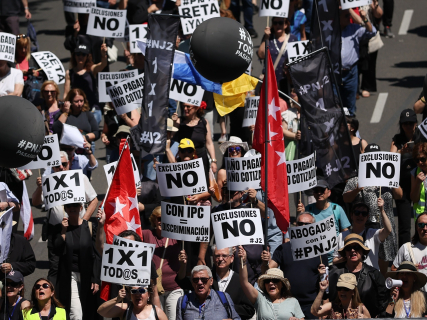
EuropaPress 7544305 numerosas personas marchan manifestacion exigir reta pasarela completa

EuropaPress 7544305 numerosas personas marchan manifestacion exigir reta pasarela completa

Add DEMÓCRATA to Google

Ask FREN

Published

Last updated

2 minutes

Most read

The Tax Agency maintains a specific service to check the status of refunds for mutual members.

The system allows for reviewing the processing corresponding to the affected personal income tax years and knowing if the Tax Agency is still studying the request, has acknowledged a refund, or considers that there is no amount in favor of the taxpayer. 

How to check the status of the request

The taxpayer must go to the mutual members section of the electronic headquarters and select "Check submitted form".

Access can be made with a reference number, Cl@ve, electronic certificate, electronic DNI, or eIDAS. It is also possible to access on behalf of another person when there is the corresponding power of attorney.

Once identified, the system displays the submitted form and observations related to each tax year.

What statuses may appear

The Tax Agency distinguishes three main situations:

•⁠  ⁠*Preliminary study phase:* The Tax Agency is still analyzing whether there is a right to a refund.
•⁠  ⁠*Refund approved:* the file has been processed and an amount has been recognized.
•⁠  ⁠*No amount to refund:* the calculation does not generate a refund, and the headquarters informs of the reason.

Among the reasons for a no-refund result may be that no withholdings were made during that tax year or that those amounts had already been refunded previously. 

How to know when the payment will be made

When the Tax Agency finishes its checks, the file may show that the refund has been admitted or indicate when it will be issued.

The general status can also be checked from "My files", using Cl@ve, electronic certificate, or electronic DNI. The procedure history and associated documents appear there.

That the form has been submitted correctly does not mean that the refund is automatically approved. The Tax Agency initiates the procedure only when its analysis indicates that there is a right to collect.

How to retrieve the receipt

The "Check submitted forms" option allows you to download a copy of the request and its receipt.

The search engine allows filtering by submission date and time. In the results, an option appears to obtain the PDF with the reference number and the declared data.

If the phone number or IBAN are incorrect, a written statement must be submitted through the registry indicating the receipt and the information to be corrected.

What is the deadline for new applications

Those who have not yet submitted the new form should pay attention to the statute of limitations.

February 2, 2026 was the deadline for a new application to jointly affect the 2020, 2021, and 2022 tax years. Until February 2, 2027, the refund corresponding to 2021 and 2022 can be requested, and until February 2, 2028, that for 2022.

Those who submitted the new form before July 26, 2025, do not need to resubmit it for those tax years.

What documentation must be provided

The form primarily requests a phone number and an IBAN owned by the applicant.

In principle, it is not necessary to attach additional documentation, although the Tax Agency may request it if it does not have sufficient information to calculate the refund

More key points, information and questions with FREN

AI-GENERATED CONTENT

What are the parliamentary steps that a possible reform in the regulations on refunds to mutualists would follow?

A potential reform of the regulations on refunds to mutualists would follow the same path as any other state law in Spain. The specific route depends on whether the initiative comes from the Government (bill) or from parliamentary groups / Senate / regional parliaments / popular legislative initiative (proposed law). In both cases, the key moments to fundamentally change the content are the submission of amendments, the work in committee, and, if applicable, the intervention of the Senate. Below I detail the usual itinerary and in which phases substantive aspects of the reform could be altered.

1. If the reform enters as a Government bill

1.1. Preliminary phase (before reaching the Cortes)

Regarding refunds to mutualists, it is most likely that the initial impetus would come from the Ministry of Finance or the ministry responsible for Social Security or Public Administration. The Government would draft a preliminary bill, which is usually preceded by:

  • Public consultations: to gather opinions from citizens and affected organizations (mutualist groups, professional associations, etc.).
  • Internal and external reports: from the State Attorney's Office, the Council of State, or other advisory bodies, depending on the scope of the reform.

After these steps, the Council of Ministers would approve the text as a bill and send it to the Congress of Deputies.

1.2. Admission, amendments, and general debate in the Congress

In the Congress, the bill follows these general phases:

  • Qualification and admission for processing: the Board of the Congress verifies that the initiative meets the formal requirements.
  • Opening of the amendment period: groups can submit total amendments (to reject the entire text or return it to the Government) and partial amendments (to modify specific articles, for example, refund criteria or prescription periods).
  • General debate in Plenary: the overall approach of the reform is discussed. It could be blocked at this stage if a total amendment with alternative text or return is approved.

In these early phases, significant changes can already be introduced, especially if a total amendment with alternative text is accepted, which would replace the original bill.

1.3. Committee work and report

If it passes the general debate, the bill goes to the competent committee (for example, Finance, Labor, or whichever is determined). This is where the most intense technical phase occurs:

  • Presentation: a small group of deputies studies the text and amendments and proposes a wording.
  • Committee: partial amendments are discussed and voted on. From here comes the report, which can already deeply change the proposed regulation (types of affected mutualists, claimable periods, refund calculation formula, transitional regime, etc.).
1.4. Plenary of the Congress, Senate, and final approval

The committee report is submitted to the Plenary of the Congress, where:

  • The text is debated and voted on article by article or in blocks.
  • The so-called live amendments (those not accepted in committee) are debated.

Once approved, the text goes to the Senate, which can:

  • Approve it as is.
  • Introduce amendments (including substantial changes, for example expanding or restricting who has the right to a refund).
  • Raise a veto (global rejection).

If there are amendments or a veto, the Congress has the final say: it can accept or reject amendments and lift the veto by absolute majority (or by simple majority after two months). The final text is sent for sanction and promulgation by the King and published in the BOE, at which point the reform comes into force in the manner and terms established by the law itself.

2. If the reform enters as a proposed law

If the initiative does not come from the Government but from parliamentary groups, the Senate, regional parliaments, or a popular legislative initiative, it would be processed as a proposed law. Essentially, from the moment it is admitted in the Congress, it follows the same phases as a bill: admission, amendments, general debate, committee, Plenary, Senate, and return to the Congress. The main difference lies in the preliminary phase: it does not go through the Council of Ministers nor the same government preliminary bill dynamics.

In both routes, the points where substantive changes regarding refunds to mutualists could be introduced are: the submission of partial amendments, negotiation in presentation and committee, debate in the Congress Plenary, and possible Senate amendments.

What powers does the Tax Agency have regarding the management of tax refunds according to the General Tax Law?

The General Tax Law assigns the State Tax Administration Agency (AEAT), within the scope of the State, the function of applying taxes, and within that “application” is included the recognition, management, and execution of tax refunds. This covers both refunds derived from the regulations of each tax and refunds of undue payments, as well as the reimbursement of guarantee costs. The law also establishes that the taxpayer has the right to obtain these refunds with late payment interest, and regulates a specific procedure for the correction of self-assessments and for the refund of undue payments, which the AEAT processes and resolves. All this is set out in Law 58/2003, General Tax Law, available in the BOE.

General framework of AEAT powers

The General Tax Law states that, within the State's competencies, the application of taxes, the exercise of sanctioning power, and the review function in administrative proceedings correspond to the Ministry of Economy and Finance, “unless expressly entrusted by law to another public body or entity.” In the same passage, it indicates that, according to its founding law, these powers correspond to the State Tax Administration Agency, with two exceptions: the declaration of nullity of full effect and economic-administrative claims, which are reserved for other bodies.

By declaring that “the application of taxes” corresponds to the AEAT, this concept includes the entire tax management cycle: verification, assessment, collection, and, importantly for your question, the processing of refunds and the recognition of economic rights in favor of the taxpayer.

Taxpayer's right to refunds and AEAT's role

Among the rights of taxpayers, the General Tax Law expressly recognizes the right to obtain:

  • Refunds derived from the regulations of each tax.
  • Refunds of undue payments that are appropriate.

Furthermore, it establishes that these refunds must be paid with the late payment interest provided in article 26 of the Law itself, “without the need to make a request for this purpose.” That is, once the refund's appropriateness is recognized, the AEAT is obliged to execute it ex officio, making the corresponding payment with accrued late payment interest.

The Law also provides that the right to request and obtain these refunds and the reimbursement of guarantee costs prescribe after four years. Within that period, the AEAT must process the requests and, if applicable, proceed with payment or motivated denial.

Correction of self-assessments and origin of many refunds

When the taxpayer submits a self-assessment and later considers that they have paid more than due, the Law provides the possibility to request the correction of the self-assessment. The legal text itself indicates that if the taxpayer believes that the self-assessment submission has resulted in an undue payment, they may request that correction “in accordance with the provisions of paragraph 3 of article 120” of the Law.

In practice, this correction is the usual channel through which the AEAT reviews the self-assessment and, if appropriate, recognizes the right to a refund (whether derived from the tax regulations or due to undue payment). The AEAT's competence here is twofold:

  • Decide on the appropriateness or not of the correction and the associated refund.
  • Execute, if applicable, the payment of the amount to be refunded with the corresponding interest.

Refunds of undue payments: recognition and execution

The Law specifically regulates the procedure for recognizing the right to refund undue payments. It establishes that it can be initiated ex officio or at the request of the interested party, and lists several cases where the refund is appropriate, including:

  • Duplicate payment of tax debts or sanctions.
  • Payment of an amount higher than that resulting from an assessment or self-assessment.
  • Payments made after the prescription periods have elapsed.
  • Other cases established by tax regulations.

In these cases, the AEAT has the competence to:

  • Initiate the procedure ex officio when it detects the undue payment, or process the request submitted by the taxpayer.
  • Recognize or deny the right to refund with reasons.
  • Calculate the late payment interest associated according to article 32.2 of the Law.
  • Execute the refund “under the terms established by regulation,” once the right is recognized.

The regulation adds that if the act that originated the undue payment is final, the taxpayer can only obtain the refund through the special review procedures of article 216 or the extraordinary review appeal of article 244. In any case, once those procedures conclude recognizing the undue payment, it is again the AEAT who must materialize the refund.

Reimbursement of guarantees and time limits

Connected with refunds, the Law provides that the tax administration reimburses the cost of guarantees provided to suspend the execution of an act or to postpone or split a debt, when the act or debt is declared improper by final judgment or resolution. The AEAT must process that reimbursement and also pay the legal interest from when the cost was incurred until the payment order.

Finally, the Law sets that both the right to request and the right to obtain refunds and reimbursements prescribe after four years, within which period the AEAT retains the power to recognize and execute these refunds.

What specific deadlines does the Tax Agency handle to resolve requests for correction of self-assessments and refund of undue payments? What appeals can I file if the Tax Agency denies or does not respond to my tax refund request? How are the powers of the state Tax Agency coordinated with regional tax authorities regarding refunds of transferred taxes?

What are the legal requirements for a request for IRPF refund to mutualists to be accepted according to current regulations?

A request for an IRPF refund from a mutualist will only be accepted if it fits within the cases of refund of undue payments or correction of self-assessment provided in the General Tax Law, the undue payment and the condition of mutualist are properly proven, and it complies with the specific tax treatment of social welfare mutualities established by the IRPF Law. Additionally, procedural requirements of the Administrative Review Regulation and the regulations developing the correction of self-assessments by administrative and telematic means must be met. Without these elements (material right to the refund, standing, documentary evidence, and correct processing), the tax administration dismisses the request.

1. Basic regulatory framework

The requirements mainly come from:

  • Law 58/2003, General Tax Law, on refunds derived from the regulations of each tax and refund of undue payments, and on self-assessments (BOE: General Tax Law).
  • Royal Decree 520/2005, Administrative Review Regulation, which develops the procedure for refund of undue payments and correction of errors (BOE: Review Regulation).
  • Law 35/2006 on IRPF, which defines the tax regime of social welfare mutualities and benefits to mutualists, including possible partial or total exemption (BOE: IRPF Law).
  • Royal Decree 439/2007, IRPF Regulation, which develops the treatment of mutualities and other welfare systems (BOE: IRPF Regulation).
  • Order of March 22, 1991, which develops the procedure for refunds of undue payments of a tax nature (BOE: Order of March 22, 1991).
  • Resolution of December 21, 2018 of the AEAT, which extends social collaboration to the telematic submission of correction requests of self-assessments (BOE: AEAT Resolution 2018).

2. General substantive requirements

For any IRPF refund (including mutualists), the General Tax Law requires:

  • Existence of undue payment or erroneous self-assessment: Law 58/2003 contemplates the obligation of the Administration to refund both amounts that are appropriate “derived from the regulations of each tax” and undue payments made in compliance with tax obligations. In mutualists' IRPF, this usually consists of having declared and paid for income or benefits that, according to the IRPF, should have been exempt or taxed at a lower rate.
  • Recognition of the right to refund: the article cited in Law 58/2003 and the refund chapter of Royal Decree 520/2005 require the Administration to expressly recognize the right to refund (usually through correction of the self-assessment or through a specific procedure for refund of undue payments).
  • Late payment interest in favor of the taxpayer: Law 58/2003 provides that, along with the refund of undue payments, the Administration pays late payment interest from the date of the undue payment until the payment order, without the need for an express request.

3. Standing and affected subjects requirements

Royal Decree 520/2005 specifies who can request the refund:

  • The taxpayer or infringing party who made the payment to the Treasury.
  • The successors of those taxpayers.
  • In the case of withholdings or payments on account, also the person or entity who bore them, when they consider the withholding or payment was undue.

Therefore, the mutualist who bore the undue taxation on their contributions or benefits from the mutuality is entitled to request the correction of the IRPF self-assessment through which the undue payment was made, as explicitly stated by the Regulation by extending standing to those who bore the withholding or repercussion.

4. Specific treatment of mutualists in the IRPF

Law 35/2006 recognizes a specific status to social welfare mutualities acting as alternatives to the special Social Security regime for self-employed workers:

  • Benefits for permanent absolute disability or severe disability recognized by these mutualities may be exempt, up to the limit of the maximum Social Security benefit for that concept; the excess is taxed as employment income.
  • In retirement benefits and others derived from contracts with mutualities, the part exceeding the contributions not reduced at the time is taxed as employment income.

In practice, for an IRPF refund to a mutualist to be accepted, it must be proven that:

  • The mutuality effectively acted as an alternative to the Social Security regime, under the terms of Law 35/2006.
  • The benefit or income declared in IRPF corresponded to one of the contingencies (retirement, disability, etc.) to which the law grants exemption or reduced treatment.
  • The original self-assessment did not apply the exemption, the exempt amount limit, or the correct integration rule of those benefits, thus generating an undue payment.

5. Formal and documentary requirements

Royal Decree 520/2005 requires that the refund or correction request addressed to the competent body include:

  • Justification of the undue payment and documents proving the right to refund (copies of the IRPF self-assessment, payment receipts, withholding certificates, etc.).
  • In the case of mutualists, certificates from the social welfare mutuality itself regarding:
    • Condition as mutualist and contribution period.
    • Alternative nature to the Social Security system, when applicable.
    • Details of benefits paid (concept, dates, and amounts).

The AEAT Resolution 2018 also enables the telematic submission of correction requests of self-assessments through social collaboration, using a standardized representation document when a third party (advisor, manager, etc.) acts.

6. Procedural limits

Although the sources analyzed do not detail specific deadlines, the procedure is framed within the general tax review regime of Law 58/2003 and Royal Decree 520/2005, which condition the refund on the taxpayer's right not having expired or prescribed and on the absence of a prior final resolution preventing reopening the matter by ordinary means. When the refund is recognized in execution of an economic-administrative or judicial resolution, the rules of the Review Regulation are also followed.

No further information is available in the consulted sources on additional specific criteria for mutualists beyond the material treatment of their benefits in the IRPF Law.

What specific documentation should I provide as a mutualist to accompany a correction request of my IRPF? In which cases are the benefits from my social welfare mutuality totally or partially exempt in the IRPF according to Law 35/2006? What appeal routes do I have if the Tax Agency denies my request for refund of undue payments for contributions to a mutuality?

Play

Test your knowledge with FREN!

How much do you know about this topic? Answer the following 3 questions.

What is one of the methods to access the status of the mutualists' refund on the Tax Agency's electronic headquarters?

Question 1 of 3

What should the taxpayer do if they detect an error in the IBAN provided in their application?

Question 2 of 3

Until what date can mutualists request the refund corresponding to the 2022 fiscal year?

Question 3 of 3

Hola, soy Fren. ¿Cómo te ayudo?