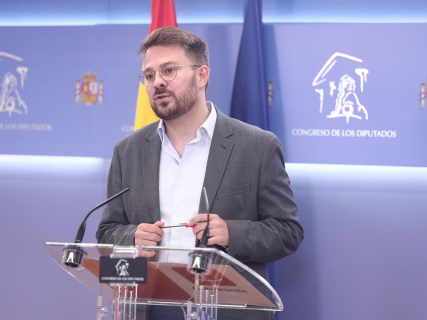

The deputy spokesperson of Sumar in Congress and deputy of Compromís, Alberto Ibáñez, accused the PSOE this Wednesday of suffering from "Stockholm syndrome" with the king of Morocco, Mohamed VI, and claims that the president of the Government, Pedro Sánchez, "is late" in offering explanations about the crisis generated by the massive entry of immigrants in Ceuta at the end of July.
In an appearance before the media in the Lower House, Ibáñez described that massive entry as "a case of hybrid attack" against Spanish sovereignty and criticized that the Executive does not explicitly point out the responsibility of Rabat in what happened. "Unfortunately, today the PSOE still has Stockholm syndrome with the king of Morocco," he stated.
The deputy of Sumar praised the actions of the State Security Forces during the crisis of July 30 and compared it to the tragedy of the Melilla fence in 2022, in which 23 immigrants died. "They are politically the responsibility of Spain, but now although there have been more than 141 deceased who deserve our respect, it is evident that the Police acted well that day," he indicated.
In this context, Ibáñez demanded that Spain "continue to be a beacon of defense of Human Rights," but also demanded a "clear" reaction against "said attack."
Criticism of Sánchez's vacation and his delay in providing explanations
Asked about Sánchez's management after the crisis, the representative of Sumar admitted that "it is human" for the president to enjoy vacations, especially after a political course "particularly difficult and painful" in which, as he recalled, he has been "a victim of family harassment for political reasons, of different 'lawfares' and of the wear from various corruption cases."
However, he added that "in life one does not always get what one wants" and considered that, given the "seriousness" of the events, Sánchez "should have agreed on a single command that reported to him specifically" or "have moved his vacation to the end of September or October."
In this line, he insisted that the head of the Executive "is late" in coming to Congress on September 9 to account for himself. In his view, in that appearance he should address several issues that have been "pending": the role of the National Intelligence Center (CNI), relations with Morocco, and Spain's energy policy with Algeria.
Clash between Robles and Marlaska and demand to clarify the role of the CNI
Ibáñez has also referred to the clash of versions between the Minister of Defense, Margarita Robles, and the Minister of the Interior, Fernando Grande-Marlaska, about whether the CNI warned or not about what was going to happen. Robles maintains that the center fulfilled its duty and issued warnings, while Marlaska claims that there was "no hint" of prior communication about the events.
The Sumar deputy has emphasized that "the serious thing is that there is not a single version in the Government" and has suggested that "perhaps there was an inaccurate oral information that something could happen and then this happened and someone says they had already warned." "I think we also have to be aware of how these reports often work and how some cover themselves and then nothing happens or then something does happen and assess the risk," he added.
In any case, he considers the "divergence" between both ministers to be "very serious" and that it has not yet been clarified what data the Spanish intelligence had. "I think this is serious," he reiterated, describing it as "shameful" that the explanations from Robles and Marlaska occurred almost simultaneously.
Finally, he recalled that his parliamentary group has already registered a request in Congress for the appearance of the director of the CNI, Esperanza Casteleiro, in order to detail what happened and what information was handled in the days leading up to the crisis.