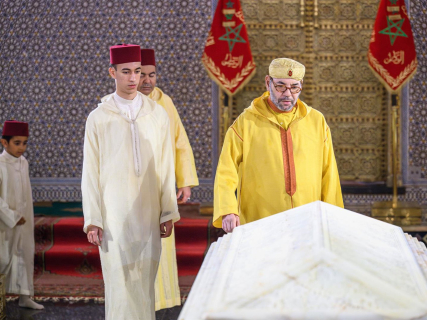

The Moroccan Minister of Islamic Affairs, Ahmed Toufiq, has once again brought up Morocco's claim over Ceuta and Melilla during a religious festival led by King Mohamed VI, which was also attended by the Crown Prince, Mulay Hasán, and the head of Government, Aziz Ajanuch.
In his speech during the Eid al Maulud ceremony at the Royal Palace in Rabat, on the occasion of the birth of the Prophet Muhammad, Toufiq referred to the two autonomous cities by citing the figures of two Islamic scholars born in Ceuta before this enclave in North Africa came under Spanish sovereignty in 1580.
According to the official agency MAP, the minister emphasized the "deep bond" of Moroccans with Muhammad, which is expressed, on one hand, in a political dimension, represented by the command of the believers exercised by the monarch as a descendant of the prophet, and on the other, in a spiritual and emotional aspect.
In this second aspect, Toufiq mentioned the works of the qadi Ayyad "Treatise on the Healing Virtues of the Knowledge of the Rights of the Prophet" and of Abú al Abbas al Zafi "Anthology of Poems Composed in Celebration of the Birth of the Illustrious Prophet." To these texts, he added the book of Imam Al Jazuli "The Guides to the Paths of Good," whose prayers, he recalled, were raised by Moroccans "in their sacred struggle to liberate the occupied cities located along the Atlantic Ocean at the beginning of the contemporary era."
The qadi Ayyad, born in Ceuta at the end of the 11th century, was a judge of the city and briefly served as a magistrate in Granada, being venerated as one of the seven saints of Marrakech, just like Imam al Jazuli, a key figure of Moroccan Sufism in the 15th century. As for Al Zafi, also originally from Ceuta, he belonged to the ruling family of the city in the 13th century.
The statements of the Minister of Religious Affairs, supported by religious and historical arguments, come after the declarations made in recent weeks by the Moroccan Minister of Justice, Abdellatif Ouahbi, following the entry of about 80,000 migrants into Ceuta between August 30 and 31. Ouahbi then defended the "historical and geographical rights" of Morocco over Ceuta and Melilla and raised the advisability of opening a dialogue with Spain on this matter.
According to the MAP agency, the presidents of the two Chambers of Parliament, royal advisors, several members of the Executive, the heads of the main constitutional institutions, high-ranking officials of the General Staff of the Royal Armed Forces, representatives of the Islamic diplomatic corps accredited in Rabat, as well as numerous ulemas and other civil and military figures also attended the event.
The king traveled to the Royal Palace in a vehicle driven by the crown prince, in which two of his closest advisors, Fuad Alí el Himma and Taieb Fassi Fihri, were also traveling, as seen in various images circulated on social media.