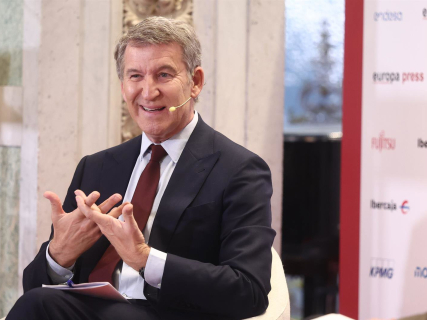

The president of the Popular Party, Alberto Núñez Feijóo, has called for a "clear" and "strong" mandate that will allow him to recover "respect" and "direction" in Spain and face the "national reconstruction that the country needs". "For me, governing has never been a joke," he has said.
"I ask for a clear mandate to make possible the national reconstruction that the country needs. A strong mandate to do everything we have to do and to do it as soon as possible. A mandate to recover the direction, confront the problems and get Spain moving," Feijóo pointed out this Tuesday during his speech at the Europa Press Informative Breakfasts.
The PP leader has acknowledged that he aspires to a "clear" mandate like the one Felipe González, José María Aznar or Mariano Rajoy achieved in their day, with a solid parliamentary group to support him and prevent him from living in a "permanent arrangement", so that he can close agreements and make decisions from the start of the legislature.
He has described that "clear" mandate as one in which there is a "harmony" to do things "well" and "soon". According to what he has emphasized, his goal is not limited to "reaching the Government and making adjustments", but to "return respect to the Rule of Law and to the independence of the institutions".
"End corruption" and "value effort"
Feijóo has detailed his campaign "road map", structured in three major commitments. The first is to guarantee "decency" in public life to "end the scourge of corruption". "Politics is a responsibility, not a privilege, so whoever does not feel this weight should not exercise it," he has stressed.
In this line, he has maintained that, after a tragedy, "responsibilities must be assumed", since, if this is not done, the "devastating" message is sent that "in Spain everything can fail without anyone answering for it". "In a country, not everything can be read from the partisan interest," he has criticized.
His second major commitment is for Spain to start "functioning" again. He has lamented that, in his words, "Sánchez does not know how to lead a nation and Puente does not know how to be minister": "I want to win to govern, I want to govern to make decisions and I want to make decisions to solve problems".
Thirdly, it is proposed to ensure that citizens’ effort "is worth it again," denouncing that "Spaniards have been asked for more than ever and have received less": "More taxes, more difficulties, more bureaucracy, more uncertainty and fewer opportunities," he listed.
"My commitment is clear. That whoever strives can progress, that a person who works can start a family, that a young person can become independent, that whoever undertakes finds a country that does not constantly put obstacles in their way, that whoever creates jobs has a stable framework and that whoever meets their obligations does not feel that they are always last in line," he claimed.
In this context, he reiterated his promise to "review the tax increases of these years," to "lower taxes" and to ensure that "every euro that is asked of citizens translates into better services, better opportunities and a State that fulfills its obligations." He also warned that on November 29, the choice is between "accepting deterioration as something inevitable" or "undertaking national reconstruction".
"Pedro Sánchez has been the mistake"
"Spain does not need more noise, it needs direction; it does not need more personalism, it needs a shared project; it does not need a government worried about surviving, it needs a government willing to serve. That is what is at stake next November 29. We are not facing a simple political alternation, we are facing the most transcendental decision of the last 50 years," he stated.
The PP leader insisted that the country "does not need a Government that only echoes its weariness, but one that guarantees it a better direction." "It is time for rectification," he argued, urging to "turn decay into a democratic decision for change".
"Pedro Sánchez has been the mistake and nations with a survival instinct do not persist in mistakes, they correct them. The dilemma that Spain faces next Sunday the 29th is not simply whether one party replaces another, it is whether we are capable of recognizing that this way of exercising power has reached its limit and of correcting the course before destroying the country completely," he concluded.