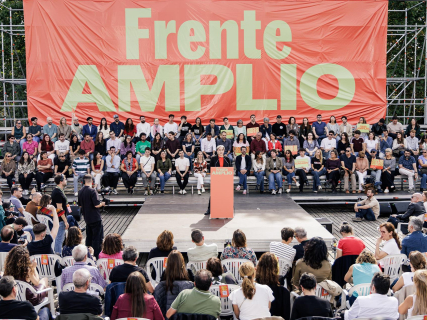

Frente Amplio reaches this Monday the deadline to register the lists for the general elections of 29N with several constituencies still without a leading candidate for Congress, after days marked by internal tensions such as the resignation to run for Teruel, which evidenced the clash between Chunta Aragonesista (CHA) and Izquierda Unida (IU).
At the same time, the already agreed starting positions reflect a profound renewal compared to the Sumar candidacy in 2023, a space that the new coalition considers itself an heir to. For now, Tesh Sidi (Más Madrid), Toni Valero (IU), Verónica Barbero (Movimiento Sumar), Esther Gil de Reboleño (Movimiento Sumar), Júlia Boada, and Viviane Ogou, both linked to the Comuns, are repeating.
Last Friday, October 23, Frente Amplio closed in extremis the first major milestone of the electoral race, by registering the coalitions for 29N. That move certified the break with Podemos, but also the continuity of agreements with territorial partners such as Chunta or Compromís, which has integrated IU, Podemos, and ERC into a unitary list in the Community of Valencia.
The new platform has also allied with the Balearic party Ara Més, under the brand Ara Més-Front Ampli. This Sunday, Podemos reached an agreement with the coalition, similar to the one sealed with ERC in Catalonia, whereby Irene Montero's formation will not run in the islands, but will incorporate representatives of Podemos as independents into the Ara Més candidacy. Thus, the 'purple' coordinator in the Balearic Islands, Lucía Muñoz, will be the 'number three' on the island list.
The pact, announced this Sunday by Muñoz herself on her social networks, comes a week after the prior conversations between both parties failed and left Podemos out of the agreement.
Despite this last incorporation, the coalition promoted by the parties of the minority wing of the Executive faces the last day of the deadline to register the candidacies with heads of lists still to be confirmed in key places like Seville.
Pending constituencies to close
In Andalusia, other fronts remain open where Sumar obtained a seat in 2023, such as Granada, while in Málaga the lawyer and activist of the Gaza support Flotilla Rafael Borrego has already been designated as the head of the list. Everything indicates that Esther Gil de Reboleño will repeat as number one in Cádiz and that the provincial coordinator of IU, Sebastián Pérez Gallardo, is shaping up in Córdoba.
Neither have the candidacies been officially announced in Galicia, where Sumar achieved representation for Pontevedra and A Coruña in 2023, nor in the constituencies of Euskadi, Extremadura, Castilla y León, and several provinces of Castilla-La Mancha.
The registration process has been marked by the decision of Chunta Aragonesista not to run for Congress in Teruel, with the intention of preventing the right from gaining seats and reinforcing the PSOE as the main progressive reference in the province.
This withdrawal provoked strong opposition from IU, which even raised the possibility of presenting its own lists. Ultimately, the formation has accepted that the regionalist party has the final word on the constituencies in which Frente Amplio presents itself, although it maintains pressure on CHA to reconsider its position.
In recent days, it has also been debated whether this resignation should extend to other territories, but the main leaders of Frente Amplio insist that the coalition will be present in most of the country and that cases like that of Teruel will be exceptional, linked to the uniqueness of each territory.
Regarding a possible joint list with the PSOE for Congress, both formations deny negotiations in that regard and emphasize that their agreement is limited to the Senate.
In the Upper Chamber, they share candidacy in more than 40 constituencies, where the new left space usually occupies the second position on the lists. One of the uncertainties still to be resolved is the candidate of Frente Amplio for Madrid to the Senate.
Change of references and notable exits
The preparation of the lists for Congress has resulted in the departure of the co-spokesperson of the Comuns, Aina Vidal, a decision that caused 30% of the national council of the Catalan party to vote against the candidacies for Catalonia. Neither does the other co-spokesperson, Gerardo Pisarello, nor the already former deputies Candela López, party coordinator, and Eloi Badia repeat.
In Barcelona, the number two will be the Minister of Culture, Ernest Urtasun, while the second vice president, Yolanda Díaz, who had already renounced to be a candidate again, will not appear on the lists. The Minister of Health and leader of Más Madrid, Mónica García, who had been strongly mentioned as a possible candidate for the Moncloa of this new project, has also declined to head the candidacy for Congress.
Neither will the deputy of Més per Mallorca Vicençs Vidal repeat, since the head of the list of the coalition Ara Més–Frente Amplio to Congress for the Balearic Islands will be Carme Gomila. In Zaragoza there will also be a change compared to 2023, after Chunta has chosen the LGTBI activist Marina Rodríguez as number one.
For his part, Rafael Cofiño will not continue as a deputy and the new head of the list for Asturias, a territory that this time will be led by IU, will be Juan Ponte.
Likewise, it is expected that Txema Guijarro, Alda Recas, Carlos Martín, and Agustín Santos, who was the 'number two' of Díaz on the Madrid lists in the elections of 23J, will not repeat in leading positions.
In Navarra, the number one will be the councilor Javier Ibáñez; in Cantabria, Carmen Martín is proposed, and in Murcia, the bet falls on the regional coordinator of IU, Penélope Luna. In this community, Sumar obtained a seat in 2023 that corresponded to the Podemos leader Javier Sánchez Serna. In Ciudad Real, IU has positioned the former councilor Juana Caro as a proposal.
Emilio Delgado and Tesh Sidi lead the list for Madrid
The candidacy for Madrid is already closed: Emilio Delgado will occupy the first position, followed by his colleague from Más Madrid Tesh Sidi as number two. The main electoral reference of IU, Toni Valero, will be third; the co-coordinator of Movimiento Sumar, Verónica Barbero, is in fourth place, and the councilor of Más Madrid, Eduardo Fernández Rubiño, in fifth position.
In the case of Compromís, Àgueda Micó, who left the plurinational group Sumar to join the Mixto, and Alberto Ibáñez will repeat on the lists.
Podemos renews its candidates
In the Valencian Community, the leadership for Alicante of the Compromís–Frente Valenciano candidacy will fall to Podemos, with its regional coordinator María Teresa Pérez as head of the list.
Within Podemos, which only runs together with Frente Amplio in the Canary Islands and the Valencian Community, there will also be a broad renewal of names.
Thus, the candidate of the purple party, Irene Montero, will have 'Tito Morano' as number two, followed by the former advisor Dina Bousselham and the former deputy in the Assembly of Madrid Serigne Mbayé.
The historic trans activist and member of the purple Executive, Mar Cambrollé, will head the list for Seville. Meanwhile, Manuel Pravia, spokesperson and delegate of the Stevedores Union in Avilés, will be number one for Asturias.
The general secretary of Podemos, Ione Belarra, does not repeat in the lists because she will run as a candidate in the elections for the Community of Madrid, and neither will former deputies Javier Sánchez Serna and Martina Velarde.