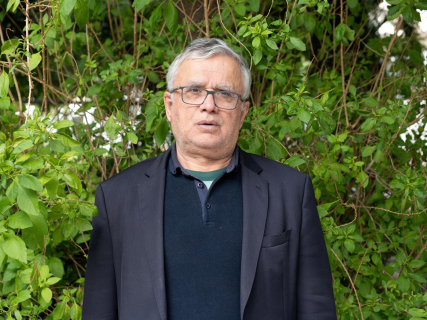

The husband of the 2023 Nobel Peace Prize winner, the Iranian activist Narges Mohammadi, Taghi Rahmani, has expressed his desire that the victory of the Democrats in the midterm elections in the United States (U.S.) be "a beginning" to put an end to the war between the U.S. and Iran.
Rahmani has said this in an interview with Europa Press ahead of the presentation in Barcelona of his wife’s book, titled 'A woman never stops fighting' (Finestres Ensayos), a work written from different Iranian prisons where he has been incarcerated. In the text, he recounts the ill-treatment suffered, in addition to personal episodes, anecdotes, and reflections on the struggle for equality, democracy, and human rights.
"We hope, we wish that the Democrats can put pressure on and that they do everything possible for the war to end. It is a necessary condition for the movement in Iran to be able to rise again", Rahmani has said, who has acknowledged that he does not see it as possible for this scenario to materialize in the short term.
In his view, Iran’s international relations context is extremely complex "because the Iranian regime has bad relations with everyone, both Democrats and Republicans," which, he says, considerably reduces the chances of opening a real path toward peace.
Rahmani has also assessed the position of the Prime Minister, Pedro Sánchez, regarding the war, "because he has condemned it and has distanced himself from it," and he has called on Western countries to shape their policy toward Iran on the basis of the defense and demand for human rights.
Situation of Narges Mohammadi and her family
Mohammadi, 52, was in prison when the Nobel Peace Prize was awarded to her and is now under house arrest, with her passport confiscated, after suffering a heart attack in March. Her husband has explained that her health has improved, but that she still needs to return to prison to "finish the 10 years she has left".
He has explained that he and his twin children, Ali and Kiana, live in exile in Paris and cannot return to Iran because they would be arrested immediately. He has admitted that they are "very worried because if Narges goes back to prison, at a health level it will be very difficult for her and she will be in danger," which is why they are trying by every means to prevent her from being readmitted to prison.
Contact with Mohammadi is sporadic and only by telephone. Rahmani has denounced that a double pressure is exerted on her in prison, limiting communication with her children to the maximum. She has recalled that she went on to spend 5 years in a row without being able to speak with them and that she lost "5 years of her children’s childhood".
In the speech read by her twins during the 2023 Peace Nobel Prize award ceremony, Mohammadi stated that the Iranian regime had reached the lowest point in legitimacy and social support, and that the appearance of any catalyzing factor could trigger a transformation in Iran.
Asked about the possibility that this change could occur in the short term, Rahmani has pointed out that the war has slowed the pace of protests, but has not reduced social unrest: "The population of Iran is dissatisfied with this regime and this has no other remedy than to end in some way."
Repression, executions and social resistance
Rahmani has denounced that, with the war, Iran has become a military-type regime and that repression against citizens who are critical of the Islamic Republic, as well as against prisoners, has intensified: "There is very strong military repression against the population and also with more force against prisoners. The regime has increased the number of executions in Iran practically every day."
She has added that the armed conflict has largely paralyzed the action of Iranian resistance and social movements, and that in practice the country lives under a kind of state of siege, in which any protest can entail "absolutely terrible consequences".
Mohammadi is one of the reference figures of the 'Women, Life and Freedom' movement, which asserts equality in Iran. Rahmani has underlined that, despite the war and repression, Iranian women have not abandoned their struggle: "Women in Iran are lovers of freedom and want to achieve their rights. And this is impossible to stop. It is an absolutely daily movement. Women keep going and they are not going to stop until they get their rights."