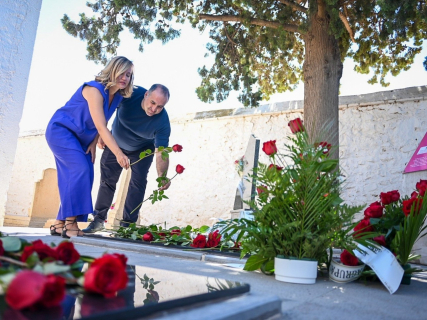

The general secretary of the PSOE Aragón, Pilar Alegría, emphasized this Sunday in Fuendejalón (Zaragoza) the need to protect and disseminate democratic memory to know and remember the history of Spain "without whitewashing it," from truth, justice, and the reparation of the victims, with the aim of preventing the darkest chapters of the past from being repeated.
Alegría participated in the central event of the 'Shaved Memory: Women and Repression in Fuendejalón' days, which this Sunday included a Memory Route from the old prison of the municipality and a tribute in the cemetery in memory of the repressed women and the former mayor of Gallur, María Domínguez Remón, whose remains are in this cemetery.
Teacher, journalist, and writer, María Domínguez was the mayor of Gallur and is recognized as the first democratic mayor of Spain. She was executed on September 7, 1936, next to the walls of the Fuendejalón cemetery, so next September 7 will mark 90 years since her murder.
The socialist leader has particularly highlighted the figure of Domínguez as a woman ahead of her time, who conceived education and knowledge as essential tools to advance in freedom, equality, and social justice, a defense of principles that ultimately cost her life.
Alegría has insisted on the relevance of maintaining this type of democratic memory events to recount the history of Spain "without whitewashing it" and to do so from knowledge, justice, truth, and the essential reparation of the victims.
"WITHOUT WHITEWASHING" and duty to new generations
In this line, she has emphasized that keeping that memory alive is also an obligation towards future generations, in order to prevent "those times of darkness and silence that our country experienced from being repeated."
The leader of PSOE Aragón has also recalled that the tribute has served to recover the memory of the women of Fuendejalón who were shaved and repressed during the Civil War, victims of a form of punishment specifically directed against women.
At the event, Pilar Alegría was accompanied by the mayor of Fuendejalón, Javier Tolosa, and several socialist councilors from the municipality. Also present were, among other officials, the secretary of organization of PSOE Aragón and provincial deputy, Manuela Berges, and the deputy in Congress, Marta Gracia.
Finally, the general secretary of the PSOE Aragón has lamented that the Law of Democratic Memory was the first norm repealed by the Government of Aragón of Jorge Azcón and has demanded that the community have legislation again that ensures truth, justice, reparation, and recognition of the victims.
Alegría has emphasized that democratic memory is not the heritage of any political formation nor of a single ideology, but of the whole citizenship. "It belongs to no one, but fundamentally it is a democratic law of all citizens and it is a democratic duty," she concluded.
The days 'Shaved memory: woman and repression in Fuendejalón', promoted by the City Council and the Association for Democratic Memory of Fuendejalón, began on Saturday with various activities focused on the repression suffered by women during the Civil War and the Franco dictatorship.