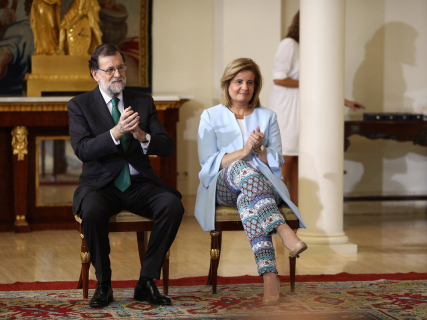

The former Prime Minister Mariano Rajoy paid tribute this Thursday to his former Minister of Labor and Social Security, Fátima Báñez, who died in the railway accident in Urda (Toledo) in which at least 69 people have lost their lives. Rajoy has underlined her dialoguing nature and her inclination toward agreement: "She was never in favor of confrontation or of rows."
"Fátima Báñez is no longer with us. But she leaves us many things," writes Rajoy in an opinion article published in 'El Debate' and reproduced by Europa Press. Báñez was at the head of the Ministry of Labor and Social Economy between 2011 and 2018 in the governments of the PP leader and, for a few months in 2016, she also served in an acting capacity as head of Health, Social Services and Equality.
The former minister, 59, was traveling in one of the seats of the Iryo train that this Wednesday was struck by an AVE from Renfe. Both trains had departed from Madrid bound for Seville, the city to which Báñez was headed to speak at a business event organized by the Andalusian employers' association.
Trajectory in the Government and role in the reforms
In his text, Rajoy recalls Báñez's work in the economic team both in opposition and in the Executive. "There it is more difficult. Before and after the 2011 elections, Fátima, a leading figure in that team, stood by my side. She entered the Government when I did and left at the moment when I ceased to be president," says the former head of the Executive.
Rajoy defines her as a "competent and very capable" leader and highlights her leading role in the labor and pension reform promoted by his Government in 2012. "Along with other decisions that we adopted then, both were decisive in recovering the bankrupt economy that we inherited from the previous Government and avoiding the European bailout," he points out, recalling that those measures triggered two general strikes. "But it was worth it," he adds.
Defender of dialogue with the unions
The former president recounts how, after those protests, it was Báñez who encouraged him to resume contact with the trade union confederations. "I confess that, after what had happened, I had my doubts. But Fátima was right. She was never in favor of confrontation. Nor of rows," Rajoy admits in his article.
According to what he explains, that search for consensus coexisted with the firm defense of one's own positions "when the general interest so demanded it". In his opinion, "that policy of building and at the same time defending what needs to be done is the responsibility of whoever governs and when one does not act with a minimum of sense and only seeks to crush the adversary, it happens that coexistence cracks and the atmosphere becomes unbreathable".
Personal memory and human legacy
Rajoy also highlights the human dimension of the former minister, whom he describes as a "good", "positive" and "conciliatory" person, capable of solving political and also personal problems. "A woman moreover with a great heart. That is why she was respected and loved by almost everyone. She deserves it and she earned it," he affirms.
The former leader recalls that "until yesterday she remained the same" and evokes the usual gatherings they held as part of the same "group of friends" with the aim of "trying to be a little happier". "Today we are sad. But we are going to recover," he assures, dedicating a few words to her husband, Jaime Alonso, and to her children.
Rajoy concludes his farewell with a message of memory and affection: "We will remember Fátima, her sympathy, her contagious joy, her generosity. Because remembering is making those who have left us and whom we never want to forget live forever among us".