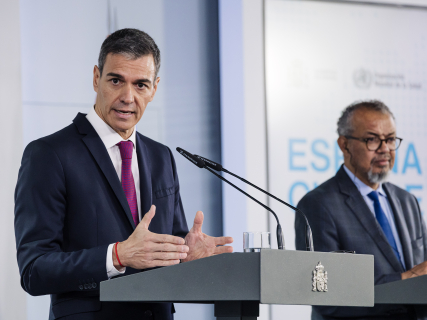

The President of the Government, Pedro Sánchez, has defended this Monday before the World Health Assembly of the World Health Organization (WHO) the need to strengthen international cooperation in health matters and has questioned approaches based on the so-called "national priority", warning that they can generate divided societies.
During his speech at the 79th World Health Assembly, held in Geneva, Sánchez warned that these types of approaches "create first-class and second-class citizens" and argued that this division "ends up weakening countries".
The head of the Executive has placed his speech in defense of multilateralism and universal public healthcare, in an international context marked by the still present lessons of the covid-19 pandemic.
🔴 79ª Asamblea Mundial de la Salud | Sánchez (@sanchezcastejon) comparece: "Frente a quienes hoy invocan prioridades nacionales para excluir, muchos entendimos hace tiempo que la verdadera prioridad de todo país es proteger la salud de sus conciudadanos sin excepciones (...)… pic.twitter.com/UwI1Q6JaRA
— demócrata (@democrata_info) May 18, 2026
"No country saves itself alone"
Sánchez recalled that Spain opted for a "universal and free" public health system four decades ago, a decision that, as he highlighted, has significantly improved indicators such as life expectancy, which now exceeds 84 years.
In his speech, he insisted that the pandemic showed that "no country saves itself alone" and that global health challenges require coordinated responses beyond national borders.
He also stressed that "viruses do not understand borders, flags, or passports", referring to the need to strengthen international mechanisms for prevention and response to health crises.
Warning about the future of global health
The president warned that the main current risk to global health is not scientific, but political and social, pointing out that "lack of awareness" can be more dangerous than lack of knowledge.
In this context, he defended the need to strengthen the Pandemic Treaty agreed upon in 2025 and called on member states to advance its development to improve global preparedness for future health emergencies.
International cooperation
Sánchez has also referred to the management of the recent hantavirus outbreak on the cruise ship MV Hondius, highlighting Spain's collaboration in the evacuation of passengers following a request for help from the WHO.
As he explained, the operation allowed for the evacuation of more than 120 people and early detection of cases, and has been presented as an example of effective international cooperation.
The president concluded by defending that solidarity between countries should not depend on convenience, but on shared responsibility, in what he described as a "contagion of solidarity" in the international arena.