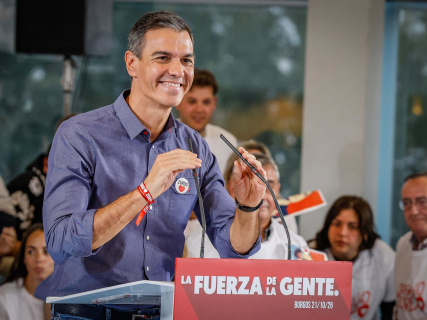

The president of the Government and general secretary of the PSOE, Pedro Sánchez, has warned that an Executive formed by the Partido Popular and Vox would mean a regression of several decades in rights and freedoms, especially on issues such as abortion, euthanasia, and culture. In an interview granted to El País, published this Sunday, October 25, the socialist leader defended his candidacy for the general elections on November 29 and assured that he aims to achieve a broader parliamentary majority to continue governing. "A Government of the PP with Vox is not alternation, it is going back 50 years", Sánchez stated, who also acknowledged that his main mistake during his eight years at the head of the Executive has been not detecting the corruption linked to former minister José Luis Ábalos.
The interview, conducted by Jan Martínez Ahrens and Carlos E. Cué at the PSOE headquarters on Ferraz Street in Madrid, comes in the midst of the electoral pre-campaign and at a time of special political pressure for the president, marked by judicial investigations affecting his environment, the migration crisis in Ceuta, and social discontent due to the rising cost of housing. Sánchez has defended that the early call for elections responds to the need to achieve a parliamentary majority that allows for the approval of new social measures, while he has accused Alberto Núñez Feijóo and Santiago Abascal of representing a project based on cuts and the questioning of consolidated rights.
Sánchez attacks Feijóo and Abascal and hopes to expand the progressive majority
The president of the Government has insisted that the upcoming elections face two different political models and has linked the proposals of PP and Vox with the economic policies of Argentine president, Javier Milei. According to his reasoning, both formations share an agenda of reducing public spending and revising certain social policies, although he has acknowledged that political alternation constitutes a positive element in any democracy. Sánchez believes, however, that the measures announced by the Spanish right could mean a regression in matters such as reproductive rights, dignified death, and cultural freedom.
In this sense, he has criticized Feijóo's proposals on the abortion of minors aged 16 and 17 and the euthanasia law, in addition to questioning the restrictions on film subsidies announced by the Junta de Castilla y León for productions considered ideologized. The socialist leader has linked these initiatives to censorship practices and has defended that his party must mobilize the electorate to avoid these changes. Despite some polls placing the right-wing formations ahead of the progressive bloc, Sánchez has expressed his confidence in obtaining sufficient support to continue another four years in the Moncloa, recalling that in previous elections unfavorable forecasts for the PSOE had also been published.
Housing, the main problem that Sánchez acknowledges after eight years in Moncloa
One of the central issues of the interview with El País has been access to housing, a matter that Sánchez himself has recognized as one of the main sources of inequality in Spain. The president has admitted that there is social discontent related to the distribution of the benefits of economic growth and has defended that the response must combine the construction of protected housing with greater regulation of the rental market. He has also pointed out that the Executive needs a broader parliamentary majority to push forward initiatives that, he claims, have been blocked on several occasions by PP, Vox, and Junts.
Sánchez has claimed the increase in the budget allocated to housing and the approval of the first state law in this area, although he has insisted that increasing construction is not enough if the new homes remain inaccessible for a large part of the population. The president has defended public intervention in the real estate market and has compared this possibility to the regulatory measures previously adopted in the energy sector. In addition, he has questioned why the communities governed by PP and Vox do not apply certain provisions of the state law, while he has presented the experience of Barcelona as an example of rent containment.
The president promises to raise the minimum wage and defends pensions
In economic matters, Sánchez has confirmed his intention to again increase the minimum interprofessional wage (SMI) and has called on business and union organizations to negotiate salary improvements to compensate for the rising cost of living. The president has defended the evolution of employment and the growth of the Spanish economy, although he has acknowledged the difficulties that many households face due to inflation, which he has mainly linked to the international consequences of the war in Iran. He has also claimed the social protection measures promoted by his Government and the need to maintain them while the situation of economic uncertainty continues.
Regarding pensions, the socialist leader has conveyed a message of reassurance to retirees and has defended that the public system is sustainable, relying on the evolution of contributions, employment, and salaries. Sánchez has also highlighted the contribution of regularized foreign workers to Social Security and has defended an orderly immigration policy that facilitates labor integration. In this area, he has rejected speeches against immigration and has recalled Spain's emigrant past to advocate for the need to maintain an open society.
Sánchez acknowledges that his biggest mistake was not detecting Ábalos' corruption
The interview also addressed the judicial cases affecting the PSOE and the president's environment. When asked about the main mistake made during his eight years in Government, Sánchez directly pointed to "Ábalos' corruption", both for not having detected it and for the events that ultimately occurred. The socialist general secretary has defended that his response to the investigations has consisted of asking for forgiveness, collaborating with Justice, and adopting measures within the party.
About the situation of his wife, Begoña Gómez, and his brother, David Sánchez, the president has once again defended his innocence and has maintained that the judicial procedures affecting them are related to their family connection with him. These statements constitute the interpretation of the head of the Executive regarding processes whose judicial situation must be differentiated: his brother has been convicted, while his wife is being prosecuted. Sánchez has also rejected that the PSOE is involved in the actions attributed to Leire Díez, who is being investigated for alleged maneuvers against members of the judiciary and the Prosecutor's Office.
The president has also referred to former president José Luis Rodríguez Zapatero, of whom he has defended his political career and his contribution to advances in social rights. Sánchez has indicated that he maintains his regard for him, although he has left open his participation in the PSOE electoral campaign for the upcoming November 29.
The Ceuta crisis and the relationship with Morocco
Another of the issues addressed in the interview with El País has been the migratory crisis of Ceuta on July 30 and 31, which left 141 dead, according to the figure presented by Sánchez. The president has acknowledged that the intelligence services and the State Security Forces received prior warnings, although he has assured that they did not anticipate the magnitude of what would ultimately occur. At the same time, he has defended the Government's actions and has maintained that a more forceful response at the border could have worsened the human consequences of the crisis.
In relation to Morocco, Sánchez has avoided attributing responsibilities to the neighboring country without conclusive evidence and has defended the need to maintain bilateral cooperation to manage migratory flows. The head of the Executive has reiterated that Ceuta and Melilla are part of Spain and the European border, while he has pointed out that a constructive relationship with Rabat is necessary to address issues of security, immigration, and foreign policy.
Sánchez criticizes the use of artificial intelligence in the electoral campaign
The president has also questioned the role of social networks in political polarization and has attributed part of the growth of far-right discourse to the functioning of digital algorithms. In this context, he has accused the PP of using manipulated content through artificial intelligence and has assured that the PSOE will not resort to fake videos that impersonate the identity of its opponents during the electoral campaign.
With the general elections on November 29 on the horizon, Sánchez has defended his economic and social management and has presented the continuity of the PSOE at the head of the Government as an alternative to the policies proposed by the PP and Vox. The interview also reflects some of the issues that will mark the socialist campaign in the coming weeks: housing, the protection of the welfare state, corruption, and the defense of social rights, matters on which the president will try to focus the electoral debate in the face of opposition criticism.