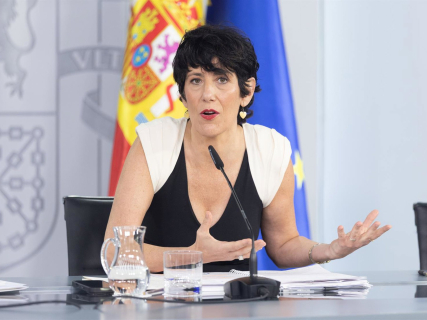
The Government avoids clarifying whether it should authorize a trip by Felipe VI to Morocco and recalls that the Royal House sets its own agenda.

Elma Saiz avoids clarifying whether Moncloa should authorize a trip of Felipe VI to Morocco and emphasizes that the Royal House manages the King's agenda.

2 minutes

fotonoticia 20260824104921 1920

fotonoticia 20260824104921 1920

Add DEMÓCRATA to Google

Ask FREN

Published

Last updated

2 minutes

The Minister of Inclusion, Social Security and Migration and Government spokesperson, Elma Saiz, has emphasized that it is the Royal House that is the "owner" of King Felipe VI's agenda. However, she has avoided specifying whether the Executive has to "authorize" a possible trip of the head of State to Morocco, as claimed by the leader of the PP, Alberto Núñez Feijóo.

"It is not my place to talk about the agenda of the Royal House," Saiz concluded in an interview on 'La hora de La 1', reported by Europa Press, when asked if the King needs the "authorization" of Moncloa to visit Ceuta. The minister insisted that her responsibility is to focus on the "government's agenda," especially in the autonomous city, where, as she emphasized, the Executive "has to be there to respond to this extraordinary situation."

The spokesperson, who has reiterated several times that she has "nothing to say" about the agenda of Zarzuela, has also not clarified whether the Government has suggested to Felipe VI that he travel to the autonomous city. "I also have no knowledge of that, I insist. I think it is important to respond for the actions of the Government, for the presence of ministers (...). And for the leadership, at all times, of the president. On that, I can give good faith," she stated.

Regarding the possibility that some member of the Executive has requested the monarch to make an intercession call with King Mohamed VI regarding the crisis in Ceuta, Saiz has avoided providing details and has referred to future appearances in Congress, where each head of each Ministry "will be able to answer." She has also emphasized that she has no "knowledge" of the existence of "impediments" for a visit of the King to the Alaouite kingdom.

Saiz asks Feijóo to clarify the information he attributes to the King

In this scenario, the minister has urged the president of the PP to "share" with the public if he has "any information" about what King Felipe VI "may have conveyed." "I cannot speak for statements made by a third party in this case," she noted.

In an interview with Europa Press, Feijóo stated that the King "wants to go to Ceuta" because "it is his duty" as head of State in light of the "humanitarian, public health, and public order crisis" that the autonomous city is experiencing, and he called on Pedro Sánchez's Government to "authorize" that trip.

The popular leader recalled that, within his constitutional functions, Felipe VI is "guarantor of the sovereignty and territorial integrity" of Spain. "I am convinced that the King wants to go to Ceuta and he will do so when the Government of Spain authorizes that movement," he added.

Morocco, a "reliable" partner in migration matters

On the other hand, Saiz has reiterated that the Executive considers Morocco a "reliable country" in migration policy and has highlighted its role in the voluntary return of "90% of the people" who accessed Ceuta en masse at the end of July. "It would not have been possible without the cooperation of Morocco, a partner that we consider a neighboring, reliable, and loyal country," he emphasized.

In this regard, he has asked not to fuel "speculations" and has referred again to the appearances of the ministers in Congress "to account for all the details" of the crisis. Likewise, he has emphasized Spain's "commitment to the protection and security of the borders," which he has described as "resounding."

More key points, information and questions with FREN

AI-GENERATED CONTENT

What parliamentary procedures are necessary for the Government to officially authorize an international trip by the head of State?

In the Spanish constitutional framework, official trips abroad by the head of State (the King) are, above all, an act of the Crown that is part of the Government's foreign policy. Therefore, the core of the answer is that there is no specific and mandatory “parliamentary authorization procedure” for each international trip of the King; what exists is a general parliamentary oversight over the Government's actions, which includes the planning and political content of those trips.

Constitutional basis: who decides and who is accountable

The 1978 Constitution establishes several key principles:

  • Head of State and external representation: the King is the head of State and is responsible, among other functions, for “exercising the highest representation of the Spanish State in international relations” (arts. 56 and 63 CE).
  • Countersignature and responsibility: all acts of the King must be countersigned by the Government or, where appropriate, by the competent minister (art. 64 CE). This means that the political decision for the King to make an official trip abroad is legally an act of the Government, which assumes political responsibility.
  • Direction of foreign policy: it is the Government's responsibility to direct domestic and foreign policy (art. 97 CE). The King's trips abroad are part of that foreign policy.

From this combination, it follows that the initiative, planning, and authorization of the head of State's international trips fall under the Government's competence (usually through the Ministry of Foreign Affairs and the Ministry of the Presidency), without the need for prior authorization from the Congress or the Senate.

Absence of a specific parliamentary authorization

There is no specific figure in the Constitution, nor in the Rules of the Congress and the Senate, such as “authorization for the head of State's trip” nor a procedure similar to those used, for example, for:

  • Authorization for international treaties in certain matters (art. 94 CE).
  • Authorization for states of alarm, exception, and siege (art. 116 CE).

The King's trip does not by itself imply the conclusion of a treaty or the adoption of international legal decisions; it is an act of representation and political diplomacy. Therefore, no mandatory parliamentary authorization channel is automatically triggered, unless the trip is linked to decisions that do require parliamentary intervention (for example, signing a treaty that must be authorized or ratified). In that case, what is submitted to the Chambers is not the trip, but the corresponding international legal act.

Political parliamentary oversight: how the Cortes intervene

Although there is no specific “trip authorization” procedure, Parliament can exercise oversight over the Government's actions regarding the head of State's trips. This oversight is part of the general oversight instruments:

  • Oral and written questions to the Government, both in Plenary and in committee, about the timeliness, objectives, agenda, or diplomatic results of a specific trip.
  • Interpellations regarding the Government's foreign action, which may include the planning of the King's official trips within a general line of international policy.
  • Appearances by the Minister of Foreign Affairs or the Minister of the Presidency, on their own initiative or at the request of groups, to report before or after a particularly relevant trip.
  • Requests for information and documentation, asking, for example, for the detailed agenda, visit notes, or internal evaluations.
  • Motions afterwards, urging the Government to guide the head of State's participation in future visits in a certain way or to avoid certain destinations or formats.

In practice, oversight tends to be ex post or accompanying, rather than prior authorization. The Chambers' Boards and Spokespersons' Committees can modulate the presence of the topic on the agenda, but there is no legally essential “green light” for the Government to confirm a trip.

Fit within the political responsibility system

Like any Government act, the head of State's travel policy is integrated into the overall foreign action. If a parliamentary majority considered that policy (including the trips) seriously inadequate, it could bring the conflict to the level of the political responsibility of the Executive, using instruments such as:

  • Intensification of ordinary oversight (questions, appearances, severe motions).
  • At an extreme, a vote of no confidence against the Government for its foreign policy, in which the King's trips would be one more element.

In summary, the Government authorizes the head of State's international trips without the need for a specific parliamentary authorization procedure, but always under the umbrella of countersignature and subject to the general political oversight of the Cortes Generales over foreign policy.

Can you detail what types of questions or interpellations have been used in practice to oversee specific international trips of the King? How is the King's international agenda coordinated in practice with that of the Prime Minister and the Ministry of Foreign Affairs? How does an official trip abroad by the King differ legally from one by the Prime Minister from the perspective of parliamentary oversight?

What are the constitutional powers and functions of King Felipe VI regarding foreign policy and territorial integrity?

The Spanish Constitution assigns the King a set of functions related to foreign policy and, more indirectly, to territorial integrity. These are formally relevant powers but are always exercised under the Government's direction and with the countersignature of its members, which limits their decision-making dimension and places them fundamentally on a representative and institutional guarantee level.

General role of the King in the constitutional system

According to Article 56 of the Constitution, the King is the Head of State, symbol of its unity and permanence, and “arbitrates and moderates the regular functioning of the institutions.” It adds that his acts will always be countersigned by the Government or the Cortes Generales (art. 64), except for very limited exceptions, which implies that political responsibility lies with those who countersign, not with the Monarch. This logic also applies to foreign policy and aspects linked to territorial integrity.

The King's powers in foreign policy

The King's functions in international matters mainly appear in Articles 63 and 62 of the Constitution:

  • International representation of the State (arts. 56.1 and 63.1): the King “holds the highest representation of the Spanish State in international relations.” This means he embodies the external representation of the State at the protocol and symbolic level: state visits, reception of foreign heads of State, speeches abroad, etc.
  • Accreditation of ambassadors and diplomatic representatives (art. 63.1): he is responsible for “accrediting ambassadors and other diplomatic representatives” and receiving the credentials of foreign representatives in Spain. This is a formal power, always exercised at the Government's proposal.
  • Expression of the State's consent in treaties (arts. 63.2 and 63.3): the King expresses, on behalf of Spain, consent to be bound by international treaties, after prior authorization or intervention by the Cortes Generales or the Government depending on the type of treaty. In practice, the Government directs the negotiation content; the King intervenes in the final, solemn, and formal phase, sanctioning the decision adopted by the politically responsible bodies.
  • Promulgation and sanction of laws and treaties (art. 62 a): when treaties require incorporation into the legal system by law, the King sanctions and promulgates those norms. Again, he does not decide the content but gives the final legal form to the will of the Cortes.

In short, in foreign policy the King does not direct foreign action—that function corresponds to the Government (art. 97 CE)—but he is the figure who personifies the State externally and performs the solemn acts that legally translate the decisions of Government and Cortes.

Relation to territorial integrity

The Constitution links territorial integrity more directly with the Armed Forces than with the King, although he holds a central role in relation to them:

  • Article 8.1 establishes that the Armed Forces have the mission to “guarantee the independence and defense of Spain, as well as the territorial integrity and the constitutional order.”
  • Article 62 h) provides that the King has the “supreme command of the Armed Forces.”

This means that the King, as Head of State and supreme commander, is the figure who symbolizes the unity of the Armed Forces and their loyalty to the Constitution, including territorial integrity. However:

  • The effective direction of defense policy and national security lies with the Government (art. 97 CE), and operational decisions are made by the competent civil and military authorities.
  • The King's acts in military matters (appointments of high commands, granting military honors, etc.) also require government countersignature.

In situations of special gravity for territorial integrity (for example, declaration of states of alarm, exception, or siege, art. 116 CE), decision-making authority also corresponds to the Government and the Cortes. The King does not politically resolve territorial conflicts but can play a role of symbolic cohesion and a call to respect the constitutional order within the limits marked by his neutrality and the absence of direct political responsibility.

Summary

In conclusion, King Felipe VI, as Head of State, exercises prominent functions in foreign policy of representation, formalization, and solemnization of decisions adopted by Government and Cortes: highest international representation, accreditation of ambassadors, and expression of the State's consent in treaties. Regarding territorial integrity, his competence is articulated through the supreme command of the Armed Forces and his symbolic role as guarantor of the unity and permanence of the State, without autonomous powers to adopt political or coercive decisions, which rest with democratically responsible bodies.

Could you detail how the countersignature of the King's acts in foreign policy is articulated? What recent examples illustrate Felipe VI's role in the symbolic defense of unity and territorial integrity? How is the King's action coordinated with the Government in official trips and international summits?

What is the political and professional background of Elma Saiz, Minister of Inclusion, Social Security, and Migrations?

Elma Saiz Delgado is a Navarrese politician from the PSOE, born in Pamplona in 1975, specialized in taxation and social policies. Since November 2023, she has been the Minister of Inclusion, Social Security, and Migrations, and since December 2025 she also serves as the Government Spokesperson of Spain, after a long career in Navarrese institutions and the General State Administration.

Academic background and early professional steps

Saiz holds a Law degree and a Master's in Tax Advisory, both from the University of Navarra. Her initial professional career developed in the field of tax advisory and university teaching, areas in which she worked before fully dedicating herself to institutional politics. This legal and tax foundation largely explains her later specialization in economic and social protection areas.

Political career in Navarra

Elma Saiz's entry into active politics occurred around 2003, when she joined the PSN‑PSOE and became part of the Parliament of Navarra. Since then, her career has been closely linked to the Chartered Community, where she has held positions of increasing responsibility.

Between 2008 and 2012, she was Government Delegate in Navarra, a position in which she acted as the main representative of the General State Administration in the community. Subsequently, she assumed responsibilities in the regional government, notably directing the Navarre Institute for Equality and Family, focusing on gender equality and work-life balance policies.

The qualitative leap in her regional career came in the legislature starting in 2019, when she joined the Government led by María Chivite as Minister of Economy and Finance and also Government Spokesperson of Navarra. From this position, she managed regional finances during a period marked by the COVID‑19 pandemic and simultaneously became one of the most visible political voices of the Navarrese Executive.

In the 2023 municipal elections, she was the PSN candidate for Mayor of Pamplona. Although the socialist list came in third, her nomination reflected the organic and public weight she had gained within Navarrese socialism. After those elections, she served as a councilor of the Pamplona City Council before fully joining the central Government.

Minister of Inclusion, Social Security, and Migrations

In November 2023, Pedro Sánchez appointed her to the Council of Ministers as Minister of Inclusion, Social Security, and Migrations. From this portfolio, she has positioned herself at the center of key debates on pensions, migration, and social inclusion.

Official notes from La Moncloa link her with the consolidation of record Social Security affiliation, which the president himself has used as an argument for economic stability. Under her leadership, the ministry has focused on:

  • The implementation of the pension reform and the defense of its sustainability before European institutions.
  • The promotion and evaluation of the Minimum Living Income (IMV) and its inclusion pathways, closely linked to pilot experiences in Navarra and other communities.
  • The reform of the Foreigner Regulation, aimed at simplifying procedures, shortening deadlines, and strengthening regular migration channels, with debates on its effects on asylum seekers.
  • A migration policy linking migration and employment, defense of human rights, and international cooperation, as reflected in her interventions in European forums and agreements with third countries.

In the parliamentary sphere, she has appeared before the Congress and the Senate to explain both migration policy and pension reform, and in 2024 she attended the so-called “Koldo case” commission in the Upper House, where she defended her department's actions during the Navarrese stage and the correction of hiring controls during the pandemic.

Government Spokesperson and political profile

On December 22, 2025, Sánchez also entrusted her with the Government spokespersonship, a responsibility she adds to her ministerial portfolio. Political press describes her as a “very PSOE” leader, disciplined with Moncloa's argumentation, firm and combative in defending the Executive's positions.

Her career combines experience in economic management, social policies, and a long association with the PSN‑PSOE, positioning her as a trusted figure both for the socialist leadership in Navarra and the party's federal leadership. From the spokespersonship, her role focuses on articulating the government discourse in a highly polarized context, while maintaining the substantive agenda of Inclusion, Social Security, and Migrations.

Play

Test your knowledge with FREN!

How much do you know about this topic? Answer the following 3 questions.

Who has emphasized that the Royal House is responsible for the agenda of King Felipe VI?

Question 1 of 3

What percentage of people who massively entered Ceuta returned voluntarily according to Elma Saiz?

Question 2 of 3

Who claims that King Felipe VI wants to travel to Ceuta and asks the Government to authorize this trip?

Question 3 of 3

Hola, soy Fren. ¿Cómo te ayudo?