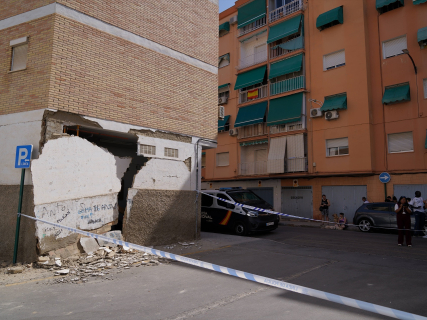
A week after the earthquake that woke up Granada: 621 earthquakes, three injured and 600 evacuated

The series began on Friday, August 14, and reached its first major jolt at 01:04 on Saturday. Seven days later, Granada accumulates two earthquakes of magnitude Mw 4.8, more than 17,000 testimonies sent to the IGN and hundreds of buildings inspected.

7 minutes

terremotos granada dílar

terremotos granada dílar

Add DEMÓCRATA to Google

Ask FREN

Published

Last updated

7 minutes

Most read

At 01:04 in the early morning of last Saturday, Granada woke up suddenly. Windows, lamps, and furniture began to move as a short rumble passed through the homes of the capital and its metropolitan area. Many neighbors jumped out of bed and went out into the street still in their pajamas. Others stayed inside, looking at the cracks, the fallen objects, or the phone, trying to figure out what had just happened.

It had been an earthquake. The movement was initially reported with a magnitude close to 5, but the National Geographic Institute later reviewed it and placed it at Mw 4.8. Sits epicenter was located in the vicinity of Alhendín, very close to one of the most populated areas of the province and at a particularly shallow depth.

This Saturday, August 22, marks a week since that early morning. What seemed like it could turn into a main earthquake followed by smaller aftershocks ended up transforming into a much more complex seismic series: at least 621 localized movements, a second earthquake of Mw 4.8 four days later, three minor injuries, 14 medical assists, and around 600 people evacuated from their homes.

Activity has decreased in the last few hours, but it has not disappeared. Granada remains alert to any vibration, any noise, and any new update from the IGN.

The earth had already warned on Friday

The seismic series did not exactly begin during the early morning of Saturday. The first relevant warning occurred on Friday, August 14, at 18:43, peninsular time, when an earthquake of magnitude 3.7 was felt in various points of the metropolitan area.

About six hours later, the big shock arrived. At 23:04 UTC on Friday, already 01:04 on Saturday in Spain, the first earthquake of Mw 4.8 was recorded.

The tremor was felt in more than 500 localities, mainly in central and eastern Andalusia, but also in parts of Murcia, Castilla-La Mancha, and, more weakly, the Community of Madrid. It reached a maximum intensity of V-VI on the European macroseismic scale within different municipalities in Granada.

112 received hundreds of calls about cracks, landslides, fallen objects, and questions from citizens who did not know how to act. There were no injuries during that first major earthquake, but there were damages to buildings, facades, cornices, and vehicles.

The Alhambra was inspected and showed no structural damage. The technicians located minor defects in certain ornamental elements, but the monument was able to continue its activity after the checks.

By Monday morning, the IGN had already recorded 348 movements. Granada was trying to return to normal when the earth changed the course of the week again.

The Tuesday that Granada went back out to the streets

The second major earthquake struck on Tuesday, August 18 at 10:37. It also reached Mw 4.8 and occurred at a very shallow depth, this time with the epicenter around Gójar.

The tremor found the city awake, with shops open, workers at their posts, tourists in the Alhambra, and families walking through the streets. The municipal buildings were evacuated, the Nevada and Serrallo shopping centers temporarily suspended their activities, and the Granada Metro reduced speed as a precaution.

The Alhambra evacuated part of the site again while new inspections were carried out. The Cathedral, museums, churches, sports centers, and other public buildings were also closed preventively.

The earthquake at 10:37 did not come alone. Fifteen minutes later, a movement of magnitude 3.9 occurred. At 11:34 another of 4.2 struck, and at 12:39 one of 4.0 was recorded. The succession of tremors kept thousands of people in squares, parks, and open spaces for hours.

The [map of the earthquakes of Granada prepared by Demócrata shows how the epicenters have concentrated around Alhendín, Gójar, La Zubia, Armilla, Ogíjares, Churriana de la Vega, Otura, and Las Gabias.

At least 621 earthquakes and 42 felt

The latest consolidated report from the Geographical Institute, updated on August 19 at 11:00 UTC, counts 621 events since the beginning of the series.

The vast majority have had a magnitude of less than 2 and could only be detected by instruments. Ten movements reached or exceeded magnitude 3, and 42 were felt by the population.

The IGN has received more than 17,000 questionnaires from citizens explaining where they were, how they felt the earthquake, and what effects they observed. These forms allow for the reconstruction of the intensity of the tremors in each locality and to complete the data obtained by the sensors.

The two earthquakes of Mw 4.8 presented a maximum acceleration close to 0.24 g at the Armilla station, located about three kilometers from the epicentral area. The shallow depth explains that, despite being a moderate magnitude, both movements were felt so clearly.

The researcher from the Andalusian Institute of Geophysics, Mercedes Feriche, raised the number of earthquakes of magnitude 4 or higher recorded during the episode to five, a figure similar to that reached during the series of 2021 in the surroundings of Atarfe and Santa Fe.

Three injured, 14 assists, and one minor transferred to the hospital

The series has not caused fatalities or serious injuries. The health report from Tuesday includes, however, 14 assists: six for anxiety crises, five for dizziness, and three for minor traumas.

Among the injured was a 13-year-old girl hit by the fall of a brick, who had to be transferred to the hospital. The other two suffered minor head traumas.

The fear was one of the most widespread consequences. Numerous neighbors decided to spend the night outside their homes, sleep in vehicles, or temporarily move to the coast. The Official College of Psychology of Eastern Andalusia provided assistance for people affected by anxiety caused by the earthquakes.

Experts remind that, during a shake, rushing out to the street can increase the risk. A large part of the recorded damages has consisted precisely of the fall of cornices, glass, cladding, and facade elements onto sidewalks and vehicles.

Six hundred people out of their homes

The most significant consequences were concentrated in Las Gabias. Technicians detected damage to pillars located on the facade line of six blocks, which forced the preventive evacuation of 371 homes where around 600 people reside.

The reinforcement work on the pillars concluded on Thursday afternoon, but the City Council maintained the evacuation while structural calculation specialists checked the intervention. Neighbors have controlled access slots over the weekend to collect medications, clothing, and other necessary items, but the definitive return depends on a technical authorization.

The inspection of 580 buildings in different municipalities of Granada detected only 14 with damages considered relevant, according to the [report released after the reviews](https://www.granadadigital.es/terremotos-granada-inmuebles-revisados/). The authorities have ruled out demolitions for now and maintain that most of the damages do not affect the main structure of the buildings.

The communications to the insurers allow measuring another dimension of the episode. Only Santalucía had processed up to Thursday 1,473 notices related to cracks, damages, and falling objects. This figure corresponds only to the clients of that company and does not represent the total damages in the province.

Earthquakes are considered an extraordinary risk. The compensations that meet the requirements correspond to the Insurance Compensation Consortium, as long as the goods were insured at the time of the incident.

Activity slows down, but has not ended

The early morning of Thursday left about twenty earthquakes. The most important reached a magnitude of 3.4 and had its epicenter in Dílar. During the early morning of Friday, seven movements were located, of which only two were felt: one of 2.2 in Armilla and another of 2.4 in Gójar.

The reduction in magnitude and the number of perceptible movements is a favorable sign, but does not allow declaring the series finished. Researchers do not know if the activity will continue for days, weeks, or months.

The comparison with 2021 forces maintaining caution. That series accumulated more than 3,000 shallow earthquakes between December 2020 and August 2021, six of them with magnitudes between 4 and 5.

What is happening now is located about ten kilometers further southeast. The episode unfolds between different active fault systems of the Granada basin, including those of Dílar, Granada, Santa Fe, and Belicena-Alhendín.

Could there be a larger earthquake?

Seismology cannot predict the day, the hour, or the magnitude of the next earthquake. It also cannot guarantee that another stronger movement will not occur.

The available data indicates, however, that a higher magnitude earthquake is possible but unlikely.

The accumulation of hundreds of small earthquakes does not necessarily mean that a larger one is being prepared. It may respond to the readjustment of a fault after a main movement or to the successive activation of several small nearby faults.

Democrat has already explained what allows seismology to anticipate and what cannot be predicted. Specialists can analyze probabilities, faults, depths, and patterns, but cannot issue a precise prediction equivalent to a weather forecast.

One week later, Granada returns to normal with an ear to the ground

The city has reopened its monuments, shops, health centers, and public buildings. The streets have regained their usual movement and the intensity of the aftershocks has decreased.

But normality is not yet complete. Hundreds of residents of Las Gabias are waiting to return to their homes. Technicians continue inspecting buildings. Insurers and the Consortium are processing the damages. And every small creak still provokes for a few seconds the same question: has it trembled again?

Granada lives on one of the most seismically active areas of the Peninsula and has historically known earthquakes. The exceptional thing about this week has not only been the number of movements, but the occurrence of two earthquakes of Mw 4.8 in four days, their shallow depth, and their proximity to a large urban area.

Seven days after that early morning, science cannot say when the series will end. It can affirm that the activity has lost intensity, that serious damages have been limited, and that the possibility of a larger earthquake exists, but it is reduced.

More key points, information and questions with FREN

AI-GENERATED CONTENT

What are the legal requirements for the Insurance Compensation Consortium to indemnify damages caused by earthquakes in Spain?

For the Insurance Compensation Consortium to indemnify damages caused by earthquakes in Spain, it is not enough that the natural phenomenon occurs: a series of legal requirements regarding insurance and coverage must be met, as defined in the Legal Statute of the Consortium (Royal Legislative Decree 7/2004, of October 29) and, above all, in the Regulation of the extraordinary risks insurance approved by Royal Decree 300/2004, of February 20, amended, among others, by Royal Decrees 1265/2006 and 1386/2011 and by Order ECC/2845/2015.

1. What is considered “earthquake” and “extraordinary risk”

Article 2 of the 2004 Regulation defines earthquake as a “sudden shaking of the ground that propagates in all directions, produced by a movement of the earth's crust or a deeper point.” The earthquake is included within the concept of “extraordinary risks”, along with other natural phenomena (tsunami, extraordinary flooding, volcanic eruption, atypical cyclonic storm, fall of celestial bodies and aerolites) and certain political or social events (terrorism, rebellion, riot, popular tumult, etc.).

2. Basic insurance requirements

For the Consortium to respond, the earthquake claim must affect a previously insured risk through an ordinary policy that includes the surcharge in its favor:

  • There must be a valid insurance policy in the branches where the surcharge is mandatory (property damage: fire, multi-risk home, commercial or industrial, automobiles, etc.; and personal insurance where applicable, according to the extensions introduced by Law 44/2002 and Law 12/2006).
  • The policyholder must have paid the mandatory extraordinary risks surcharge to the Consortium, which is channeled through the insurance premium itself. The Resolutions of the Directorate General of Insurance (for example, the one of March 28, 2018, modified by that of December 30, 2025) set these surcharges and the coverage clause that must be inserted in the policy.
  • The territorial scope: risks located in Spain (art. 1 of the Regulation) are considered those affecting vehicles with Spanish license plates, real estate in national territory, movable property in those properties and, in personal insurance, when the insured or the policyholder has habitual residence or registered office in Spain. For personal injuries, the Consortium can also cover extraordinary events occurring abroad if the insured habitually resides in Spain.

Certain policies are excluded, such as combined agricultural insurance and other specific coverages that the extraordinary risks regulation refers to their own regimes.

3. Material damages, loss of profits, and personal injuries
  • Material damages: direct damages to insured goods caused by the earthquake are indemnified, with the limits and deductibles established by the Regulation and Order ECC/2845/2015 (which regulates applicable deductibles). Generally, indirect damages, damages to goods not insurable under the regulation, or expressly excluded goods are not covered.
  • Loss of profits: the Regulation, after its amendment by Royal Decree 1265/2006, provides that the Consortium covers loss of profits when:
    • An ordinary policy covers that loss of profits against “normal” risks (fire, explosion, atmospheric phenomena, etc.).
    • There is a direct material damage to insured goods of the insured as a consequence of the earthquake.
    Loss of profits derived from damages suffered by third-party goods or by suppliers/customers are not covered.
  • Personal injuries: personal injuries (injuries or death) are covered when included in personal insurance policies subject to the surcharge regime in favor of the Consortium and when it is an extraordinary event under the required terms. In the case of personal injuries, as noted, coverage may exist even if the earthquake occurs outside Spain, provided the insured habitually resides in Spanish territory.
4. Main exclusions

Among the usual exclusions are: damages caused by construction defects or lack of maintenance of the property; damages to goods not listed in the policy; claims occurring before the policy takes effect or after its termination; or when the surcharge to the Consortium has not been effectively paid. Certain goods and activities that the Regulation refers to specific regimes are also excluded.

5. Basic claims procedure

The extraordinary risks Regulation and the resolutions of the Directorate General of Insurance provide that claims management is carried out by the Consortium itself. In practice, after an earthquake:

  • The insured reports the claim (usually to their insurance company or directly to the Consortium, as provided by the extraordinary risks coverage clause of their policy).
  • They must provide the policy and receipts proving payment of the surcharge to the Consortium, as well as a list of damaged goods and, if applicable, economic documentation to justify loss of profits.
  • The Consortium appoints experts to assess the damages and processes the indemnity according to the limits, conditions, and deductibles established in the Regulation and in the resolutions on surcharges and coverage clauses.

In summary, the key for the Consortium to indemnify earthquake damages in Spain is not only the intensity of the phenomenon but that there is an adequate ordinary insurance with up-to-date extraordinary risks surcharge, that the risk is correctly located in Spain (or the insured resides in Spain in the case of personal injuries), and that the damage fits materially and temporally within the legal regime of extraordinary risks.

What competencies do municipalities and autonomous communities have in seismic emergency management according to current legislation?

In Spain, competencies in seismic emergencies are divided into three levels: State, autonomous communities, and local entities. The basic legislation (mainly the Law 17/2015, of July 9, on the National Civil Protection System, and the Basic Civil Protection Standard approved by Royal Decree 524/2023) establishes a “minimum national model”; on this basis, autonomous communities assume ordinary civil protection competence and municipalities act as the first line of response within their municipal area. Details are completed with autonomous legislation and civil protection plans, including the State Civil Protection Plan against Seismic Risk (Resolution of March 29, 2010, BOE-A-2010-5661).

Basic regulatory framework

  • Law 17/2015, on the National Civil Protection System (BOE-A-2015-7730): defines the National Civil Protection System, the distribution of competencies, and types of plans (state, autonomous, local, and self-protection).
  • Royal Decree 524/2023, Basic Civil Protection Standard (BOE-A-2023-14679): specifies the structure of territorial and special plans (including seismic ones) and how they are integrated by levels (State–Autonomous Communities–local entities).
  • Law 7/1985, Regulating the Bases of the Local Regime (BOE-A-1985-5392): recognizes civil protection and emergency safety as matters of local interest, forming the basis of municipal intervention.

Competencies of the autonomous communities

The statutes of autonomy and Law 17/2015 assign autonomous communities the ordinary competence in civil protection and emergencies, including seismic risks. Generally, they are responsible for:

  • Territorial and special planning: approving the territorial civil protection plans and the special plans against seismic risk required by the basic regulation. These plans:
    • Define seismic hazard zones, damage scenarios, and emergency levels.
    • Set the autonomous command and coordination organization.
    • Integrate municipal seismic action plans as lower-level plans (article related to territorial and special plans of the Basic Standard, RD 524/2023).
  • Direction and coordination of the emergency in their territory unless conditions of “national interest emergency” occur (art. 29 of Law 17/2015, interpreted by STC 58/2017, BOE-A-2017-6854).
  • Activate territorial and special plans in the event of earthquakes, declare emergency phases or situations, and coordinate autonomous services (autonomous civil protection, health services, autonomous firefighters when existing, etc.).
  • Arrange and coordinate state aid (for example, Military Emergency Unit and other resources of the General State Administration) when the earthquake magnitude exceeds autonomous capacities or when the State declares a national interest emergency.
  • Standardization and support to municipalities: set common criteria for municipal plans, train participants, and ensure integration of local plans into the autonomous and state scheme (PLEGEM) provided in the Basic Standard.
  • Information and alert to the population at the regional level, in coordination with the State and municipalities, using alert systems and the National Civil Protection Information Network created by Law 17/2015.

Competencies of the municipalities

Based on Law 7/1985 and Law 17/2015, municipalities are the first operational instance in a seismic emergency within their municipal area. Generally, they are responsible for:

  • Local planning:
    • Develop and approve the municipal territorial or emergency plan and, if applicable, the municipal action plans against seismic risk, following the structure set by the autonomous community and the Basic Standard (territorial plans as “higher instruments” integrating local plans, RD 524/2023).
    • Integrate self-protection plans of centers and activities in the municipality that generate risk (industry, large facilities, etc.).
  • Activation of the municipal plan in the event of an earthquake affecting the municipality: mobilize local resources (local police, municipal firefighters, public works and maintenance services, municipal civil protection and volunteers).
  • Immediate emergency management:
    • Apply measures of evacuation, confinement, rescue, and basic assistance to the population.
    • Set up shelters, meeting points, and emergency social aid devices.
    • Assess initial damages to municipal infrastructures and buildings.
  • Proximity information to the population: disseminate warnings, self-protection recommendations, and orders from competent authorities using municipal means (loudspeakers, website, local networks, police).
  • Communication and collaboration with the autonomous community and the State:
    • Notify the situation, damages, and needs to the autonomous emergency coordination center.
    • Follow directives from the autonomous command (or state, if the emergency is declared of national interest) when management exceeds the strictly local level.
  • Restoration of normality in the municipal scope (repair of local services, cleaning, protection of damaged buildings, support for reconstruction), in coordination with state and autonomous aid programs provided in Law 17/2015.

In summary, in seismic emergencies, municipalities plan and execute the first response in their municipality, while autonomous communities design comprehensive seismic risk planning in their territory, coordinate the emergency at the regional scale, and, together with the State, mobilize major resources when the earthquake has supra-municipal or national interest effects.

How many similar seismic episodes have been recorded in Granada in the last decade and how were they managed?

With the available information, two major “collective” seismic episodes comparable in the Granada area in the last decade can be identified —the Vega de Granada swarm of 2020‑2021 and the August 2026 series in Alhendín‑Gójar— in addition to other relevant but isolated earthquakes. Both episodes have been managed with a combination of emergency plan activation, inter-administrative coordination, technical damage assessment, and self-protection campaigns.

Relevant seismic episodes

1. Atarfe–Santa Fe swarm (2020‑2021)

The synthesis work by Demócrata reports that between December 2020 and August 2021 the Vega de Granada experienced a major seismic crisis around Atarfe and Santa Fe:

  • The National Geographic Institute (IGN) counted more than 3,000 earthquakes.
  • According to data cited by Demócrata, the episode included 2,804 events of magnitude <2, 239 between 2 and 3, 30 between 3 and 4, and six of magnitude ≥4.
  • Several shakes reached magnitude 4.1–4.5, with intensities V–V‑VI and very widespread perception by the population.

This swarm is the immediate reference cited in recent coverage of the 2026 earthquakes: articles about aftershocks and geological context explicitly recall “the 2021 swarm” and speak of “thousands of movements” in the Vega (Demócrata).

2. Alhendín–Gójar seismic series (August 2026)

In August 2026, a new very energetic seismic series was triggered:

  • A first main earthquake, revised to magnitude 5.0, with epicenter northeast of Alhendín, very shallow and maximum intensity V‑VI, generated more than 200 calls to 112 and numerous minor material damages (Demócrata).
  • Subsequently, at least two earthquakes of magnitude 4.8 (Alhendín and Gójar) were recorded, cataloged as the largest shallow earthquakes in Granada since 1984 (Demócrata).
  • By August 19, the IGN had detected 621 seismic movements, ten with magnitude ≥3 and 42 felt by the population (Demócrata).

Demócrata's coverage and notes from the Junta de Andalucía agree that this series is different from the 2021 swarm (more concentrated on a fault and led by a main earthquake), but similar in social impact: nights of fear, hundreds of calls to 112, and massive building inspections.

3. Other significant earthquakes in the decade

Besides the two major episodes, recent documentation records:

  • Several isolated earthquakes in the Vega (for example, a magnitude 3.6 earthquake in Armilla in July 2026, managed with nearly fifty calls to 112 and dissemination of self-protection recommendations; official note).
  • The deep Nigüelas earthquake (2010), magnitude 6.2 and about 623 km deep, which, although outside the strict decade, is cited as the largest recent by magnitude but with reduced surface effects (Demócrata).

Regarding 2010‑2011 in the Vega itself, consulted sources do not detail a swarm comparable to 2020‑2021; therefore, the count of “similar” and well-documented seismic episodes in the last decade is basically two major crises: 2020‑2021 and 2026.

How these episodes were managed

Plan activation and institutional coordination
  • In 2026, the Junta activated the Seismic Risk Emergency Plan in Andalusia at operational situation 1 (emergency phase) for the province of Granada, reinforcing monitoring, resource coordination, and building assessment (Demócrata and official note).
  • The Advisory Committee of the seismic plan meets continuously, with representatives from state, autonomous, provincial, and local administrations, 112, health services, security forces, and scientific institutes (IGN, Andalusian Institute of Geophysics, IGME, CSIC).
  • The Andalusian Emergency Agency sets up an Advanced Command Post in especially affected municipalities, such as Las Gabias.
Technical damage assessment and specific devices
  • The Voluntary Architects Group in Emergencies (GAVE) is mobilized to inspect homes and public buildings; by August 2026, 447 homes had been evaluated, using a “traffic light” system (green, yellow, red) and no buildings in black category (demolition) (Junta).
  • Preventive evacuation of apartment blocks with significant cracks is decreed (case of six blocks in Las Gabias) and alternative accommodations are provided.
  • In the health sector, the Andalusian Health Service temporarily suspends non-essential activity in provincial centers for safety and, after inspections, restores normal activity (suspension and restoration).
Communication, self-protection, and population support
  • 112 coordinates hundreds of calls and disseminates self-protection guides against earthquakes, developed after the Vega de Granada seismic series, for adults and minors (2024 agreement).
  • Emphasis is placed on not spreading hoaxes, following only official sources, avoiding approaching damaged facades, and knowing what to do during and after an earthquake (messages from Minister Antonio Sanz in the note of 08/18/2026).
  • A free psychological support phone (900 102 513) is activated for people emotionally affected by the seismic series.
  • Municipalities (Granada, Las Gabias, Cúllar Vega, etc.) handle building inspections, marking risk zones, and municipal assistance, complementing the autonomous emergency management (Demócrata).

In summary, in the last decade Granada has experienced two major documented seismic crises (2020‑2021 and 2026) managed through emergency plan activation, intensive damage assessment, health reinforcement, and a strategy strongly focused on self-protection and transparent communication with the public.

Play

Test your knowledge with FREN!

How much do you know about this topic? Answer the following 3 questions.

What was the revised magnitude of the first major earthquake that shook Granada?

Question 1 of 3

Approximately how many people were evacuated from their homes in Las Gabias?

Question 2 of 3

What type of damage was mostly detected in buildings as a result of the earthquakes?

Question 3 of 3

Hola, soy Fren. ¿Cómo te ayudo?