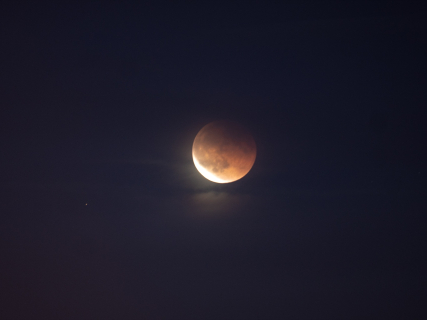

The lunar eclipse on Friday, August 28 will be visible from all of Spain, although it will not be observed in the same way in all territories. While the start of the partial phase and the maximum will coincide within each time zone, the time of the Moon's setting will change depending on the city.
Featured story
Solar and lunar eclipse: what differences are there and how each one is observed
4 minutes
This difference will be decisive during the final stretch. In Barcelona, Valencia, Madrid, or Bilbao, the satellite will disappear before the partial phase ends. In contrast, in Seville, Málaga, A Coruña, Badajoz, Ceuta, and the Canary Islands, it can be followed until its conclusion, as long as the clouds and the horizon allow it.
The National Geographic Institute places the magnitude of the phenomenon at 0.93. It will be a deep partial eclipse: the Earth's shadow will cover a large part of the lunar disk, although a total phase will not occur.
What time does the lunar eclipse of August 28 start
On the Peninsula, Balearic Islands, Ceuta, and Melilla, the main moments of the eclipse will be as follows:
- 03:23 hours: the penumbral phase begins, still difficult to distinguish with the naked eye.
- 04:33 hours: the partial phase begins and the Earth's shadow starts to clearly cover the Moon.
- 06:12 hours: the maximum of the eclipse occurs.
- 07:51 hours: the partial phase ends, although it will not be observable from all cities because the Moon will have already set in some of them.
- 09:01 hours: the penumbral phase ends, when the satellite will already be below the horizon in Spain.
In the Canary Islands, one hour must be subtracted: the partial phase will begin at 03:33, reach its maximum at 05:12, and conclude at 06:51 hours.
Time of the lunar eclipse by cities
As mentioned before, the lunar eclipse will start at 4:33 hours and reach its maximum splendor at 6:12 hours in all cities of Spain, except in the Canary Islands. However, the setting of the Moon will have different times depending on the city from which it is observed. To prepare the following table, DEMÓCRATA has used the astronomical calculations from Time and Date.
| City | Moonset1 |
| Madrid | 7:46 hours |
| Barcelona | 7:21 hours |
| Valencia | 7:33 hours |
| Sevilla | 7:59 hours |
| Zaragoza | 7:33 hours |
| Málaga | 7:53 hours |
| Murcia | 7:38 hours |
| Palma de Mallorca | 7:21 hours |
| Bilbao | 7:40 hours |
| Alicante | 7:35 hours |
| Córdoba | 7:54 hours |
| Valladolid | 7:49 hours |
| Vigo | 8:05 hours |
| Gijón | 7:51 hours |
| Granada | 7:49 hours |
| Oviedo | 7:52 hours |
| Santander | 7:43 hours |
| Salamanca | 7:54 hours |
| Badajoz | 8:02 hours |
| A Coruña | 8:02 hours |
| San Sebastián | 7:36 hours |
| Ceuta | 7:58 hours |
| Melilla | 7:49 hours |
| Las Palmas de Gran Canaria2 | 7:47 hours |
| Santa Cruz de Tenerife2 | 7:50 hours |
1The lunar setting may vary slightly depending on the specific observation point, altitude, and the presence of buildings, mountains, or other obstacles on the horizon.
2The hours in the Canary Islands are expressed in local time of the archipelago. In the rest of the locations, the peninsular time is used.
In which cities the eclipse can be seen until the end
The partial phase will end at 07:51 hours on the Peninsula and at 06:51 hours in the Canary Islands. The locations where the Moon sets before that moment will lose the last minutes of the phenomenon.
In Barcelona and Palma, the setting will occur approximately at 07:21, about half an hour before the end. In Valencia and Zaragoza, the satellite will disappear around 07:33, while in Madrid it will remain visible until approximately 07:46.
In Valladolid, Granada, and Melilla, the margin will be even tighter: the Moon will hide around 07:49, just two minutes before the partial phase ends.
On the contrary, Sevilla, Córdoba, Málaga, Salamanca, Badajoz, A Coruña, Vigo, and Ceuta will be able to see the end of the eclipse before the lunar setting, although in some cities the margin will be just a few minutes.
Gijón and Oviedo will be practically at the limit. The effective visibility will especially depend on having a completely clear western horizon.
The Canary Islands will have better temporal conditions: both in Las Palmas de Gran Canaria and in Santa Cruz de Tenerife, the partial phase will end almost an hour before the Moon sets.