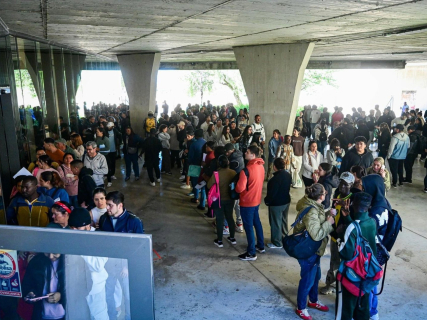
Only 37.6% of Spaniards support the extraordinary regularization of immigrants, compared to 33% who reject it and 21.5% who maintain an intermediate position. This is according to a survey conducted by 40dB and published this Monday by Cadena SER and El País, which reflects a clear division in public opinion.
The poll shows that there is no clear majority either for or against the measure, in a context where the debate on immigration remains polarized. The distribution of responses shows a fragmented society, with a relevant percentage of undecided or nuanced positions.
This scenario contrasts with previous experiences in Spain, where similar regularization processes have already been carried out. The current measure is not the first: during the Government of Felipe González, 174,011 people were regularized in different processes between 1986 and 1996; with José María Aznar, there were 503,327 between 2000 and 2001; and with José Luis Rodríguez Zapatero, 576,506 in 2005.

No callback in previous experiences
Diverse studies agree that the 2005 regularization did not cause a pull effect. An analysis published in 2025 in Journal of Labor Economics, in which Esade participated, concludes that there was no significant increase in immigration after the measure, as flows continued to depend mainly on economic factors.
Along the same lines, the Social Observatory of the "la Caixa" Foundation pointed out in 2021 that the process did not translate into an increase in the arrival of immigrants. For its analysis, it compared countries affected by regularization with others that were not and detected no relevant differences in migratory flows or in the volume of the immigrant population.
Also Professor Joan Monràs, from IESE and Pompeu Fabra University, has pointed out that no increase was observed either in the total number of immigrants or in those from the same countries of origin as those who benefited from the measure.
More income without relevant increase in spending
The studies also agree that the regularization of immigrants increased public revenue without generating a significant increase in spending. According to Esade, each regularized immigrant contributed around 4,000 euros annually in Social Security contributions, in addition to other tax revenues such as personal income tax.
The Social Observatory of the ”la Caixa” Foundation estimates an increase of 4,189 euros per regularized person in income tax revenue. In some provinces with a high immigrant presence, revenue in this area grew by 50% in 2005 and 100% in 2006.
For his part, Monràs points out that payroll withholdings increased by more than 4,000 euros per immigrant per year, without any evidence of an increase in public spending associated with the measure.