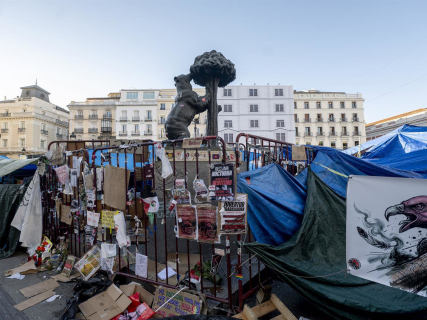
The Sol encampment comes to an end: most of its committees leave the square to prepare for the strike on November 11

Seven of the ten commissions leave Puerta del Sol to concentrate on the general strike of November 11 and move the mobilization to the neighborhoods. The protest over housing, started on September 26, has remained 35 days in the Madrid square

fotonoticia 20261023130522 1920

fotonoticia 20261023130522 1920

Add DEMÓCRATA to Google

Ask FREN

Published

Last updated

2 minutes

Most read

Elecciones 29N · Encuestas

La media de las encuestas

Media a 27 de octubre de 2026 · 15 institutos

  • PP31,0 %
  • PSOE27,3 %
  • Vox18,9 %
  • Frente Amplio6,3 %
  • Podemos2,9 %
  • ERC2,3 %
010203040ene 2024jul 2024ene 2025jul 2025ene 2026jul 2026

Media del último estudio de cada instituto en 30 días y su evolución semanal desde el 23J. Partidos con al menos un 2 %.

Todas las encuestas

Elecciones generales del 29 de noviembre · Demócrata

The Puerta del Sol camp in Madrid is heading toward its end after 35 days of mobilization, a duration that has even surpassed that of the historic 15M camp in 2011. Seven of the ten committees that organized the protest have decided to leave the square to concentrate their efforts on the general strike next November 11, according to what Cadena SER reported this Saturday.

The decision, communicated by the participants themselves, means the withdrawal of most of the organizational structure of a mobilization that began last September 26 to demand measures against the housing crisis and that, for more than a month, has transformed one of Madrid's main public spaces.

In their statement, the seven committees explain that they are leaving the camp to "transmute into a social and working-class movement", with an eye on the upcoming strike call. The intention is to move the activity to the neighborhoods and give continuity to the demands beyond the physical presence in Sol.

The majority withdrawal does not, however, imply the immediate dismantling of all the installations. Three committees have not joined the announcement and some participants, together with an association of homeless people, still expect to remain in the square.

A camp that has lasted longer than that of the 15M

The protest began on the night of September 26, after a demonstration against evictions called under the slogan "Not one more Maricarmen". Its origin lay in the eviction of Maricarmen Abascal, an 87-year-old woman who had to leave the home where she had lived for decades and who died weeks later.

What initially began as a gathering against that eviction ended up becoming a broader protest movement against rental prices, real estate speculation, and the difficulties of accessing housing.

During the following weeks, Puerta del Sol came to host more than a thousand tents, in addition to organizational spaces, work committees, assemblies, and food and care services for the participants.

The mobilization reached a symbolic milestone last weekend by surpassing the 28 days that the main 15M camp lasted, set up in the same place between May and June 2011.

Fifteen years later, Sol once again became the scene of a far-reaching social protest, although with differences compared to the indignados movement. While 15M was born out of a widespread rejection of the political and economic system, the 2026 encampment initially focused its demands on access to decent housing.

From Puerta del Sol to the November 11 strike

The decision to leave the square comes after several weeks of internal debate about how to prolong the mobilization without depending exclusively on the encampment. The withdrawal has also been accelerated by communications from the Government Delegation, which warned the participants that the concentration may have lost its legal coverage by considering its protest objective fulfilled.

The collectives leaving Sol intend to continue organizing under the name of Movimiento 26S, with a presence in the neighborhoods and with the general strike on November 11 as the next major event. The call seeks to bring to the streets and workplaces the demands that for more than a month have occupied the Madrid square.

The departure of most of the committees thus opens the process of closing an encampment that has recovered the image of Sol as the epicenter of social protest. Although there are still participants in the square, the bulk of the organization is going to opt to bring this stage to an end and continue the mobilization away from kilometer zero.

More key points, information and questions with FREN

AI-GENERATED CONTENT

What parliamentary procedures are necessary to approve housing measures such as the 'Maricarmen decrees'?

To approve housing measures through a royal decree-law, two decisions must be distinguished: the Government initially approves the regulation and the Congress later decides whether to maintain it through its validation. If parliamentary amendments are also to be negotiated, its processing as a bill must be agreed upon. This explanation refers to the state procedure for royal decree-laws, without attributing a specific content to the expression "Maricarmen decrees."

1. Justify the urgency of the measures

The decree-law allows action in a situation of extraordinary and urgent need. The Government must explain that need and the relationship between the identified problem and the adopted measures: it is not enough to generically invoke the difficulty of accessing housing.

Housing can justify urgent actions. The Constitutional Court recognized this when examining measures on rent, household vulnerability, shortage of social housing, and accessibility in Judgment 14/2020. This does not mean that any housing reform can be approved by this route: constitutional limits of the decree-law must also be respected, especially when it affects essential aspects of property rights.

2. Submit the decree-law to Congress

Once published in the BOE, the text can be included on the agenda for debate. Article 86.2 of the Constitution requires an express pronouncement on its validation or repeal within thirty days following its promulgation. The procedure is developed in article 151 of the Congress Regulations.

  • Government defense: a member of the Executive explains the reasons that motivated the approval.
  • Parliamentary debate: groups present their positions on the entire regulation.
  • Voting: affirmative votes support validation and negative votes, repeal. A simple majority applies: more favorable than opposing votes, with the required quorum.
  • Publication: the validation or repeal agreement is published in the BOE.

At this stage, the articles are not modified by amendments: the decision is on the complete text. The Senate does not participate in the validation.

3. Agree on a second processing to introduce changes

After validating it, the Presidency asks if any group requests processing it as a bill. If requested, the Chamber votes on that possibility. These are different decisions: maintaining the decree-law does not oblige opening an amendment negotiation.

If that second processing is approved, the urgency procedure is followed, with ordinary deadlines reduced by half, without prejudice to regulatory agreements on deadlines. Article 151.4 excludes total amendments that intend to return the text to the Government.

  • Amendments: allow deleting, modifying, or adding provisions. Those that increase credits or reduce budget revenues require Government consent.
  • Committee and subcommittee: a report is prepared and modifications are debated and voted on.
  • Congress approval: corresponds to the Plenary or, when appropriate, to a committee with full legislative competence.
  • Senate: receives the bill and can introduce amendments or veto it. If it does, Congress must decide again.

Congress accepts Senate amendments by simple majority. To lift a veto, an absolute majority is needed in a first vote or a simple majority once two months have passed since its imposition.

4. If Congress is dissolved

The Permanent Deputation assumes the powers of Congress regarding decree-laws. Article 151.5 also contemplates their processing as bills during periods between legislatures. Therefore, dissolution does not eliminate parliamentary control: it changes the body responsible for exercising it.

What are the powers of the Government Delegation in authorizing and supervising public gatherings in Madrid?

The Government Delegation in Madrid does not authorize gatherings in advance: it receives their communication, protects the exercise of the right of assembly, and can adopt restrictions within legal limits. The distinction is fundamental: article 3 of the Organic Law 9/1983 establishes that "no assembly shall be subject to prior authorization."

1. Receive and examine the communication

Gatherings in public transit places and demonstrations must be communicated in writing to the governmental authority. In Madrid, this function corresponds to the Government Delegation. The communication allows preparing security measures and assessing risks; it is not a request for permission.

  • Ordinary deadline: between ten and thirty calendar days before the event.
  • Urgent calls: at least twenty-four hours before, when there are extraordinary and serious causes justifying urgency.
  • Content: identification of organizers, place, date, time, duration, purpose, itinerary when appropriate, and planned or requested security measures.

These obligations appear in articles 8 and 9 of the law. Organizers are responsible for good order and must adopt measures for the proper development of the call.

2. Prohibit or propose modifications

The Delegation can prohibit the gathering or propose changes of date, place, duration, or itinerary when there are "well-founded reasons" of possible public order disturbances "with danger to persons or property," according to article 10.

It does not have, therefore, a general power to prevent acts due to disagreement with their content or mere inconveniences. The restriction must respond to concrete risks, be motivated, and respect proportionality: if a less restrictive measure can avoid the danger, it must be preferred over prohibition.

The resolution must be notified within a maximum of seventy-two hours from the communication. It is not enough to generically invoke security or public order.

3. Coordinate with the City Council and other administrations

Except in urgent calls, it must forward the data to the affected City Council so that it reports on the route within twenty-four hours. That report must be motivated, refer to objective technical circumstances — condition of spaces, coincidence with other events, or security conditions — and is not binding. If it does not arrive on time, it is understood as favorable.

The City Council thus provides information but does not replace the Delegation in the decision on the right of assembly. The Law 40/2015 also assigns delegates coordination functions with the autonomous community and local entities.

4. Protect and supervise its development

Supervision aims to guarantee, not to control the message. The Delegation must protect meetings against those who try to prevent or disturb them. To guarantee rights and citizen security, it exercises the leadership of the State Security Forces and Corps, under the functional dependence of the Ministry of the Interior.

Article 5 allows suspending and, if applicable, dissolving criminally illicit meetings, those where public order disturbances occur with danger to persons or property, or where paramilitary uniforms are used. It also contemplates certain breaches of limitations applicable to military and civil guards. These decisions must be previously communicated to attendees in the legally established manner.

5. Submit its decisions to judicial control

Organizers can challenge the prohibition or modifications through an administrative contentious appeal within forty-eight hours, sending a copy to the governmental authority. The Delegation must immediately forward the file. Judicial control allows reviewing the motivation, alleged risk, and proportionality of the restriction.

What legal requirements must be met for a camp to maintain its legal coverage in a public space like Puerta del Sol?

A protest camp in Puerta del Sol can be protected by the right of peaceful assembly, but that protection does not make any permanent occupation of the square legal. Collective protest and added installations or activities must be distinguished, which may be subject to other administrative requirements.

1. Peaceful assembly and prior communication

Article 21 of the Constitution recognizes the right of peaceful and unarmed assembly, without the need for prior authorization. For assemblies in public transit places, Organic Law 9/1983 requires prior communication to the governmental authority, in Madrid, the Government Delegation.

As a general rule, it must be submitted between ten and thirty calendar days in advance. When there are extraordinary and serious causes justifying urgency, the minimum advance notice is twenty-four hours. The communication must identify the promoters and indicate place, date, time, expected duration, purpose, itinerary when applicable, and planned security measures.

Communicating does not mean requesting permission. Nor is it enough to communicate a gathering for a few hours to consider an indefinite occupation covered: the effective activity must correspond to what was communicated.

2. Protest and occupation are not identical

The assessment depends on the expressive purpose, duration, installations, and the intensity with which shared use of the space is prevented. A gathering with assemblies and banners does not necessarily pose the same requirements as a settlement with tents, kitchens, generators, or stages.

Installations and special or exclusive uses of public domain may require additional municipal permits. The communication of the assembly does not replace those authorizations, but neither can a municipal license be required to authorize, as such, the exercise of the fundamental right. Both dimensions must be weighed together, without using ordinances to prevent protest.

3. Safety, coexistence, and third-party rights

To maintain its coverage, the camp must remain peaceful and avoid significant damage or risks. In particular, the following must be respected:

  • Emergency accesses, essential services, and necessary passages for other people.
  • The safety of structures, electrical installations, kitchens, and equipment.
  • Cleanliness, healthiness, and waste management.
  • Noise limits and nighttime rest.
  • Heritage, urban furniture, and the rights of residents, workers, and merchants.

Ordinary inconveniences of a protest do not automatically justify its prohibition. Invoked risks or damages must be concrete and sufficiently proven; a traffic cut requires assessing its intensity, duration, and alternatives.

4. Competences and possible measures

The Government Delegation intervenes in matters of assemblies and public order. The City Council retains its competences over mobility, noise, cleanliness, and occupation of public space. Added commercial, hospitality, or recreational activities may require their own permits; they should not be confused with the protest purpose.

An occupation that exceeds protected exercise, dangerous installations, violence, or serious risks may justify restrictions or eviction. However, not every ancillary infringement allows dissolving the entire assembly. Lack of communication should not be presented as an automatic cause for eviction either.

5. Guarantees against eviction

The action must have legal basis, sufficient motivation, and respect necessity and proportionality. Whenever effective, less restrictive measures should be preferred: requirements, passage corridors, sound reduction, or removal of dangerous installations. Normally, prior warning is required before intervening, except justified urgency. Sanctions and administrative decisions can be challenged through the corresponding channels.

Play

Test your knowledge with FREN!

How much do you know about this topic? Answer the following 3 questions.

Why have seven of the ten committees of the Sol camp decided to leave the square?

Question 1 of 3

What specific event triggered the camp that led to the Sol mobilization?

Question 2 of 3

What main difference does the news highlight between the 15M camp and the 2026 camp in Sol?

Question 3 of 3