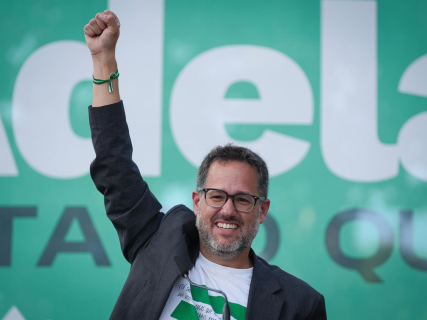

The growth of Adelante Andalucía in the regional elections has opened a fundamental debate within the space of sovereignist and plurinational left-wing parties about the future of the left alternative to the PSOE. The Andalusian party has managed to overtake the coalition Por Andalucía —made up of Sumar, IU, and Podemos— and become the emerging reference point for the space to the left of the socialists in the region.
The interpretation that is beginning to prevail in sectors of ERC, EH Bildu, BNG, and other peripheral formations is that the Andalusian result demonstrates that projects with their own territorial identity have greater mobilizing capacity than large state platforms articulated from Madrid.
Adelante Andalucía thus goes from being seen as a territorial exception linked to the political legacy of Teresa Rodríguez to becoming, for part of the plurinational left, a possible exportable model of political construction.
The "Andalusian factor" gains weight in the alternative left
In the hours following the count, leaders and cadres from different sovereignist spaces focused on the distinctly Andalusian character of the candidacy led by José Ignacio García. The formation campaigned by demanding political autonomy from state leaderships and presenting itself as an "Andalusianist force with Andalusian obedience."
That message has connected with debates that have been open for months in the confederal and sovereignist space about the wear and tear of state brands and the loss of territorial presence of the alternative left.
The thesis gaining strength is that organic unity is no longer enough to guarantee electoral results if there is no recognizable project in each territory. This is a reflection that directly affects both Sumar and Podemos after the setback of Por Andalucía.
Rufián and the debate on the plurinational space
The Andalusian result also indirectly reinforces the theses that Gabriel Rufián has been defending for months within ERC about the need to build a broad plurinational space that does not depend exclusively on a political leadership based in Madrid.
In republican sectors, they consider that Adelante Andalucía has shown that there is room for its own territorial formulas capable of competing electorally with more consolidated state brands.
Nevertheless, other sovereignist forces remain cautious about the possibility of converting the Andalusian model into a general recipe. Both EH Bildu and BNG have historically shown reservations about broad state platforms that could dilute their own profiles.
BNG, Compromís, Chunta, CUP
The national spokesperson for the BNG, Ana Pontón, has interpreted Adelante's result as the demonstration that “there is another way of doing politics”.
For his part, from Compromís, Joan Baldoví, has reiterated that "the local, the territorial, is the path and the key to defeat the right in the future"
For the president of Chunta Aragonesista (CHA), Jorge Pueyo, his party and Adelante will meet again “on the path” to “continue working” together in the future but has warned the left that “unity can work, but unity as the sole political message falls short for people”, which is why he considers it essential that “what we have to talk about is what Julio Anguita precisely said, which was program, program, program” and also about “a different capacity to inspire, for people to understand that there is a defense of the territory, of what is ours, and that there is a different struggle”.
Also regarding Adelante's result, the CUP has declared that “the left gains confidence when it is sustained by a project that responds to reality”.
The sorpasso reopens the crisis of the state left
Beyond the territorial dimension, the sorpasso of Adelante Andalucía over Por Andalucía reopens the strategic debate within the state left after months of tensions between Sumar and Podemos. The coalition backed by IU, Sumar and Podemos manages to maintain representation, but falls behind a candidacy built precisely from the rupture with that political space.
The result is especially uncomfortable for the state leaderships because it occurs in a symbolically key territory for the Spanish left and at a time when the alternative space to the PSOE still fails to find consolidated leadership after the withdrawal of Yolanda Díaz.
In this sense, Podemos has committed this Monday, after the poor results of Por Andalucía, to work to weave a space for the left "as broad as possible", a left that is "radically autonomous" from the PSOE, without any subordination to the socialists, and without forgetting "plurinationality." Its organization secretary and spokesperson, Pablo Fernández, has stated that the Andalusian results make it clear that there is an electorate that wants to vote left and it is for that collective that they want to work. He has made it clear that Podemos will seek alliances for a broad space to the left of the PSOE.
The general elections, on the horizon
In the plurinational bloc, the conclusion that is beginning to emerge is that the future general elections could demand a different political architecture than that of recent years.
The Andalusian experience feeds the idea that strong territorial brands —such as Adelante Andalucía, Compromís, the comuns, Chunta or the sovereignist forces themselves— could have more electoral traction if they maintain political autonomy and their own decision-making capacity within eventual state alliances.
The left must now debate not only whether or not to run united in a future general election, but also who would lead that unity and from where it is built.