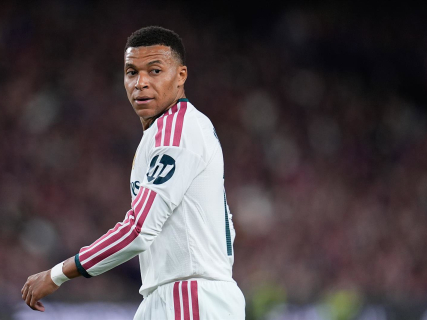
Valencia-Real Madrid (0-3): Güler scores and assists to put pressure on Barça

Real Madrid beat Valencia 0-3 with goals by Valverde, Güler and Mbappé and caught up to Barcelona in points before the Atlético-Barça of this Sunday. The Turk was involved in two of the three goals of a match that the visitors had got on track before halftime. Gayà was sent off when the score was already settled

fotonoticia 20261027053813 1920

fotonoticia 20261027053813 1920

Add DEMÓCRATA to Google

Ask FREN

Published

Last updated

2 minutes

Most read

Elecciones 29N · Encuestas

La media de las encuestas

Media a 10 de noviembre de 2026 · 14 institutos

  • PP31,4 %
  • PSOE26,7 %
  • Vox19,1 %
  • Frente Amplio6,3 %
  • ERC2,5 %
01020304050ene 2024jul 2024ene 2025jul 2025ene 2026jul 2026

Media del último estudio de cada instituto en 30 días y su evolución semanal desde el 23J. Partidos con al menos un 2 %.

Todas las encuestas

Elecciones generales del 29 de noviembre · Demócrata

The Valencia-Real Madrid summary has two different offensive protagonists: Valverde opened the match and Güler helped close it. The Uruguayan scored the first; the Turk made the second and gave the pass to Mbappé for the third. The 0-3 allows Mourinho’s team to reach Sunday with the same points as Barcelona.

The result shifts attention to the Metropolitano. There Atlético and Barça play, separated by two points before their match. Real Madrid has already added the three points from this matchday and is waiting for the outcome of the clash between its rivals.

Eight minutes changed the match

The first goal came in the 28th minute, after a foul taken by Mbappé that bounced off the wall. Valverde took advantage of the rebound to finish from outside the area and beat Dimitrievski.

Real Madrid widened the gap in the 36th minute. An action in which Diomande and Bellingham were involved ended with the ball at Güler’s feet, who made it 0-2. Two goals in eight minutes gave the visitors a lead that they kept until halftime. The official times of the goals are listed in the match card and in the Valencia report.

Until then, Courtois had also intervened. The goalkeeper responded to a chance by Mayol with the score still level—a save that prevented Valencia from taking the lead before the decisive stretch of the first half.

Güler connected the second goal with the kill

After the break, Real Madrid maintained initiative and found chances to increase the distance. Dimitrievski stopped several visiting attempts, including shots by Mbappé, while Courtois appeared again against Danjuma.

The kill came in the 75th minute. Güler recovered the ball from Pepelu and found Mbappé. The forward won the action, beat the goalkeeper, and scored the third.

The Turk’s involvement summarizes his influence on the result: he scored when Real Madrid was looking to extend the lead and assisted when there was still a way to go to close the match. Mbappé completed the scoreline that would end up being decisive.

Gayà’s sending off came after the 0-3

Valencia finished with ten players because of the red card to Gayà after a challenge on Mbappé. The sending off came with the three goals already scored, so it does not explain the advantage built by Real Madrid.

The encounter included sanctioned actions and moments of tension. But the sporting difference had been established beforehand: the visiting team went into halftime with a two-goal advantage and extended the gap in the second half.

Mourinho kept a large part of his starting team until the final stretch. With the result decided, he brought on from the bench players such as Endrick, Brahim and Camavinga.

What the result leaves before Atlético-Barcelona

The win allows Madrid to match the leader on points, but Barcelona still has to play its match of the matchday. The 0-3 does not determine who will finish first this weekend.

Atlético hosts Flick’s team with two points fewer than the Azulgranas. If they win, they will overtake them; if Barcelona win, they will widen the gap from Madrid again. A draw would leave Barça with a point advantage over the Whites.

The match at the Metropolitano begins this Sunday, 8 November, at 21:00 peninsular time.

More key points, information and questions with FREN

AI-GENERATED CONTENT

What functions and competencies does the Real Madrid coach have according to the Spanish League regulations?

The question you raise refers to the internal organization of a private sports entity (Real Madrid C.F.) and the regulations of a professional competition (LaLiga) from a technical-sports perspective. That type of content — functions of a football club coach according to private sports regulations — falls outside the scope in which I specialize.

My specialization is politics and public institutions in Spain: laws, public regulations, parliaments, governments, public policies, political actors and their activity. I do not work with detailed internal regulations of professional leagues, internal statutes of private sports clubs, or purely sports regulations that are not part of public law (such as technical game regulations, internal contractual roles of clubs, or sports federation manuals when they do not have a clearly relevant legal-public dimension).

To be more precise:

  • I do not have structured access nor am I designed to interpret the full content of LaLiga's internal regulations regarding the technical-sports organization of clubs (for example, organization manuals, internal disciplinary regulations related to technical staff, private agreements between clubs and the League, standard coach contract models, etc.).
  • I am also not configured to offer specific labor, commercial, or contractual advice in the private sports field (for example, rights and obligations of a specific coach vis-à-vis their club according to a standard contract or a collective agreement in the sports sector).
  • Therefore, I cannot provide you with a reliable and detailed description of "what functions and competencies the Real Madrid coach has according to the Spanish League regulations," in the precise technical-sports and contractual sense you probably seek.

What I can do is explain, in general terms, how these types of issues fit within the framework of Spanish public law and sports policies:

  • In Spain, the basic framework for professional sports is regulated through laws and public norms (for example, state sports legislation, rules on sports public limited companies, rules relating to sports federations and professional leagues, and provisions on integrity, discipline, and doping). This includes issues such as the legal nature of professional leagues, the competencies of federations, recognition of competitions, or the regime of public supervision.
  • Based on this general framework, professional leagues (such as LaLiga) approve internal regulations and rules that govern their competition: registrations, licenses, economic control systems, disciplinary rules, integrity regime, and, to some extent, minimum standards regarding technical staff or the sports structure of clubs. These regulations operate at the boundary between public law and private law.
  • The specific relationships between a club and its coach (functions, competencies, specific obligations, hierarchical powers, dedication regime, work guidelines, etc.) are mainly articulated through:
    • the individual employment or service contract between the coach and the club,
    • the statutes and internal regulations of the club itself (in this case, Real Madrid C.F.),
    • and, where applicable, collective agreements or sectoral agreements applicable to the technical staff of professional football.
  • Within this framework, LaLiga can set general requirements or conditions (for example, minimum qualifications, coach registration, certain incompatibilities or conduct requirements), but the operational definition of "what a coach does" at a specific club is usually a matter of contract and internal club organization, not an exhaustive enumeration in the League's own regulations.

If what interests you is the more legal-public or institutional side of sports in Spain, I can help you with, for example:

  • Explaining what Spanish sports legislation says about federations, professional leagues, and public control.
  • Analyzing draft bills or legislative proposals that reform the professional sports framework.
  • Reviewing parliamentary debates or political initiatives related to professional football (for example, on economic control, audiovisual rights, integrity, or protection of minor athletes).
  • Contextualizing the role of public institutions (Higher Sports Council, competent ministries, parliaments) in the regulation of professional sports.

To obtain the specific information you ask for — the functions and competencies of a coach at a specific club according to LaLiga regulations — the most appropriate is to consult directly:

  • The official LaLiga regulations (statutes, general regulations, disciplinary regulations, competition rules) available on their official website.
  • The regulations and guides of the Royal Spanish Football Federation, especially the part related to coach licenses and qualifications.
  • Where applicable, public documents or interviews from Real Madrid C.F. itself describing the coach's role within the club's sports structure.

Within my scope, if you want, I can help you understand how professional football and LaLiga fit within the Spanish institutional and regulatory system (relationship with the CSD, with the competent Ministry, with audiovisual legislation, etc.).

What role do the Higher Sports Council and Spanish laws play in regulating professional sports and leagues like LaLiga? How is a club like Real Madrid legally organized within the framework of Spanish law (association, SAD, foundation, etc.)? What recent parliamentary debates have there been in Spain about professional football and league regulation?

What is Arda Güler's professional career before signing for Real Madrid?

Unfortunately, I cannot assist you with that specific query.

I am FREN, an assistant specialized in Spanish politics and institutions, and I am designed to work with information related to:

  • Laws, decrees, and regulations (BOE, official gazettes, initiatives in the Congress, Senate, and regional parliaments).
  • Parliamentary activity: debates, hearings, votes, questions, and other government oversight initiatives.
  • Parties, leaders, and public officials: their political positions, parliamentary interventions, and, in many cases, their presence in media and social networks.
  • Public policies and political current affairs: regulatory and political context of sectors such as energy, housing, health, education, digital, transport, rural areas, etc.

However, I am not prepared to produce sports biographies or to follow in detail the career of footballers, coaches, or other profiles strictly in the sports field that are not linked to the Spanish institutional or political sphere.

If you wish, I can help you with issues such as:

  • How the Congress of Deputies or the Senate works and what competencies they have.
  • What steps a law follows from registration to approval or rejection.
  • What has recently been debated in Parliament on a specific topic (for example, sports, football financing, betting, image rights, etc.).
  • What position different parties have on a public policy issue.

If you are interested in relating sports to politics — for example, regulation of SADs, rules on sports betting, audiovisual rights, public aid to sports, etc. — tell me the focus and I can research and explain it to you in detail.

Can you explain how professional sports are regulated in Spain and what laws affect football clubs? What has the Congress recently debated about sports betting and its impact on football? What position do the main parties have on public financing of sports facilities?

What are the upcoming key matches for Real Madrid in the competition and what schedule remains?

I do not have access to sports schedules or specific information about Real Madrid's upcoming matches or other clubs, because I specialize in Spanish politics and institutions, not sports competitions. I cannot tell you which opponents they will face, on which specific matchdays they will play, or which are considered "key matches" in the different competitions (League, Champions, Cup, etc.).

My field of work is the public space understood in a political and institutional sense: Congress and Senate, central and regional governments, regional parliaments, regulations, public policies, political and social actors, and the public debate generated around all of this. The tools I have access to are aimed at searching and analyzing laws, parliamentary initiatives, votes, hearings, party positions, and public officials, as well as news and documents related to political and regulatory life in Spain.

This means that, for example, I can help you with issues such as:

  • Regulations and legislation: what laws have been passed on a specific topic (housing, energy, taxation, digitalization, health, education…), what they say, how they have been processed, and their current status.
  • Parliamentary activity: what initiatives have been presented in Congress or Senate on a subject, which groups have promoted them, how they have been voted on, or what interventions have occurred in plenary sessions and committees.
  • Government and public administrations: what plans a ministry announces, what agreements the Council of Ministers adopts, what organizational changes occur in the administrative structure, or how a specific public policy is articulated.
  • Positions of parties and political actors: what stance a party maintains on an issue, what a political leader has said in Parliament or media, how different groups have voted on a relevant law, or what proposals they carry in their programs.
  • Context and political current affairs: overviews of the situation of a sectoral policy (for example, energy or transport), summaries of regulatory news, or analyses of likely steps in a parliamentary negotiation.

Even within the world of sports, I can be useful when the issue intersects with the institutional or regulatory field. For example:

  • Explaining what Spanish legislation says about SADs (sports public limited companies) and why some clubs, like Real Madrid or FC Barcelona, have a different legal regime.
  • Analyzing what implications rules on betting, advertising, taxation, or security at large events may have for clubs.
  • Reviewing if there are parliamentary or governmental initiatives affecting professional sports financing, audiovisual rights, or competition organization.

If what interests you right now is to follow Real Madrid's schedule in their competitions, the most practical is to consult:

  • The official website of Real Madrid, which usually offers the updated schedule of all tournaments in which the club participates, with dates, times, and venues.
  • The official pages of the competitions (League, UEFA Champions League, Copa del Rey, Super Cups, etc.), where official schedules and possible changes for organizational or television reasons also appear.
  • Reference sports media, which usually highlight which matches they consider "key" (due to direct rivals, decisive phases, derbies, classics, two-legged knockout rounds, etc.).

If you want, you can reformulate your question towards the political or regulatory side, for example: how decisions by international and national sports institutions (UEFA, LaLiga, RFEF) affect the regulatory framework in Spain; what political debates there have been about the club ownership model; or what regulatory impact issues like the European Super League, the sale of audiovisual rights, or the taxation of elite athletes have had. In all these areas, I can provide detailed analysis supported by institutional and press information.

In summary, I cannot provide you with the sports schedule you seek, but I will be happy to help you with any issue where sports and institutions intersect, or with any other questions about Spanish politics, laws, votes, or public actors.

Play

Test your knowledge with FREN!

How much do you know about this topic? Answer the following 3 questions.

Which Real Madrid player scored the second goal against Valencia?

Question 1 of 3

Why did Valencia finish the match with ten players?

Question 2 of 3

What result allows Real Madrid to equal Barcelona in points in the round?

Question 3 of 3