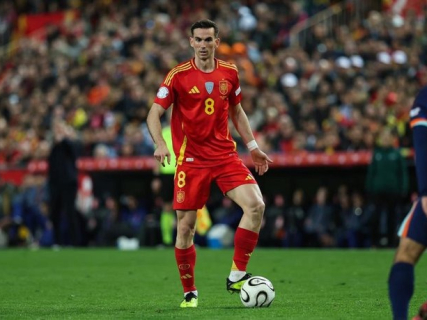
Possible lineup of Spain against France: Fabián Ruiz wins the tie and Pedri aims for the bench

Luis de la Fuente is outlining a starting eleven very similar to the one that eliminated Belgium to face France in the World Cup semifinals. Fabián Ruiz would once again be a starter alongside Rodri, while Pedri would wait for his opportunity from the bench.

2 minutes

WhatsApp Image 2026 07 14 at 16.08.03

WhatsApp Image 2026 07 14 at 16.08.03

Add DEMÓCRATA to Google

Ask FREN

Published

Last updated

2 minutes

Most read

The cards are already on the table to face the World Cup semifinals against France. Luis de la Fuente is expected to bet on maintaining the block that brought La Roja to this round, with Fabián Ruiz continuing as a starter and Pedri starting the match as a substitute.

The coach's idea would be to maintain the balance shown in recent matches. Fabián's physical deployment, combined with Rodri's presence, would allow reinforcing the midfield against a French team that stands out for its power and ability to punish transitions.

Fabián consolidates his place in the starting eleven

After his performance against Belgium, everything indicates that Fabián Ruiz will once again be one of the chosen ones. His ability to cover ground, help in pressing, and reach the opponent's area has convinced the coaching staff, who consider it a priority to maintain the physical rhythm that a rival like France will demand.

Rodri will continue to be the team's axis, while Dani Olmo would play a few meters ahead to connect with the attack.

Pedri, a game-changer for the second half

Pedri's absence from the starting eleven would not be due to a loss of confidence, but rather a tactical approach. The Barcelona player could become one of Spain's main weapons during the second half, providing control, composure, and the final pass when the match is more open and more spaces appear.

De la Fuente already used this formula in the previous match and everything indicates that he will repeat the strategy in a scenario of maximum demand.

Nico Williams threatens Álex Baena's spot

The other big unknown in the starting eleven is on the left wing. Nico Williams, now recovered from his physical problems, has a chance to return to the starting lineup to provide speed and dribbling against the French defense.

However, Álex Baena also has a chance to remain in the team after his good performance against Belgium. The coach will decide in the hours leading up to the match whether to opt for Nico's pace or for the greater control offered by the Villarreal player.

Possible Spain lineup against France

Barring last-minute changes, this would be the eleven Luis de la Fuente is preparing to seek a place in the World Cup final:

Line Players
Goalkeeper Unai Simón
Defense Pedro Porro, Pau Cubarsí, Aymeric Laporte, Marc Cucurella
Midfield Rodri, Fabián Ruiz, Dani Olmo
Attack Lamine Yamal, Álex Baena (or Nico Williams), Mikel Oyarzabal

More key points, information and questions with FREN

AI-GENERATED CONTENT

What is the current status of the World Cup processing and what are the remaining steps for organizing the final?

The political and institutional processing of the 2030 World Cup is already in the organization phase, not the candidacy phase: FIFA officially designated Spain, Portugal, and Morocco as host countries in December 2024, with Spain as the main host. The Government has created an Interministerial Commission and holds regular meetings with FIFA and the other two countries to plan the tournament, while the federations and cities refine the map of venues. Regarding the final, there is political and federative consensus that it should be held in Spain, and FIFA has framed it as such, but the specific stadium (with Madrid and Barcelona as major contenders) has not yet been formally confirmed. The key decisions will be concentrated in the next two to three years: final venues, final tournament format, and official selection of the final stadium.

Status of the candidacy and organization

The candidacy phase ended with the official designation by FIFA at its extraordinary Congress on December 11, 2024, where Spain, Portugal, and Morocco were confirmed as host countries, a recognition that the Spanish Government presented as a “historic day” and a demonstration of the country's capacity to host major events, according to the Moncloa note and reports from the RFEF (RFEF, Spanish venues).

Spain will provide the most venues: eleven stadiums compared to six in Morocco and three in Portugal, as noted both by the Ministry of Justice in Rabat when signing a Judicial Memorandum of Understanding for the tournament (Demócrata) and the Andalusian Government when announcing La Cartuja and La Rosaleda as venues (Andalusian note). The venue map has generated political tensions, as shown by the cases of Vigo, Valencia, or the Basque proposal for a joint Bilbao-San Sebastián venue (Demócrata Vigo, Demócrata Galicia, Demócrata PNV, Bilbao note, Valencian Generalitat).

At the governmental level, the Council of Ministers approved in February 2025 the creation of an Interministerial Commission for the preparation and organization of the World Cup, which leads the dialogue with Portugal and Morocco, as reported by the newspaper Demócrata in its Council summary (Council of Ministers). This commission, involving 15 ministries and about 150 technicians, is fully operational and was reviewed in June 2026, when Pedro Sánchez chaired its third meeting and described the tournament as “one of the most important events in recent Spanish history” (Sánchez mobilizes 15 ministries).

In parallel, the Prime Minister has maintained a direct political channel with FIFA and the authorities of Portugal and Morocco, such as the September 2025 meeting in New York to advance competition planning (meeting with Infantino) and various international forums (Luso-Spanish forum, Summit of the Future). Additionally, the Government has had to respond to Sumar's criticisms regarding human rights in Morocco, defending that the World Cup will be compatible with a “full” commitment to human rights, sustainability, and inclusion (Demócrata: human rights).

At the international level, the format is still under debate: FIFA is considering expanding the tournament to 64 teams in 2030, which would have a strong impact on schedule, venues, and logistics (Demócrata: 64 teams, FIFA organization, 2030 World Cup).

Final venue: what is decided and what remains

There are two levels of decision regarding the final. The first, already on track, is the country: both the official candidacy documentation (joint candidacy) and statements from the RFEF president, Rafael Louzán, assume that the final must be held in Spanish territory, given Spain's “weighty majority” in organization (55% of venues) and its role as main host (Louzán and economic impact, ABC: candidacy leader).

The second level is the specific stadium. According to Louzán, candidate cities for the final are Madrid, Barcelona, and Casablanca, although the latter depends on the construction of a large stadium (Nueva Economía Fórum). Other sports sources point to a technical duel between the new Santiago Bernabéu and Camp Nou, with Bernabéu favored for capacity and infrastructure (ABC 2030 venues, RTVE World Cup 2030, El País concession, AS venues).

However, and this is the key point, neither FIFA nor the RFEF have yet officially announced the final stadium designation. FIFA is in the phase of technical evaluations of stadiums in the three countries, including visits to Spain to examine candidate venues and their remodeling plans (Infobae inspections). The Spanish federation also insists that “FIFA has the final word” and that any decision about the final will be part of the overall package of venues and schedule.

Therefore, in the coming years, the pending steps are: finalizing the list of venues and sub-venues; resolving internal political disputes (cases like Vigo, Valencia, etc., extensively covered by media such as Demócrata, El País, El Diario, or ABC: Vigo-San Sebastián controversy, candidacy resignation, venue “botch job”, absurd meeting, Louzán vs Caballero, NEF Vigo); adjustments due to a possible format change to 64 teams; and, ultimately, FIFA's decision on the final stadium, likely once major remodeling works at candidate venues are completed.

Other contextual pieces

The 2030 World Cup is part of a broader strategy by Spain, particularly Madrid and other cities, to attract major sporting events and international fairs, as highlighted by reports from Demócrata and other media about securing events like the F1 Grand Prix, The District, or the Ryder Cup (The District in Madrid, The District real estate fair, F1 Madrid, Spain and major events).

At the same time, the organizational experience of other World Cups, such as the 2026 tournament in the United States, Mexico, and Canada — which Demócrata is covering in detail from a sports, economic, and tourism perspective (2026 World Cup start, 2026 format, 2026 tourism impact, 2026 venues leisure, Spanish travelers, flight searches, World Cup calendars, Spain schedule, Spain-Portugal, Spain eliminates Portugal, road to final, 2026 semifinalists, Morocco 2026, cities without matches, Spain-France semifinal, France-Spain preview)— serves as a reference to understand the demands and risks of being left out of the match map, as has already happened in major North American cities.

Finally, the 2030 World Cup intersects with broader debates about sports geopolitics and security, visible in episodes such as the cancellation of the Spain-Argentina Finalissima in Qatar due to the Middle East war (Finalissima at risk, Madrid as possible venue, official cancellation) or the discussion about the presence of certain teams, which the Spanish Government links to sports sanction policies (Alegría on Israel).

In summary: the political and organizational framework of the 2030 World Cup is quite advanced (host countries, Spain's role, government commission, initial venues), but the specific final venue remains open and will be one of FIFA's major pending announcements once technical evaluations are completed and the final tournament design is closed.

[link] [link] [link] [link] [link] [link] [link]

What schedule does FIFA have to definitively decide which city and stadium will host the 2030 World Cup final? Which Spanish cities are already practically confirmed as venues for the 2030 World Cup and which remain in doubt or political dispute? What public and private investments does the Government foresee in infrastructure and security related to the 2030 World Cup in Spain?

What are the main functions and competencies of the national football team coach according to the Royal Spanish Football Federation?

The figure of the national football team coach and their competencies within the Royal Spanish Football Federation (RFEF) belong to the sporting and organizational sphere of Spanish football, not the political, institutional, or regulatory sphere in which I specialize. For that reason, I cannot provide you with a precise and documented description of the official functions of the national coach according to the RFEF nor cite its internal rules or sporting regulations. However, I can explain what kind of issues I am designed to help with and how, when appropriate, sport and politics in Spain are related.

Area of specialization: politics and public affairs in Spain

I am an assistant focused on Spanish politics and topics directly linked to:

  • Parliamentary activity: functioning of the Congress of Deputies and the Senate, legislative initiatives (bills and proposals, royal decree-laws, motions, interpellations, etc.), composition and actions of parliamentary groups (PSOE, PP, Vox, Sumar, PNV, Bildu, Republican Group, Junts, etc.).
  • Executive activity: decisions of the Government of Spain, agreements of the Council of Ministers, drafting of preliminary bills, public consultations and hearings, as well as their subsequent parliamentary processing.
  • Regulation and legislation: explanation of laws already approved, their content and political, social, or economic impact; also the path norms follow from proposal to publication in the Official State Gazette (BOE).
  • Political and social current affairs: interpretation of political, social, and economic news in Spain, with special attention to coverage by political media such as the newspaper Demócrata, as well as institutional context and main actors and parties.
  • Relationship between politics and other fields: when sport, business, culture, or technology intersect with political decisions (for example, legal reforms affecting professional sport, public funding, transparency, governance of federations, etc.).

In other words: I can help you with almost everything related to legislative power, executive power, political parties, regulation, public policies, and public debate in Spain, as well as their reflection in specialized media.

Why your question is beyond my scope

What you ask refers to the functions and competencies of the national football coach within the RFEF. This falls within:

  • The sporting sphere (technical organization of the national team, selection criteria, relationship with clubs, sports planning).
  • The internal statutory sphere of a sports federation (federative regulations, organizational structure, dependence on the RFEF president or technical bodies).

Although the RFEF has a public dimension (it is subject to certain public law norms, supervision by the Higher Sports Council, etc.), the details of the coach's tasks — for example, what exact competencies the federative regulations assign, how their contractual relationship is structured, or what decision-making margin they have over technical staff — are not part of the political-institutional information I am trained on nor my main sources.

To avoid providing imprecise or outdated information, I cannot describe, as if they were official data, those functions or reproduce specific articles from RFEF statutes or regulations.

What types of questions I could address related to this topic

Although I cannot detail the “manual of functions” of the coach according to the RFEF, I could help if your interest shifts toward the connection between sport and politics, for example:

  • How professional sport is regulated in Spain and the role of the Higher Sports Council and federations.
  • What political debates have taken place in Congress or the Government about the governance of sports federations, transparency, good governance, or possible legal reforms.
  • How certain controversies in the RFEF (for example, institutional crises, changes in presidency, scandals) have influenced the political agenda, parliamentary appearances, or regulatory reforms.
  • What impact public institutions' decisions (laws, subsidies, labor or tax regulations) have on professional football, national teams, or major sporting events.

In all these cases, the focus is on political and regulatory decisions affecting the football ecosystem, rather than the technical description of the work of a specific sports professional such as the national coach.

Recommendation to find the information you seek

If you need an exact and official answer about the functions and competencies of the national football coach according to the RFEF, the most appropriate is to go directly to:

  • The RFEF statutes and regulations (especially the general regulation and specific regulations of national teams).
  • Official RFEF communications or organizational charts describing the structure of the Sports Directorate and the coach's role.

These documents are usually accessible on the Federation's official website and will offer you an accurate, updated, and legally binding description of the functions assigned to the position.

What legal relationship and supervision exists between the RFEF and the Higher Sports Council in Spain? What political debates have recently taken place in Spain about transparency and governance of sports federations? How is professional sport and sports federations legally regulated in Spain at the state level?

What is Fabián Ruiz's professional career and achievements before this tournament?

Footballer Fabián Ruiz is not within the scope of information I am designed for. I am an assistant specialized in Spanish politics, parliamentary and executive activity, as well as social current affairs linked to public decisions, institutions, and political actors. Therefore, I do not have a reliable and detailed repertoire about the individual sports achievements of football players nor about their strictly sporting career before a specific tournament.

My knowledge framework is oriented to explain how the Congress and Senate work, what measures the Government promotes, what votes have taken place, what agreements have been made in the Council of Ministers, or how certain social and economic news relate to public action. I can also contextualize the role of sports clubs, federations, or national teams when they appear in debates about public funding, sports regulation, labor rights of athletes, or use of facilities financed with public money.

In that sense, if the figure of Fabián Ruiz appeared in a specific political controversy (for example, a parliamentary debate about the Spanish national team's bonuses, the taxation of top athletes, or institutional campaigns in which he participates), I could analyze the political and regulatory context around the case. However, a detailed description of his club career, goal statistics, league or cup titles won, or his performance in international tournaments belongs more to the realm of general sports information, which is outside my specialization.

The reason for this limitation is that I am conceived as a support tool for monitoring politics and regulation in Spain, not as a sports encyclopedia or a statistical archive about results and personal careers of athletes. My “memory” of facts focuses on legislative initiatives, royal decree-laws, parliamentary appearances, interventions, party programs, institutional pacts, and current political and social news, not on competition histories or individual achievements in national and international leagues.

If you are interested in connecting the world of sport with politics, I could be useful in other types of questions. For example, I could explain how professional sport is regulated in Spain, the role of the Higher Sports Council, what laws affect football clubs as sports public limited companies, or how the distribution of audiovisual rights of football has been debated in Congress. I could also comment on political controversies related to major sporting events organized in Spain or the use of public funds for stadiums and sports cities.

Likewise, I can help you understand the political dimension of the Spanish national football team when it enters public debate: from statements by Government officials about sporting successes or failures, to parliamentary controversies about symbols, anthems, flags, or institutional alignments around the team. In all these cases, my added value is to offer institutional, regulatory, and political context, not to break down the individual sports resume of players.

To obtain the information you request about Fabián Ruiz — his professional career prior to a specific tournament and his concrete achievements — the most appropriate would be to consult specialized sports sources, football statistics databases, or the official pages of the clubs and federations where he has played. Those sources usually detail precisely the matches played, goals, assists, collective titles, and even individual awards received in different seasons and competitions.

If from that sports information you have any questions about how his figure or that of the national team relates to political decisions, regulations, subsidies, public contracts, or institutional debates, I can help you analyze it from the perspective of Spanish politics, which is where I am specifically prepared to add value.

What competencies does the Higher Sports Council have over the Spanish national football team? How are sports facilities used by national teams in Spain financed with public money? What laws regulate professional sport and football clubs in Spain?

Play

Test your knowledge with FREN!

How much do you know about this topic? Answer the following 3 questions.

Which player is expected to start in the midfield for Spain against France?

Question 1 of 3

What is the main reason Pedri would start the match as a substitute?

Question 2 of 3

Who are likely to form Spain's defensive line for the semifinals according to the news?

Question 3 of 3

Hola, soy Fren. ¿Cómo te ayudo?