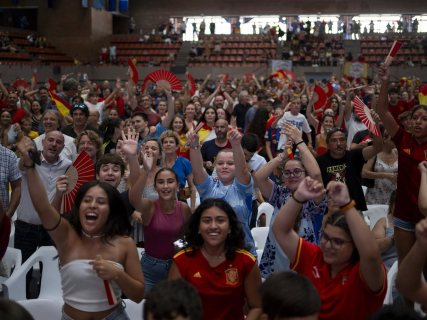

Spain has this Sunday a last opportunity to leave Berlin with a medal. The women's basketball team faces Germany in the bronze medal match of the 2026 World Cup, after losing this Saturday to the United States by 66-76 in a semifinal much more balanced than what the final score reflects. The match will begin at 16:30 hours at the Berlin Arena and can be followed for free on Teledeporte and RTVE Play, whose programming will start before the jump ball.
The duel offers Spain the possibility of regaining a place among the three best teams in the world after missing the 2022 World Cup. It will also mean an immediate revenge between two teams that already met on the first day of the tournament, when the Spaniards crushed the host by 83-53. Germany has changed a lot since then and has had the best World Cup in its history, so that result serves as a reference, but it can hardly be interpreted as a forecast for a match that will decide a medal.
Schedule and where to watch Spain-Germany
The third place match is played this Sunday, September 13 at 16:30 hours, Spanish peninsular time, at the Berlin Arena. FIBA officially sets the match at that time, while RTVE has reserved its slot from 16:00 for the broadcast of the match. Teledeporte and RTVE Play will offer the match live and for free.
After that, the final of the tournament will take place, in which the United States and France will compete for gold starting at 20:00 hours. The Americans eliminated Spain, while France clearly defeated Germany by 86-64 in the other semifinal.
Spain arrives affected, but reinforced by its match against the United States
The team of Miguel Méndez was very close to turning the semifinal into one of the great surprises of the championship. Spain started with enormous intensity against the United States, managed to take the lead and entered the last quarter with 58-58, but ended up paying for the physical effort, foul problems, and the depth of the reigning world champion. The Americans signed the decisive partial in the last ten minutes and ended up winning by 66-76.
Iyana Martín and María Conde finished with 17 points each, while Awa Fam once again played an important role in a team that has combined experienced players with a young generation that is quickly gaining prominence. Martín summarized after the match the feeling in the locker room by stating that Spain had pushed the United States “to their limit.” The challenge now will be to recover the team physically and mentally in less than 24 hours to play a match that, although it is not the desired final, can return Spain to the world podium.
Germany seeks its first world medal in history
The context is very different for the host team. Germany had never even reached the quarter-finals of a women's World Cup and is now one victory away from achieving its first medal. The German team has taken advantage of the momentum from the Berlin crowd to rebuild after its harsh initial defeat against Spain and advance to a semi-final where France ended up imposing its superiority.
The great German reference is Leonie Fiebich, one of the players who will have to take on more offensive responsibility against Spain. The host also arrives with two particularly relevant statistical advantages: it is obtaining 42 points per game from the bench, compared to Spain's 26.2, and averages 45.3 rebounds, compared to the 39.2 of the Spanish team. Controlling the rebound and preventing the German second unit from changing the pace of the game are, therefore, among the priorities for Méndez's team.
The precedent: Spain won 83-53
There is a fact that is impossible to ignore. Spain and Germany already faced each other in this same Berlin Arena on the first day of the World Cup and the result was conclusive: 83-53 for the Spanish team. Spain dominated practically from the start, went into halftime with a 50-24 lead, and finished with a 50% success rate from three-point range, 14 baskets out of 28 attempts, a figure that crushed any German option.
Repeating such exterior effectiveness will be complicated, but that match showed one of the ways to hurt Germany: moving the ball quickly, punishing their turnovers, and opening the court. Spain also generates 17 points per game after a rival turnover, compared to Germany's 9.8. This statistic becomes important after the hosts committed 24 turnovers against France in the semi-finals.
The recent precedent also favors Spain outside the World Cup. Both teams faced each other on German soil during the Eurobasket of 2025 and the Spanish team imposed itself again, then by 79-60 in Hamburg. Germany will therefore have to demonstrate that the evolution shown during the last matches is enough to change a dynamic clearly favorable to the Spaniards.
Iyana Martín, one of the keys to the match
FIBA directly points to Iyana Martín as the main focus of the Spanish attack. The young point guard has become one of the revelations of the tournament and arrives at the bronze match after being one of the top scorers against the United States. Germany will have to decide how to stop her ability to generate from the dribble and will likely turn to Alexis Peterson or Britta Daub to try to limit her influence.
Spain will need, however, something more than individual inspiration. The control of turnovers, defensive rebounding, and outside shooting can decide a match between two teams that arrive with very few hours to recover from demanding semifinals. Germany will have the support of a Berlin Arena focused on the host; Spain, the confidence of having clearly surpassed them just nine days ago and the feeling of having competed on equal terms against the great world power.
Spain seeks its fourth medal in five World Cups played
A victory would also have considerable historical weight. Spain was bronze in 2010 and 2018 and world runner-up in 2014, so reaching the podium in Berlin would mean achieving its fourth medal in its last five World Cup participations. The only interruption was particularly painful: the team failed to qualify for the 2022 edition in Sydney.
Germany plays for something even more unprecedented: the first world podium in its history. That difference makes the clash more than just a consolation match. Spain wants to confirm that it has returned to the world elite and Germany aims to culminate the best championship in its history in front of its home crowd.
The appointment is this Sunday at 16:30 hours, on Teledeporte and RTVE Play. Spain already knows how to beat Germany in Berlin; now it will have to do it again when the prize is no longer two points in the group stage, but a world bronze medal.