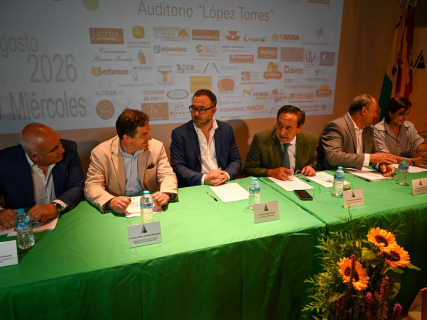

The national president of Asaja, Pedro Barato, has once again focused on the "complex situation" currently facing the agricultural sector, marked by the rising costs of production, an increasing bureaucratic burden, and prices perceived by producers that he considers insufficient.
In the framework of the XL Day of the Winemaker held in Tomelloso, Barato has demanded "fewer sanctions and more solutions," a CAP endowed with more resources, and preferential support for professional farmers. He has also defended the urgency of simplifying administrative procedures and articulating measures that ensure the availability of water.
During his speech, he also announced the imminent opening of a new Asaja office in Tomelloso, as well as the call for new protests from the sector in different autonomous communities, including Castilla-La Mancha, scheduled for October 6.
According to a press release from the City Council, the mayor of Tomelloso, Javier Navarro, focused his speech on the support of the City Council for the agricultural sector and on his personal commitment "total, absolute, and unbreakable" to the farmers and ranchers of the municipality. He emphasized that agriculture "is not simply another economic sector," but "the indispensable engine, the heart that pumps life, employment, and prosperity" of the locality.
Navarro has demanded effective water policies in light of the growing water needs, warning of the social and economic repercussions that a reduction in available resources or the loss of usage rights would have. In this context, he referred to the efforts being made to propose a moratorium on the application of the Water Framework Directive, due to the impact that, he emphasized, it could have on thousands of hectares and numerous wells in La Mancha.
The mayor has also called for new infrastructure and legal security for the future of the sector, as well as concrete responses to problems such as the rabbit plague, asking that the competent administration officially declare it and articulate direct aid to compensate for the losses of farmers, as well as addressing the excessive bureaucratic procedures that the countryside endures.
In his intervention, he has also highlighted the investment effort of the City Council in the rural road network, with more than 300 kilometers conditioned so far in the legislature and a municipal contribution of over 250,000 euros allocated to the repair of the Camino del Campo Bridge.
Navarro has recalled that 2026 will be the second year of validity of the collaboration agreement signed with Asaja Tomelloso and has advanced the intention of the City Council to extend it to continue working together in defending the interests, demands, and priorities of the local agricultural sector.
Water, a key challenge for the sector
For his part, the president of the Ciudad Real Provincial Council, Miguel Ángel Valverde, has also pointed out water as one of the great challenges of the province and has called for investments and measures that ensure the continuity of the agricultural sector.
He has also referred to the rabbit plague and the half a million euros fund established by the provincial institution to support the affected municipalities.
In the same vein, the provincial and local president of Asaja, Emilio Cepeda, has warned about the low prices of grapes and has requested that the Food Chain Law be effectively applied to guarantee, at a minimum, the coverage of production costs. He has also insisted that "without water there is no future" for farmers, ranchers, and winemakers.