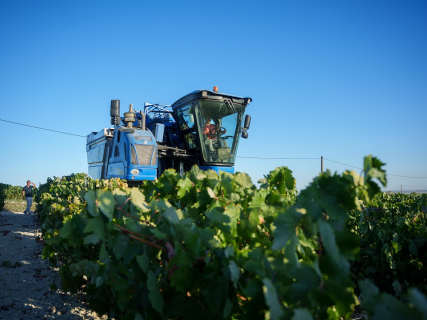

The person responsible for the vineyard sector of COAG Andalucía, Manuel Alférez, has warned of the growing lack of qualified and young labor in the field of grapes, a "widespread and increasing problem" in the Andalusian community, focusing on what is happening in the wine-growing area of Montilla-Moriles, in Córdoba.
In statements to Europa Press, Alférez indicated that the scarce availability of personnel is related to the high presence of foreign workers who, "in addition to not understanding the language," create difficulties when it comes to being registered with Social Security and legally hired due to "lack of papers." He also pointed out the obstacle that it poses for the farms to locate personnel with the necessary training to perform the tasks specific to the vineyard.
"This year companies are having many problems during the campaign to have personnel with knowledge and who are natives; there are few here willing to work or of working age in agriculture. The few that exist are immigrants, many of whom come without understanding the language and then have the difficulty that they cannot be insured due to lack of papers," the COAG representative pointed out, also emphasizing that the absence of young people interested in joining the field is causing a deficit of "generational replacement" in agriculture.
The person responsible for the Vineyard sector of COAG Andalucía has stressed that this personnel deficit is not limited to the harvest, but extends to all vineyard tasks. As he explained, "the difficulty in finding specialized workers becomes especially evident in other tasks, such as pruning, since it is a job for which there are not enough professionals."
Regarding Montilla-Moriles, Alférez specified that, for now, the situation is not causing a collapse to complete the harvest, partly due to the reduction in vineyard area and the advancement of mechanization. However, he recalled that, years ago, a similar scenario could have meant that "part of the grapes would remain unharvested."
He also explained the particularities of this Córdoba region, where a significant portion of the harvest is directed to the drying process and must be collected manually. In this context, he has estimated that in the current campaign between ten and twelve million kilos of grapes will be harvested for drying, which maintains a high demand for labor for manual harvesting.
"Mechanization can help alleviate the lack of labor, but it does not solve all the needs of the sector; professionals are needed or there are people who know how to prune," lamented Alférez, warning that this situation could intensify in the coming years. He insisted that "grape harvesting requires knowledge and certain skills, especially in trellised plantations, where workers must correctly locate the clusters and avoid damage to the crop."
Lack of generational replacement and need for training
Given the lack of "generational replacement" due to the scarcity of young farmers, Alférez has urged administrations to facilitate the incorporation and professionalization of workers, both natives and foreigners who wish to develop their agricultural activity in Andalusia.
In this line, he has proposed that the Junta de Andalucía promote specific training programs for these people, with courses aimed at acquiring technical skills in agricultural tasks, especially in pruning, felling, and grape harvesting. In addition, he has demanded that the procedures be expedited so that "those who can work legally have the necessary documentation to be registered." "We need that foreign labor," he stated, considering that the lack of young people willing to perform manual agricultural work forces reliance on workers from other countries.
In his view, these employees could become "a fundamental part of the labor replacement in the Andalusian countryside," as long as they receive adequate training and have conditions that allow them to stay longer in rural areas. In this regard, he cited some service companies that already provide accommodation to workers who return from one campaign to another, thus guaranteeing them a part of their future employment.
Alférez has insisted that the goal must be for foreign workers to specialize and consolidate a more stable trajectory in the Andalusian field, instead of continuously rotating between different agricultural campaigns. For this, he has considered it essential that farmers and companies have "certain security" that these trained employees will remain available in subsequent campaigns.
"The farmer does not have the security that when he goes to another place, he will return next year for the Harvest. That uncertainty and insecurity is there, and solutions must be sought so that they can bet on their future in agriculture," explained the representative of COAG Andalucía.
Finally, he warned that "the problem does not only affect the harvest, but the whole of Andalusian agriculture," due to the absence of generational relief. He pointed out that temporary workers allow campaigns to be completed, but in many cases they do so "without knowledge," which, in his opinion, highlights the urgency of reinforcing specific training and advancing in the professionalization of these agricultural tasks.