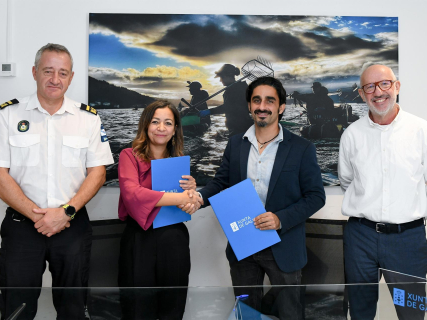

The conselleira do Mar, Marta Villaverde, has signed a collaboration agreement with the biotechnology company Octolarvae whose purpose is to give a second life to octopus, cuttlefish, and squid eggs seized by Gardacostas, dedicating them to the repopulation of the Galician rías.
The agreement establishes a coordinated action protocol to rescue the clutches of species of high commercial and environmental interest --especially the common octopus ("Octopus vulgaris"), the cuttlefish and the squid-- located in illegal or unidentified fishing gear, the so-called "cacharros", removed by Gardacostas agents in Galician waters.
With this initiative, the aim is to reduce mortality of these eggs as much as possible, so that their biological potential is used in regenerative aquaculture projects and the recovery of natural populations in the rías is strengthened.
The priority intervention area is located in the coastal stretch between the ría of Vigo and the ría of Pontevedra (from the mouth of the Miño to A Lanzada beach). The company ensures a swift response thanks to the proximity of the facilities that Octolarvae has in Meira, in the municipality of Moaña.
The agreement also promotes joint research, development and innovation (R+D+i) work focused on the recovery, incubation under controlled conditions and subsequent release into the sea of viable cephalopod clutches.
At the signing were also present the company's technical director, Álvaro Roura Labiaga, and the deputy director xeral of the Servizo de Gardacostas de Galicia, Juan Carlos Codesido.
Commercialization of biological material prohibited
The protocol establishes rigorous biological handling guidelines: Gardacostas personnel will keep the clutches in baskets with continuously renewed seawater until their transfer in approved tanks, guaranteeing at all times traceability through official handover and receipt reports.
The text specifies that all recovered biological material will be destined exclusively for scientific research, assisted incubation and possible repopulation releases, with any commercialization of the eggs or of the larvae obtained expressly prohibited.
The initial validity of the agreement will be one year, with the possibility of extending it to a maximum of four, within the framework of the Galician research and innovation plan 2025-2027 and the Estratexia de Especialización Intelixente (RIS3).