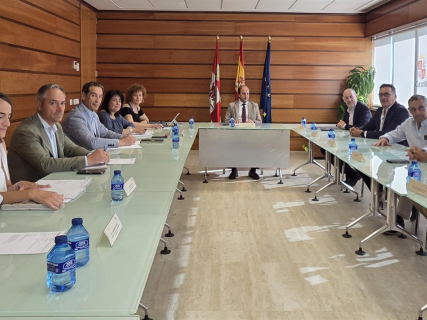

The Minister of Agriculture, Livestock, Rural Environment and Environmental Policy, Joaquín Antonio Pino, held a working meeting today with ACOR officials, in which he defended sugar beet "as a strategic crop" and emphasized his intention to strengthen support for this crop in the Community.
This meeting is part of the series of contacts that the Ministry is carrying out with the main players in the agri-food sector of Castilla y León.
During the meeting, Pino stressed that Castilla y León is the main sugar beet producing area in Spain and pointed out that "sugar beet is in Castilla y León and maintaining this crop" in this Community "is maintaining it in Spain," for which reason he once again defended the need to promote it.
Joaquín Antonio Pino explained that the Ministry will continue to demand greater support for the crop within the Common Agricultural Policy and announced that Castilla y León will request, in the next Financial Framework, from the Ministry of Agriculture, Fisheries and Food, an increase in associated aid for sugar beet.
The minister stressed that ensuring "a priority" such as decent income for farmers is essential to preserve a living rural environment with future prospects. He also recalled that sugar beet has traditionally been "one of the crops that has contributed most to population settlement, job creation, and the promotion of economic development" in many regions of Castilla y León, where the industry linked to sugar beet and sugar has sustained a large part of the local economy for decades.
For this reason, Pino insisted on the convenience of returning this crop to the importance it had in the past.
During the meeting, Pino conveyed to the ACOR representatives the Ministry's willingness to maintain continuous dialogue with the sector to "listen to their proposals" and encourage their participation in government action "to incorporate their needs and contributions into the legislation that this Ministry promotes."
Likewise, the minister shared his concern about several factors that affect the profitability of sugar beet, such as the evolution of international sugar prices, regulations on sugar beet seed, the reduction in polarization, and the increase in energy costs.
In this scenario, he has announced that he will demand from the Government of Spain the recovery of "a special irrigation tariff" that helps reduce the production costs of agricultural holdings.
In the field of innovation and modernization, Joaquín Antonio Pino has also expressed his intention to promote regulations that allow the use of drones for the application of phytosanitary treatments, a technology increasingly used by farmers and companies to intervene in plots where the orography or weather conditions prevent working with traditional means.
Similarly, the minister has reiterated his opposition to sugar from third countries being used as a bargaining chip in the European Union's trade agreements, such as the one recently signed with Mercosur, understanding that this practice "harms the competitiveness of the European producing sector and, especially, that of the beet growers of Castilla y León".
Another topic discussed was the future of irrigation in the Community and the new Duero Hydrographic Plan 2028-2033. At this point, the minister has presented the sector's position, which advocates for increasing the irrigated area to bring it closer, at least, to the national average and reinforcing regulatory capacity through new hydraulic infrastructures that ensure water supply for agriculture.
Finally, the meeting also addressed the option of launching new avenues of collaboration with the Agrarian Technological Institute of Castilla y León (ITACyL) to analyze the use of agricultural by-products in biomass production and the subsequent use of ashes as fertilizer, with the aim of promoting the circular economy, generating new value-added opportunities for the sector, and moving towards a more sustainable production model.