
The third vice president and conseller of Environment, Infrastructure, Territory, and Recovery, Vicente Martínez Mus, has announced the balance of the actions of the surveillance and protection teams of the marine environment of the Generalitat, emphasizing the relevance of the Marine Surveillance Service and the team of Coast Guards of Protected Natural Spaces in the defense of marine ecosystems, whose work has contributed to reducing the impact of vessels on the posidonia meadows.
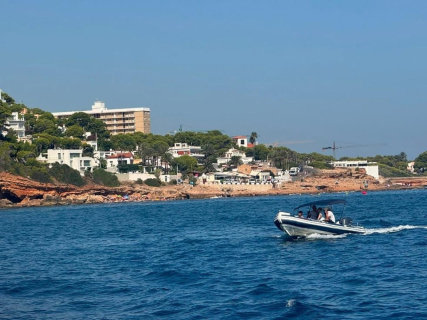
In an outing carried out between the coast of Dénia and Xàbia (Alicante), in the surroundings of the Marine Reserve of Cabo de San Antonio, and in the subsequent presentation before regional and municipal representatives, the conseller has highlighted the importance of the work of these specialized teams to safeguard marine areas of high ecological value and promote responsible use of the coastline, as noted by the Generalitat in a statement.
Martínez Mus has emphasized that the Marine Surveillance Service of the Generalitat "has consolidated itself as a fundamental tool for the protection and conservation of especially sensitive habitats of the Valencian coastline, such as this posidonia reserve." In this line, he stressed that the reinforcement applied "is already translating into a lower impact of vessels."
This surveillance device carries out tasks of control, environmental education, collection of technical information, and support for the protection of the marine environment from six bases distributed throughout the Comunitat Valenciana: Oropesa del Mar, El Perelló, Dénia, Moraira, El Campello, and Torrevieja. In this context, the conseller has highlighted the recent renewal of the agreement with Dénia.
The conseller has indicated that the data from the work carried out by these vessels "supports the push given by the Generalitat to this service." Throughout 2025, the surveillance teams informed the skippers of 1,184 anchored vessels about posidonia oceanica meadows, urging them to leave these protected areas.
So far in 2026, more than 500 warnings have already been exceeded, which, in the opinion of the conseller, highlights "the importance of maintaining and intensifying surveillance and awareness-raising efforts on the Valencian coastline, but also a decrease in the records considered positive."
Pressures on the marine environment
According to the data collected by the surveillance vessels, one of the main pressures on the marine environment comes from recreational boating, which accounts for 83 percent of the detected vessels, with a special concentration in Marina Alta and other points along the Alicante coastline.
As the third vice president has stated, the defense of the marine environment "requires combining surveillance, outreach, and collaboration with coastal users to ensure the conservation of especially fragile ecosystems of great ecological value."
Two decades of coast guard service
During the event, the twentieth anniversary of the Coast Guard Service of Protected Natural Spaces based in Dénia was also celebrated, an operation that began its journey in 2006 to reinforce the surveillance and conservation of the Natural Reserve of the Marine Bottoms of Cap de Sant Antoni and that, over time, expanded its area of action to other protected enclaves of the Valencian coastline.
Its work complements that of the surveillance service focused on posidonia and encompasses other functions, such as interventions on fauna, control of the speed of vessels, or checking that jet skis do not circulate in restricted areas.
Currently, this service supports the management and conservation of the Marine Natural Reserve of Cap de Sant Antoni, the Natural Park of Serra Gelada, and the Marine Natural Reserve of Irta. Throughout these two decades, its personnel have carried out more than 300 interventions related to maritime emergencies, rescues, and incidents on the Valencian coastline.
The third vice president has highlighted "the work of the professionals who make up the service" and has emphasized that it constitutes an "example of cooperation between administrations, scientific entities, security bodies, and maritime professionals committed to the conservation of natural heritage."