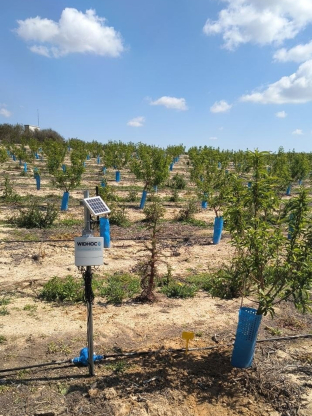

The Autonomous Community has launched a pilot project in Abanilla for the modernization, digitalization, and technological improvement of irrigation, with the aim of monitoring in real time the state of the soil and crops, optimizing the consumption of water and fertilizers, and strengthening the control of agricultural leachates in an area classified as vulnerable to nitrate contamination.
The action, funded by the Ministry of Water, Agriculture, Livestock, and Fisheries with a budget of 43,706 euros, will directly impact the nearly 1,100 members who are part of the El Porvenir irrigation community.
This community has an irrigable area of 1,850 hectares, mainly dedicated to citrus and olive trees, although it also includes horticultural crops, stone fruit trees, and almond trees, as detailed by the regional government.
The plan includes the installation of volumetric measurement lysimeters in real time, moisture and conductivity probes, weather stations, and flow control systems, along with various digital tools that will provide precise information to improve decision-making and adjust irrigation and fertilization doses to the actual needs of each crop.
The Minister of Water, Agriculture, Livestock, and Fisheries, Joaquín Buendía, emphasized that with this pilot project "we take a step further in the digitalization of irrigation and leave behind estimates to move towards data-driven management and scientific certainties."
As he explained, "the installation of lysimeters and probes that record in real time the behavior of the soil allows us to know more precisely what each crop needs at each moment, optimizing the use of resources and reducing losses of water and nutrients."
Buendía stressed that "the nearly 1,100 members of El Porvenir de Abanilla represent the effort and adaptability of our farmers, who continue to advance towards an increasingly efficient and sustainable production model, even in a scenario of structural water scarcity."
The minister added that "digitalization is not an abstract concept, but a tool that reaches directly to the field and helps the farmer make better decisions, reduce costs, and improve the water and environmental efficiency of their operations."
TECHNOLOGY FOR MORE EFFICIENT MANAGEMENT
Among the measures contemplated is the placement of real-time lysimeters, which will make it possible to accurately quantify the drainage water from the crops and obtain data to adjust irrigation schedules and reduce nutrient losses.
The project also foresees the installation of moisture and conductivity probes both in the active root zone and below its area of influence, which will allow for continuous monitoring of the soil condition and the movement of water and nutrients in the soil profile.
The initiative will also integrate a network for pluviometric and atmospheric control through weather stations capable of recording variables such as temperature, relative humidity, wind, precipitation, and solar radiation. This will be complemented by flow control systems in the conduits and an annual analytical plan.
In the same way, a precision analysis station will be enabled that will continuously measure key parameters related to water and soil quality, such as ammonium, nitrites, nitrates, phosphates, salinity, and pH.
The set of these data will provide a global view of the state of the crops and the soil, favoring a more precise management of irrigation and fertilization and helping to reduce agricultural leachates.