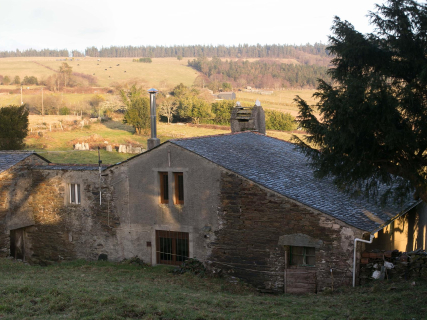

The Galician Peasant Union (SLG) urges the Xunta de Galicia to ensure that its housing policies decisively include the rural environment, and do not focus solely on urban areas. In this context, it demands the establishment of a public housing bank in the villages and an urgent plan for the rehabilitation of properties in these areas.
In a press conference in Santiago, the general secretary of the Peasant Union, María Ferreiro, referred to "the problem" that also exists with housing in the rural environment, where young people face significant obstacles to starting their activities, along with the difficulty of accessing useful agricultural land.
Ferreiro pointed out that in many rural nuclei, there are many houses in ruins due to abandonment and the lack of generational change, while in certain municipalities there is practically no rental offer. Therefore, she demands that both the Xunta and the municipalities promote social rental and guarantee housing to "those who want to settle" to work in the countryside.
Along with the creation of a public housing bank in the rural area, the agrarian union proposes the granting of specific aids so that young people who are going to start a project in the rural environment can buy or rehabilitate houses, thus complementing the support lines for the incorporation of young people into agriculture.
In this regard, Ferreiro emphasized the support of the Peasant Union for the general strike called for November 11 promoted by the CIG, opposing "neoliberal" and "speculative" logics regarding housing.
At the same time, she highlighted the importance of having public services with "dignity," without processes of dismantling healthcare, education, or transportation, among other essential areas for life in the rural environment.
Protest in Madrid against rising costs
On the other hand, the Peasant Union reiterated its support for the mobilization called for this Wednesday, October 28, by Asaja, COAG, and Union of Unions in front of the Ministry of Agriculture, in Madrid, in protest against the escalation of production costs.
Regarding this issue, Ferreiro considers the measures put forward by the Ministry to be "insufficient," in a context where the price of diesel has "doubled" and the sector is already suffering the effects of climate change, such as drought. He also denounces that the application of the chain law "is not enough," given that there are differences of up to "500%" between what the producer receives and what the consumer ultimately pays.
Nonetheless, the Sindicato Labrego also directs its criticisms at the Xunta, to which it demands a "shock plan" that combines medium and long-term actions to alleviate the situation of the Galician countryside.
Finally, the secretary of Trade Union Action of the SLG, Brais Álvarez, announced that the Sindicato Labrego will present its proposals for the new legislature 2026-2030 in a specific day in which it will invite the political forces running in the general elections to participate. Among its demands are a solid budget for the Common Agricultural Policy (CAP), improving access to useful agricultural land, a subsidy model that prioritizes permanent pastures, and strengthening services in rural areas to curb depopulation.