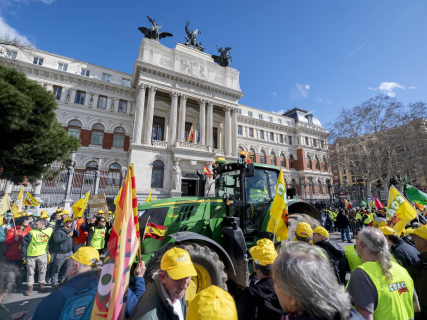

Asaja, COAG, and Unión de Uniones de Agricultores y Ganaderos will mobilize their tractors again this Wednesday, October 28, to collapse the streets of Madrid in a large tractor parade that will conclude in front of the headquarters of the Ministry of Agriculture, Fisheries, and Food, with the aim of denouncing the serious problems that, they claim, are suffocating the agricultural sector.
On this occasion, the three main agricultural organizations, to which Cooperativas Agroalimentarias de España has joined, will march under the slogan "We produce your food, we deserve to live from our work," staging a common front to demand "urgent" responses to the rising costs, lack of profitability, and threats that jeopardize the future of thousands of farms.
The mobilization is structured around five major demands. The first is the implementation of an emergency plan against the increase in production costs, with the immediate establishment of a professional agricultural diesel. They demand reduced and stable taxation, with bonuses that are applied directly at the time of refueling, to alleviate the pressure on the farms.
Farmers and ranchers insist that they need a structural solution and, while it arrives, "sufficient extraordinary measures" to face the rising costs of fuel and other inputs that are suffocating rural areas. They warn that if action is not taken, sectors such as cereal production will be doomed to ruin and at serious risk of disappearance.
Secondly, the organizations demand a future CAP "strong enough to protect the income" of farmers and ranchers in the face of the uncertainty surrounding the upcoming agricultural policy. They reject any cuts to the budget allocated to the countryside and demand that the CAP remains truly common, with "sufficient" funding and its two pillars clearly differentiated.
The third axis of their demands is to achieve "fair prices" and the effective enforcement of the Food Chain Law. They consider it unacceptable that farmers and ranchers continue to be the weakest link in a chain where their costs keep rising without being able to pass them on to the prices they receive for their products.
As a fourth claim, the organizations stand against unfair competition arising from certain trade agreements. They denounce that European products cannot compete with imports that are not subject to the same requirements and reiterate their opposition to the current EU-Mercosur agreement and the agreement with Morocco, demanding regulatory reciprocity and rigorous border controls.
The fifth point focuses on bureaucracy. They ask for "less paperwork and fewer regulations," because they assert that farmers and ranchers want to dedicate themselves to their operations instead of investing more and more hours in procedures, registrations, and administrative obligations that they consider disproportionate.
In this scenario, the organizing organizations call for massive participation from the sector in the tractor protest, convinced that the time has come "to make it clear, in a forceful way, that the countryside needs solutions to continue producing and living from their work."
Agri-food Cooperatives of Spain also supports the protest, as a good part of these claims coincide with the proposals that it has been conveying to national and community administrations.
The sharp increase in energy costs, especially of diesel B, the widespread rise in production costs, the unfair competition from imports that do not meet the standards required in the EU, and a bureaucratic burden that they describe as unbearable, where the producer is treated as a presumed defrauder, are pushing the viability of hundreds of thousands of agricultural and livestock operations to the limit.
The cooperatives warn that this scenario requires "urgent measures" to maintain productive capacity and sustain economic activity and employment in rural areas.
To all this, it is added that the Spanish countryside is "strongly" conditioned by geopolitical uncertainty, the lack of generational change and labor, as well as by the increasing impacts of climate change, which further aggravate the situation of the sector.