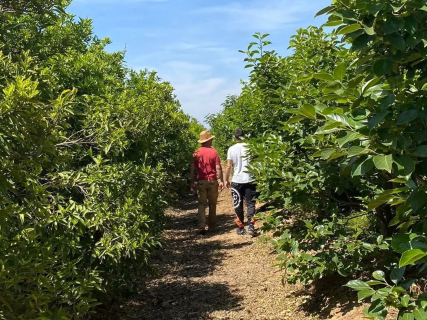

The Valencian Community ranks as the second autonomous community in Spain with the greatest lack of generational replacement in agriculture, only behind the Canary Islands, recording a 48% agricultural aging, according to the Valencian Association of Farmers (AVA-Asaja) based on data from the Ministry of Agriculture.
According to these figures, people over 65 years old account for 48.07% of the 31,405 recipients of direct aid from the Common Agricultural Policy (CAP) in the region, almost nine points above the state average, where the percentage reaches 39.56%.
The analysis of the age and sex of the beneficiaries, both in Spain as a whole and by autonomous communities for 2025, has been prepared by AVA-Asaja based on the report "Direct Aid and Rural Development" from the Ministry.
The Canary Islands is the only autonomy that presents a similar level of beneficiaries over 65 years old (48.4%), while the rest of the territories decrease their degree of aging. Following are the Balearic Islands (46.23%), Navarra (45.61%), Castilla-La Mancha (42.51%), Madrid (42.22%), Catalonia (41.86%), Andalusia (41.27%), Extremadura (38.34%), Murcia (38.11%), Aragon (36.23%), the Basque Country (34.61%), Castilla y León (32.72%), Galicia (28.60%), La Rioja (26.11%), Asturias (17.13%) and Cantabria (15.13%).
In the case of the Valencian Community, farmers under 40 years old represent only 5.8% of the total (0.52% under 25 years and 5.28% between 25 and 40 years). This proportion is three points below the national average, which reaches 8.83%.
With a percentage very close to that of the Canary Islands (5.71%), the Valencian Community is among the autonomous communities with the least generational replacement, behind Castilla-La Mancha (8.08%), Andalusia (8.12%), Navarra (8.48%), Catalonia (8.92%), Madrid (9.07%), the Balearic Islands (9.45%), Galicia (9.58%), Castilla y León (9.85%), Extremadura (10.42%), the Basque Country (10.49%), Aragon (10.65%), Murcia (10.8%), La Rioja (13.97%), Asturias (14.76%) and Cantabria (18.8%).
In this scenario, the president of AVA-Asaja, Cristóbal Aguado, has denounced that "Valencian agriculture is the red lantern of Spain and Europe. The "dramatic" profitability crisis, "aggravated by the minifundia structure, the discrimination of the CAP against Mediterranean crops, and unfair competition, especially from fruits and vegetables from third countries, encourages the abandonment of fields, the closure of farms, and rural depopulation," he stated in a statement.
Aguado has insisted that this is a situation "dragged on for decades": "Not only do farmers and ranchers lose, but all of society and the environment lose, since the function of the agricultural sector is fundamental for food sovereignty, health, fire prevention, and land management," he expressed.
To reverse this trend, the agricultural organization demands structural actions that allow for the recovery of abandoned lands, since "the Valencian Community holds the record for the area left uncultivated with 180,000 hectares." Likewise, one of its priority objectives is to facilitate the incorporation of young people into the sector.
Requests from AVA-Asaja to the Consell and the Government
The entity has urged the Ministry of Agriculture to coordinate with the central Government and this, in turn, with the Mediterranean member states "in order to reach consensus and carry out actions, with European funds, that can partially mitigate the impact of the EU's trade agreements with third countries and other agricultural and environmental policies taken in recent years."
Among the main demands of AVA-Asaja are specific plans for the expansion and modernization of agricultural operations, varietal reconversion, the incorporation of technological innovations, adaptation to new climatic conditions, the promotion of research and authorization of effective solutions against pests and diseases, the demand for reciprocity in imports, and the control of the overpopulation of wildlife.