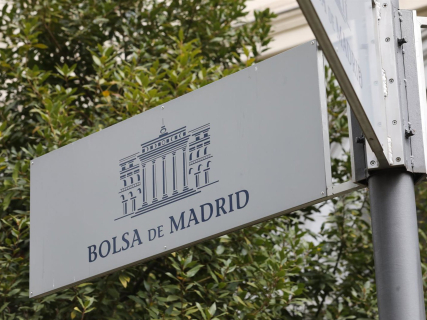

The Ibex 35 of the Madrid Stock Exchange started this Monday's session with a slight increase close to 0.1%, which placed the index at 19,978 points, on the verge of recovering the psychological barrier of 20,000 points lost last week.
The stock market day is once again conditioned by the tension in the Middle East, coinciding with the start of the economic offensive announced by the United States against Iran, dubbed "D-Day" economic.
The U.S. Treasury Secretary, Scott Bessent, has stated that the campaign against the Central Asian country is "in its final phase," following the declaration of an "economic war" that represents "the largest financial offensive ever orchestrated against an adversary." "We are entering the final phase. At dawn begins an economic D-Day: the largest financial offensive ever orchestrated against an adversary," he noted on social media.
In response, Tehran has issued new warnings to Washington and its partners. It has reiterated that if economic and trade pressure on Iran persists, it will not allow "a single drop" of crude oil to leave the Persian Gulf region. "If the economic war continues, not a single drop of oil will be exported either through the Strait of Hormuz or through any other part of the Persian Gulf," emphasized Ebrahim Rezaei, spokesman for the Iranian Parliament's National Security Commission. "Iran will consider the participation of any country in the economic war of the United States against the Iranian people as an act of war," he added.
From the White House, President Donald Trump has defended that the strategy of financial pressure on Iran will involve "isolation on an unprecedented scale" and has called on U.S. allies to join this campaign.
In parallel, the Persian Gulf Strait Authority (PGSA, for its acronym in English), an Iranian body that supervises maritime traffic in the Strait of Hormuz, has released a blacklist of almost fifty "violating" vessels for "violating Iranian maritime traffic regulations," which may face "fines, detention, or confiscation" when they transit the area again.
At the same time, the U.S. military claims to have diverted 70 merchant vessels, immobilized three boats, and boarded two others as part of the naval blockade imposed on Iranian ports and coasts.
In this scenario, the price of Brent, a reference in Europe, was down 1.7% at the opening of European markets, to 92.7 dollars per barrel, while West Texas Intermediate (WTI), a reference in the US, fell 2.2%, to 85.1 dollars.
On the macroeconomic front, the agenda for this Monday arrives almost empty of relevant data, waiting for the first inflation estimates from several countries, including Spain, as well as the GDP figures for the second quarter from Germany, France, and the United States to be published throughout the week.
However, the focus of the markets is directed towards the central bankers' summit in Jackson Hole, which will begin on Thursday and will feature the intervention of the Federal Reserve Chairman, Kevin Warsh, on Friday, in his first participation in this forum, in a context marked by the volatility associated with the rise in US debt yields.
In addition, investors are keenly awaiting the quarterly results from chip manufacturer Nvidia, which will be published on Wednesday at the close of European stock exchanges.
Highlighted values of the Ibex 35 at the opening
In the first minutes of trading, the most notable advances within the Ibex 35 were for Indra, which rose 1.1%, followed by Cellnex (+0.61%), IAG (+0.53%), Sacyr (+0.51%), and Ferrovial, which gained 0.48%.
On the downside, the largest corrections corresponded to ArcelorMittal, with a drop of 1.76%, ahead of Merlin (-0.85%), Repsol (-0.29%), and Amadeus, which lost 0.17%.
In the rest of Europe, the main markets did not accompany the positive tone of Madrid and started with declines. At 9:08 AM, Milan and Paris were down just over 0.1%, London was down 0.06%, and Frankfurt was down 0.2%.
In the foreign exchange market, the euro lost ground against the dollar and was trading around 1.1676 "greenbacks." In the fixed income market, the interest on the Spanish ten-year bond relaxed to 3.686%.