

During the last few years and, especially among the youngest, the use of AI has been progressively integrated into study, work, and creativity dynamics. Everything seemed to point to an enthusiastic, almost uncritical, adoption among this group.
However, something is changing.
The data from a recent report by Gallup are beginning to outline a fundamental shift: Generation Z no longer looks at AI with the same fascination. It uses it, yes, but it questions it. And this change in approach is no small matter.
Intensive use, decreasing trust
The starting point is paradoxical. Never has so much AI been used as now, but it has never generated so many doubts among those who use it the most.
The fall in levels of enthusiasm and hope, along with the increase in anxiety and rejection, reflects an interesting phenomenon: familiarity is not generating trust, but critical awareness.
This breaks with a usual logic in technological adoption. Traditionally, continued use reduces uncertainty. In this case, the opposite happens: the more AI is used, the more its limits become visible.
Technology is not feared. Its effects are concerning
There is a perception that younger people are increasingly concerned about the consequences of the massive - and almost uncontrolled - use of artificial intelligence. In this scenario, Generation Z fears not so much the tool as what can be done with it.
Or, more precisely, to what it can do to them.
The data is overwhelming: an overwhelming majority perceives that the intensive use of AI can deteriorate their learning capacity. Added to this is the suspicion that it negatively affects creativity and critical thinking. In other words, AI is not perceived solely as a support, but as a possible shortcut that weakens fundamental capacities.
This change in perception is key. It means moving from seeing AI as a competitive advantage to considering it, potentially, a dependency against which one must react.
Work, merit, and authenticity
Skepticism also extends to the professional sphere. Low confidence in AI-assisted work and a preference for "algorithmic intervention-free" results point to an implicit claim of individual merit.
Is it possible to revive, among the youngest, an education based on principles and values to be able to face the hyperdigital era of the future? Some initiatives offer us resources to achieve it.
Here emerges the social (and economic) debate of greatest depth: if AI facilitates production so much as to act autonomously, how is the real value of work measured?
For a generation that has grown up in environments of constant evaluation, authenticity—knowing that something has been done “for real”—takes on a new meaning.
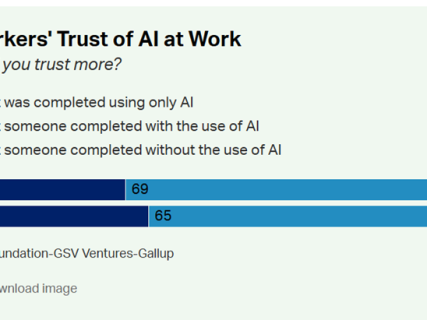
It is not about rejecting efficiency, but about preserving the originality of authorship.
Towards a more conscious (and more demanding) use
Far from abandoning AI, Generation Z seems to be entering a more mature phase of adoption. They know they will need these tools in their professional future, but they are not willing to accept them unconditionally.
What is beginning to emerge is a different claim: not to use less AI, but to use it better.
This implies several implicit demands:
- understand how it works, not just consume its results
- maintain spaces for unassisted thought
- demand transparency about its impact on educational and labor processes
- redefine what it means to learn, create, and work in a hybrid human-machine environment
A signal for companies and institutions
This change in attitude should not be interpreted as generational resistance, but as an early sign of social maturity in the face of technology.
Companies, the educational sector, public administrations and, even, the legislator himself, would do well to take note.
IF this trend consolidates, we can affirm that the adoption of AI will not depend solely on its technical power, but on its capacity to integrate without eroding the skills and confidence of its users.
Because, ultimately, the real challenge is not that young people embrace artificial intelligence, but that they do not feel that, by using it, they are giving up something essential of themselves.