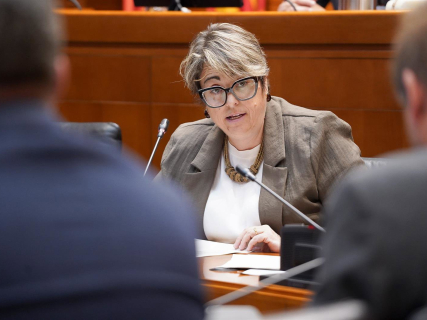

The counselor of Agriculture, Livestock, and Food of the Government of Aragón, Arancha Simón, intervened this afternoon in the sectorial Commission of the Cortes, at the request of the PSOE, where she emphasized that "the model that the Government of Aragón wants is one that lives off the land and does not compete with one hand tied behind its back against what comes from outside."
In her appearance, Simón stressed that for the regional Executive "extensive livestock farming is very important" because "a flock that grazes is the best brush cutter that exists."
Likewise, she assured that "the rancher will not be left alone in front of the bear and the wolf" and that the Department will work "on profitability," since "the sector is built by selling well and for that, fair competition is needed." In this line, she insisted that "it makes no sense to demand from the producers of Fraga what we do not demand from the products that come in from Algeciras, for example."
Regarding generational change in the countryside, the counselor specified that so far this year "more than two hundred fifty people have joined with an average age of twenty-eight years, and one in four is a woman" and reflected that "a young person does not enter for the subsidy, they enter if they have land and if the investment of the first year is not eaten up by the management."
Simón also highlighted that "pork is the first sector in Aragón and the one that feeds the rural environment" and, although she admitted that it faces challenges, she reiterated her commitment to advance so that "manure stops being a problem and becomes a fertilizer."
To conclude, the head of Agriculture emphasized the need to strengthen the regional offices with the aim that "the administration is close to the producers," and stressed that "the sector needs to be paid, allowed to irrigate, and allowed to work." "For the moment, in five months we have made more payments than announcements," she concluded.
RESULTS and positions of the groups
The socialist deputy Marcel Iglesias asked the counselor "what she wants the future of the primary sector in the Community to be, what models she wants to promote, and where she wants the agricultural sector to head" considering that "intentions must turn into results" and that, so far, the primary sector "has been a bargaining chip in the electoral adventures of Azcón." In his opinion, "we have had four years of paralysis in agricultural policies."
From the PP, José María Macarulla has pointed out that "we come from three years of recovery of the sector" and that, currently, "the costs of fertilizers are exorbitant and diesel has almost doubled its price compared to the previous year." In addition, he emphasized that "agricultural insurance is fundamental and is the future of the sector."
The Vox parliamentarian, David Arranz, has acknowledged that "the production costs of any farmer are skyrocketing and farmers and ranchers have to face more and more bureaucracy." In his opinion, "farms have difficulties in being profitable and many young people do not even consider continuing with their parents' activity."
On behalf of CHA, Miguel Jaime has expressed his concern about "not being clear whether the model defended by the Government of Aragón is one based on the entry of large business groups or one that guarantees the continuity of traditional agricultural and livestock farms." Likewise, he has stated that "there can be no future for the countryside if farmers and ranchers cannot live decently from their work."
Finally, the deputy of Teruel Existe, Pilar Buj, has warned that "up to forty percent of Aragonese cereal is at risk of remaining unsown," and has questioned "what actions the Government of Aragón is going to promote to improve the profitability of agricultural farms in Teruel" understanding that "the announced aid is not sufficient."